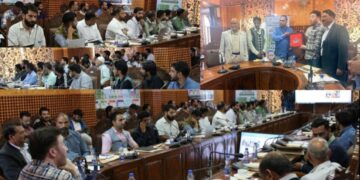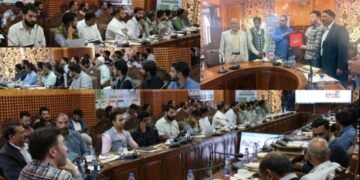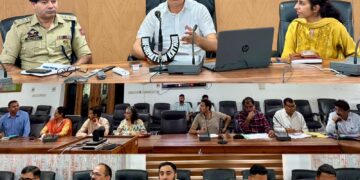
Srinagar, FEBRUARY 17: The Department of Mechanical Engineering, National Institute of Technology (NIT) Srinagar, in collaboration with Greenovator Incubation Foundation (GIF)–NIT Srinagar, organized a One-Day Workshop on the MSME Design Scheme at the Common Hall of the institute.
The workshop, as per PIB statement, was sponsored by the Ministry of MSME, Government of India, and witnessed active participation from entrepreneurs, startups, faculty members, and students.
The programme commenced with the inauguration of the MSME Project Stall at Indus Park, marking the beginning of a day-long engagement focused on strengthening the MSME and startup ecosystem in the region.
The event was presided over by Registrar NIT Srinagar, Prof Atikur Rehman, Assistant Director, MSME-DFO Srinagar, Mr Saheel Allagband was the Guest of Honor on the occasion.
Dean, Alumni and International Affairs, Prof MA Shah, Prof. Nazir Ahmed Sheikh, among other faculty members, also attended the event. Dr Dinesh Kumar Rajendran is the Nodal Officer & Convenor of the event.
In his address, Prof. Binod Kumar Kanaujia, Director, NIT Srinagar, underscored the institute’s commitment to promoting innovation, entrepreneurship, and nation-building.
He remarked that empowering MSMEs through structured support mechanisms like the Design Scheme aligns with the broader vision of self-reliance and economic resilience.
Addressing the gathering, Mr. Saheel Allaqband, Assistant Director, MSME-DFO Srinagar, elaborated on various flagship schemes of the Ministry of MSME and encouraged entrepreneurs to avail themselves of financial and technical assistance available under the Design Scheme.
He highlighted the importance of formal registration, digital compliance, quality certification, and participation in government procurement platforms to ensure long-term growth and sustainability.
Dr. M. Hanief, Head of the Department of Mechanical Engineering, reaffirmed the department’s commitment to supporting MSMEs through technical expertise, laboratory facilities, prototyping support, and consultancy services.
He stated that academic institutions must play a proactive role in addressing real-world industrial challenges and promoting innovation at the grassroots level.
Prof. Atikur Rehman, Registrar, NIT Srinagar, highlighted the pivotal role of MSMEs in employment generation and economic development.
He appreciated the initiative and stated that continuous engagement between policymakers, academia, and industry stakeholders is essential to accelerate regional growth and create sustainable enterprises.
Prof Rehman emphasized the importance of research, consultancy, and technology transfer in strengthening the MSME ecosystem.
He encouraged entrepreneurs to collaborate with NIT Srinagar for research-driven product development and the commercialization of innovative ideas.
Earlier in his welcome address, Dr. Dinesh Kumar Rajendran, Nodal Officer, MSME Design Scheme at NIT Srinagar, outlined the objectives of the workshop and highlighted the significance of the MSME Design Scheme in enhancing product competitiveness through expert design intervention and financial assistance.
He emphasized that such initiatives provide a crucial bridge between innovators and government support mechanisms.
Dr. Saad Parvez, Principal Investigator of Greenovator Incubation Foundation, spoke about the growing importance of incubation support in nurturing innovative ideas into viable enterprises.
He stressed that startups must actively leverage institutional mentorship, research facilities, and government-backed schemes to scale sustainably and compete in broader markets. He also underlined the need for stronger industry-academia collaboration to foster innovation-driven entrepreneurship in Jammu and Kashmir.
The inaugural session concluded with a vote of thanks by Dr. H. S. Pali, Coordinator of the MSME Workshop. The technical sessions that followed covered funding opportunities in MSMEs, facilitation support through MSME PPDC, the MSME/startup ecosystem, application procedures for the MSME Design Scheme, and the GeM purchase process for MSMEs. The workshop concluded with a valedictory session and certificate distribution ceremony.
Following the inaugural session, a series of focused technical deliberations were held to provide participants with comprehensive insights into the MSME framework.
The first session on Funding Opportunities in MSME was delivered by Mr.Saheel Allagband, Assistant Director, MSME-DFO Srinagar, who elaborated on various financial assistance schemes and support mechanisms available under the Ministry of MSME.
This was followed by a session on Facilitation in MSME PPDC by Ajaz Hussain, who explained the role of Process and Product Development Centres in offering technical support, testing facilities, and technology upgradation services to MSMEs.
Dr. Saad Parvez, Principal Investigator, Greenovator Incubation Foundation, conducted an engaging session on the MSME/Startup ecosystem, highlighting incubation support, innovation strategies, and the importance of institutional collaboration.
In the post-lunch session, Dr. Dinesh Kumar Rajendran, Nodal Officer, MSME Design Scheme, provided a detailed presentation on the Application Procedure for the MSME Design Scheme, guiding participants through eligibility criteria, documentation requirements, and submission processes.
The technical deliberations also included a session on GeM Purchase for MSMEs by Mr. Tauseef Jeelani and Mr Mudassir Qadir, who explained the onboarding process and procurement opportunities and benefits through the Government e-Marketplace platform.
Later, selected entrepreneurs and participating MSME representatives were presented with felicitations and appreciation awards in recognition of their innovation, commitment, and contribution to strengthening the local enterprise ecosystem.
The certificates and mementos were distributed during the valedictory session, where organizers lauded the proactive participation of startups and MSMEs and encouraged them to effectively utilize the MSME Design Scheme and other government support mechanisms for sustainable growth and competitiveness.