Key Takeaways
- Union Budget 2026–27 proposes preserving temples and monasteries, creating pilgrimage centres, and improving connectivity and amenities in Arunachal Pradesh, Sikkim, Assam, Manipur, Mizoram, and Tripura.
- India to host the first Global Big Cat Summit, bringing together leaders and ministers from 95 countries, reinforcing India’s leadership in eco-tourism diplomacy.
- Five major tourism destinations to be developed across Purvodaya States with 4,000 e-buses for connectivity.
- Five regional medical hubs to be established, to promote India as a hub for medical tourism services.
- 15 archaeological sites including Lothal, Dholavira, Rakhigarhi, Adichanallur, Sarnath, Hastinapur, and Leh Palace to be developed into vibrant, experiential cultural destinations.
Tourism is a key sector of the Indian economy with significant potential for employment generation, foreign exchange earnings, and balanced regional development. Owing to its strong multiplier effect and capacity to create livelihoods across hospitality, transport, handicrafts, and allied services, tourism has been identified as a strategic growth driver in the Union Budget 2026–27. Based on the India Tourism Data Compendium 2025 by the Ministry of Tourism, the sector contributes 5.22% to India’s GDP (total impact), with a direct share of 2.72%. It also supports 13.34% of total employment, with a direct employment share of 5.82%, reflecting its strong role in livelihood generation and inclusive development.
Reflecting this economic priority, the Budget proposes a series of targeted interventions to strengthen institutional capacity, enhance service quality, and improve destination competitiveness. Major initiatives include the establishment of a National Institute of Hospitality to address skill gaps and align academic training with industry requirements, as well as a pilot programme to upskill 10,000 tourist guides at iconic destinations through partnerships with premier institutions. These measures are aimed at improving workforce productivity and elevating visitor experiences across key tourism circuits.
The Budget also focuses on destination development and sector modernisation through proposals for heritage and experiential site development, creation of digital knowledge grids for tourism assets, and promotion of nature-based and wildlife tourism. Infrastructure and connectivity enhancements are expected to further integrate remote and emerging destinations into the tourism value chain, thereby supporting local entrepreneurship and regional economies.
Overall, the Union Budget 2026–27 positions tourism as a resilient and high-impact sector within India’s economic framework, with a clear focus on job creation, investment stimulation, and sustainable growth across regions.
UNION BUDGET 2026-27 ANNOUNCEMENTS
Thematic and Destination-Led Tourism Development
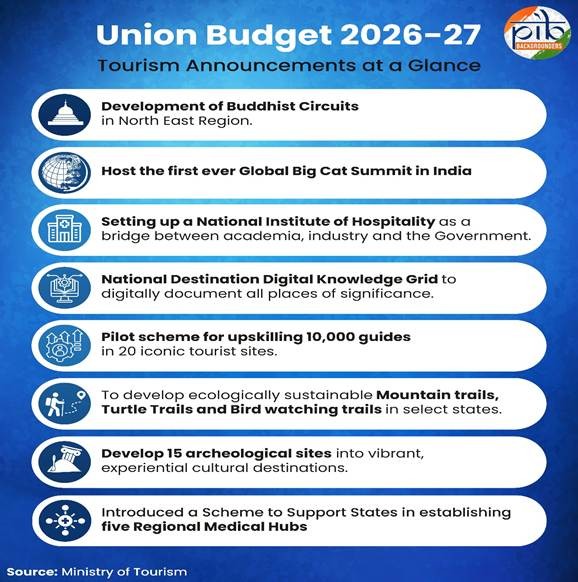
Recognising the growing importance of spiritual tourism and the rich Buddhist heritage of the North-Eastern Region, the Government has announced a new Scheme for Development of Buddhist Circuits in the North-Eastern Region. The initiative aims to strengthen tourism infrastructure at key Buddhist sites and position the region as an important destination on the global Buddhist tourism map.
The scheme will cover the states of Arunachal Pradesh, Assam, Sikkim, Manipur, Mizoram and Tripura, which are home to several historically and spiritually significant Buddhist sites. The key components of the scheme include development and conservation of temples and monasteries, establishment of pilgrimage interpretation centres, improvement of connectivity to important Buddhist sites, and creation of pilgrim amenities and heritage-related infrastructure. The initiative is expected to promote spiritual tourism, attract domestic and international pilgrims, and contribute to tourism-led socio-economic development of the North-Eastern States in a sustainable manner.
The announcement of the new scheme builds upon the experience gained from earlier thematic tourism initiatives of the Ministry of Tourism, particularly the Swadesh Darshan Scheme launched in 2014–15.
It was designed to develop theme-based tourist circuits across the country and it focused on the creation of quality tourism infrastructure at identified destinations to enhance accessibility, visitor amenities and overall tourist experience.
In line with evolving tourism trends and sustainability priorities, the scheme was subsequently revamped as Swadesh Darshan 2.0 (SD 2.0), focusing on responsible tourism, conservation of cultural and natural heritage, community participation and improvement of local livelihoods.
As of date, 76 projects have been sanctioned under the Swadesh Darshan Scheme, with a total approved cost of ₹5,290.33 crore. Of these, 75 have been physically completed, reflecting significant progress in strengthening tourism infrastructure across the country.
Eco-Trails and Connectivity
The Budget emphasised nature-based and sustainable tourism, proposing the development of ecologically sustainable mountain and nature trails in Himachal Pradesh, Uttarakhand, Jammu & Kashmir, Araku Valley in the Eastern Ghats and Podhigai Malai in the Western Ghats. Initiatives such as turtle trails along key nesting sites in the coastal areas of Odisha, Karnataka and Kerala and bird-watching trails along the Pulicat Lake in Andhra Pradesh aim to leverage India’s biodiversity and promote eco-tourism.
In addition, expansion of rail and regional connectivity, including high-speed rail and improved access to remote areas, is expected to facilitate tourism mobility and enhance accessibility to emerging and established destinations. These measures are designed to integrate tourism planning with infrastructure development, providing visitors with seamless access while promoting local economic growth and sustainability.
Global Positioning: Big Cat Summit 2026
The Union Budget 2026–27 announced that India will host the first-ever Global Big Cat Summit in 2026, inviting heads of governments and ministers from 95 big cat range countries to deliberate on collective strategies for conservation, habitat protection, scientific collaboration, and sustainable wildlife tourism. This reflects the Government’s intent to elevate India’s role in eco-tourism and international wildlife cooperation.
India’s leadership in this domain is further exemplified by its role in the establishment and operationalisation of the International Big Cat Alliance (IBCA), a treaty-based intergovernmental organisation dedicated to facilitating global cooperation for big cat conservation. The Framework Agreement for IBCA, approved by the Union Cabinet and ratified by multiple countries, formally
brought the body into force with India hosting its headquarters and secretariat, and providing budgetary support to advance its mission.
India is home to five of the world’s seven big cat species – tiger, lion, leopard, snow leopard and cheetah.
Hosting the first Global Big Cat Summit is expected to further reinforce India’s standing in international conservation leadership, promote exchange of best practices, and strengthen collaborations among big cat range countries.
Institutional and Human Capital Reforms
The Budget proposed measures to strengthen institutional capacity and human capital in the tourism and hospitality sector. A major initiative is to upgrade the National Council for Hotel Management and Catering Technology to a National Institute of Hospitality, aimed at providing high-quality professional education, an industry-aligned curriculum, research opportunities, and international collaboration. The Institute is also expected to function as a bridge between academia, industry and the Government. In addition, a pilot scheme for upskilling 10,000 tourist guides across 20 iconic destinations has been announced. The programme, implemented in collaboration with an Indian Institute of Management, will follow a 12-week hybrid training model combining classroom instruction, field training, and digital modules. This initiative is expected to professionalise guiding services, enhance visitor experience, and support employment generation.
These interventions complement existing Ministry of Tourism initiatives such as Capacity Building for Service Providers (CBSP) and the Incredible India Tourist Facilitator (IITF) programmes, which aim to enhance skills, certification standards, and professionalism in tourism services. Together, these measures aim to create a robust talent pipeline and improve the quality of services across domestic tourist destinations.
Digital and Heritage Infrastructure
To enhance planning, research, promotion, and visitor engagement, the Budget announced the creation of a National Destination Digital Knowledge Grid. This digital platform will document cultural, spiritual, and heritage sites across India, providing resources for researchers, content creators, historians, and tourism. The Grid will support data-driven decision-making, improve destination visibility, and aid heritage management.
The Budget also proposed development of 15 archaeological sites into vibrant experiential cultural destinations, including Lothal, Dholavira, Rakhigarhi, Sarnath, Hastinapur, and Leh Palace. This will involve the creation of curated walkways, interpretation centres, visitor amenities, and heritage conservation infrastructure to provide immersive experiences for tourists.
These initiatives build upon ongoing schemes such as Swadesh Darshan 2.0 and SASCI, which provide financial assistance for tourism infrastructure and heritage development. Complementing the PRASHAD scheme, these measures aim to preserve India’s cultural assets while promoting sustainable tourism and local community participation.
Medical Tourism and Wellness Integration
The Union Budget 2026–27 introduced a Scheme to Support States in establishing five Regional Medical Hubs, aimed at promoting India as a global destination for medical and wellness tourism. The hubs will integrate advanced healthcare services, AYUSH centres, and medical value tourism facilitation centres, and infrastructure for diagnostics, post-care and rehabilitation through public-private partnerships, enhancing India’s competitiveness in global healthcare travel.
These initiatives build upon the Government’s broader efforts to integrate wellness and traditional medicine into tourism, including upgrading the WHO Global Traditional Medicine Centre in Jamnagar, while strengthening local health and hospitality infrastructure to improve service quality and visitor satisfaction.
Regional Development Push: Purvodaya States
The Union Budget 2026-27, outlined a targeted focus on the Purvodaya states, Bihar, Jharkhand, West Bengal, Odisha and Andhra Pradesh, as part of the Government’s vision to drive regional development and expand tourism infrastructure. The Budget proposes the creation of five tourism destinations, one in each of the Purvodaya states, under an integrated development framework that also includes the East Coast Industrial Corridor with a well-connected node at Durgapur. Alongside this, provisions for 4,000 electric buses were announced to support improved connectivity, cleaner transport and greater accessibility for travellers across these regions.
The emphasis on Purvodaya reflects a broader strategy to leverage local cultural, natural and heritage assets as part of tourism-led growth, complementing infrastructure expansion and employment generation. By linking tourism development with improved transport connectivity and public services, the initiative aims to position the eastern region as a competitive and attractive destination for both domestic and international visitors.
Conclusion
The Union Budget 2026–27’s tourism initiatives present a strategic plan to boost economic growth, employment, and cultural heritage. It combines new schemes with existing programmes to improve infrastructure, heritage conservation, skills, digital systems, and niche tourism segments like spiritual, eco, adventure, and medical tourism.
Focus areas include developing Buddhist Circuits in the North-East, upgrading hospitality, digital knowledge, and heritage sites, demonstrating a commitment to sustainable, destination-focused tourism. These measures integrate with schemes like Swadesh Darshan 2.0, PRASHAD, and capacity-building, ensuring policy coherence and resource efficiency.
Linking infrastructure, community, and culture establishes a solid base for India to become a competitive, inclusive tourism destination. Successful implementation is expected to enhance visitor experience, create jobs, and promote India’s cultural and natural heritage globally, making tourism a key driver of socio-economic growth.