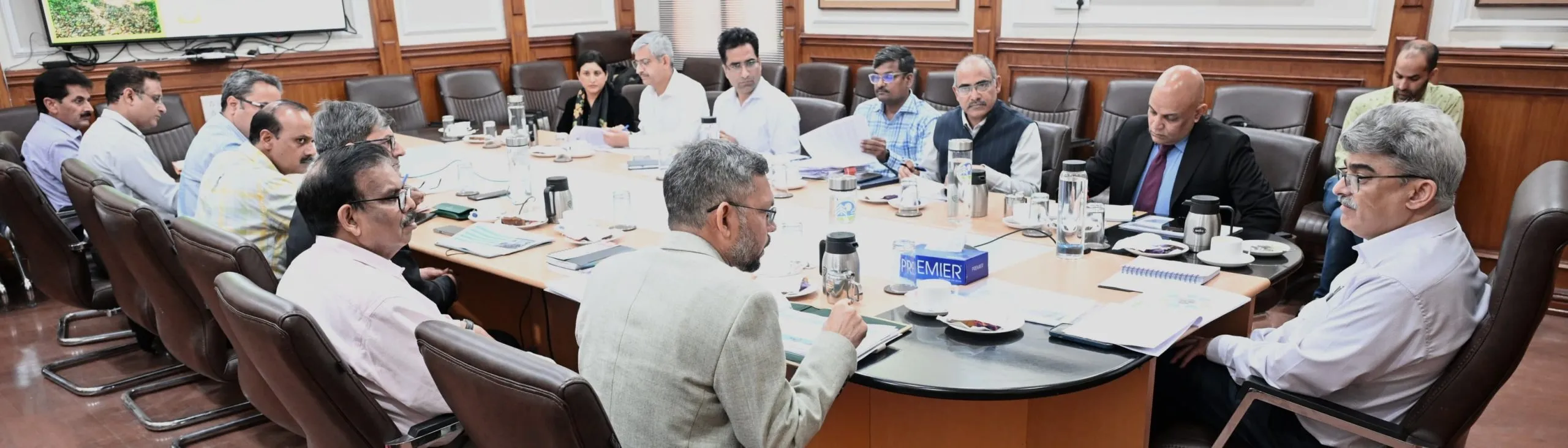
Jammu, Mar 12: Chief Secretary, Atal Dulloo on Thursday held a meeting to review the progress on the proposed strategy for large-scale commercial cultivation of Medicinal and Aromatic Plants (MAPs) across Jammu and Kashmir, aimed at strengthening the sector and enhancing farmers’ income through scientific cultivation, value addition and market integration.
The meeting was convened to assess the progress made by the Agriculture Production Department in formulating a comprehensive strategy for developing the MAP sector in the Union Territory following consultations with private pharmaceutical companies, MAP dealers, Minor Forest Produce depot holders, Biodiversity Management Committees and other industry stakeholders.
During the meeting, the Chief Secretary took a detailed appraisal of the concerns raised by these stakeholders and the measures proposed by the department to address them. He observed that medicinal and aromatic plants represent a high-value sector with immense potential for livelihood generation in the region.
Emphasizing the importance of scientific planning, the Chief Secretary noted that the major bottlenecks in scaling up commercial MAP cultivation include availability of quality planting material, development of crop-specific package of practices and establishment of reliable market linkages for farmers. He said that addressing these challenges would be critical for encouraging farmers to adopt MAP cultivation on a large scale.
The Chief Secretary underlined that research institutions have a significant role to play in identifying commercially viable species suited to different agro-climatic zones of the Union Territory. He asked the research institutions to assist the department in developing cultivation protocols, identifying suitable zones for different MAP species and ensuring that the recommended crops are both environmentally sustainable and commercially viable.
He further advised the department to hold wider consultations with the Ministry of Agriculture and Farmers Welfare and the Ministry of AYUSH while framing the strategy and also suggested taking guidance from eminent agricultural experts such as Dr Mangla Rai and Dr Ashok Dalwai to make the initiative more impactful.
Additional Chief Secretary, APD Ashish Chander Verma briefed the meeting about the initiatives taken so far by the department. He informed that consultations had been held with leading industry players including Dabur, Emami, Patanjali Ayurved, Sami-Sabinsa Group and Dehlvi Naturals to understand the scope, demand patterns and challenges related to the commercial production of MAPs in the Union Territory.
He added that based on the feedback received from these stakeholders, the department has undertaken a preliminary exercise to identify solutions to the challenges and frame a structured roadmap for the development of this sector.
Managing Director, Holistic Agriculture Development Programme (HADP), Sandeep Kumar, made a detailed presentation outlining the proposed intervention framework.
He informed that the proposed strategy is structured around six key intervention areas, including conservation and sustainable management of Medicinal and Aromatic Plants (MAPs) in forest areas, promotion of their commercial cultivation on private lands and village woodlots, strengthening of nursery systems to ensure availability of certified planting material, establishment of primary processing and value-addition facilities, promotion of branding, cluster development and market integration, besides enhancing research, capacity building and skill development in the sector.
Under the proposed plan, geo-spatial mapping of niche MAP zones will be undertaken by the Department of Ecology, Environment and Remote Sensing (DEERS) between 2026 and 2028, while a baseline survey will be carried out by the J&K Agriculture Production Department in collaboration with the Indian Institute of Integrative Medicine (IIIM), Jammu during 2026-27.
The strategy also includes nursery raising of medicinal plants with an annual capacity of about 50 lakh plants, to be implemented by the Forest Department from 2026 to 2032 to ensure the availability of quality planting material.
It was further given out that initially Plantation activities are proposed to be taken up on a large scale, including 1,500 hectares in forest areas, 62 hectares on government land outside forest areas, and 80 hectares on private lands, with further yearly augmentations upto the year 2032.
Experts from Indian Institute of Integrative Medicine, Sher-e-Kashmir University of Agricultural Sciences and Technology of Jammu and Sher-e-Kashmir University of Agricultural Sciences and Technology of Kashmir also shared their inputs regarding the role their institutions could play in strengthening research, developing technologies and supporting farmers in the cultivation of MAPs.
The Chief Secretary urged all stakeholders to work in close coordination to successfully implement the proposed strategy, stating that a collaborative effort between government departments, research institutions and industry partners would help overcome existing hurdles and unlock the vast potential of medicinal and aromatic plants for the benefit of farmers across the UT.