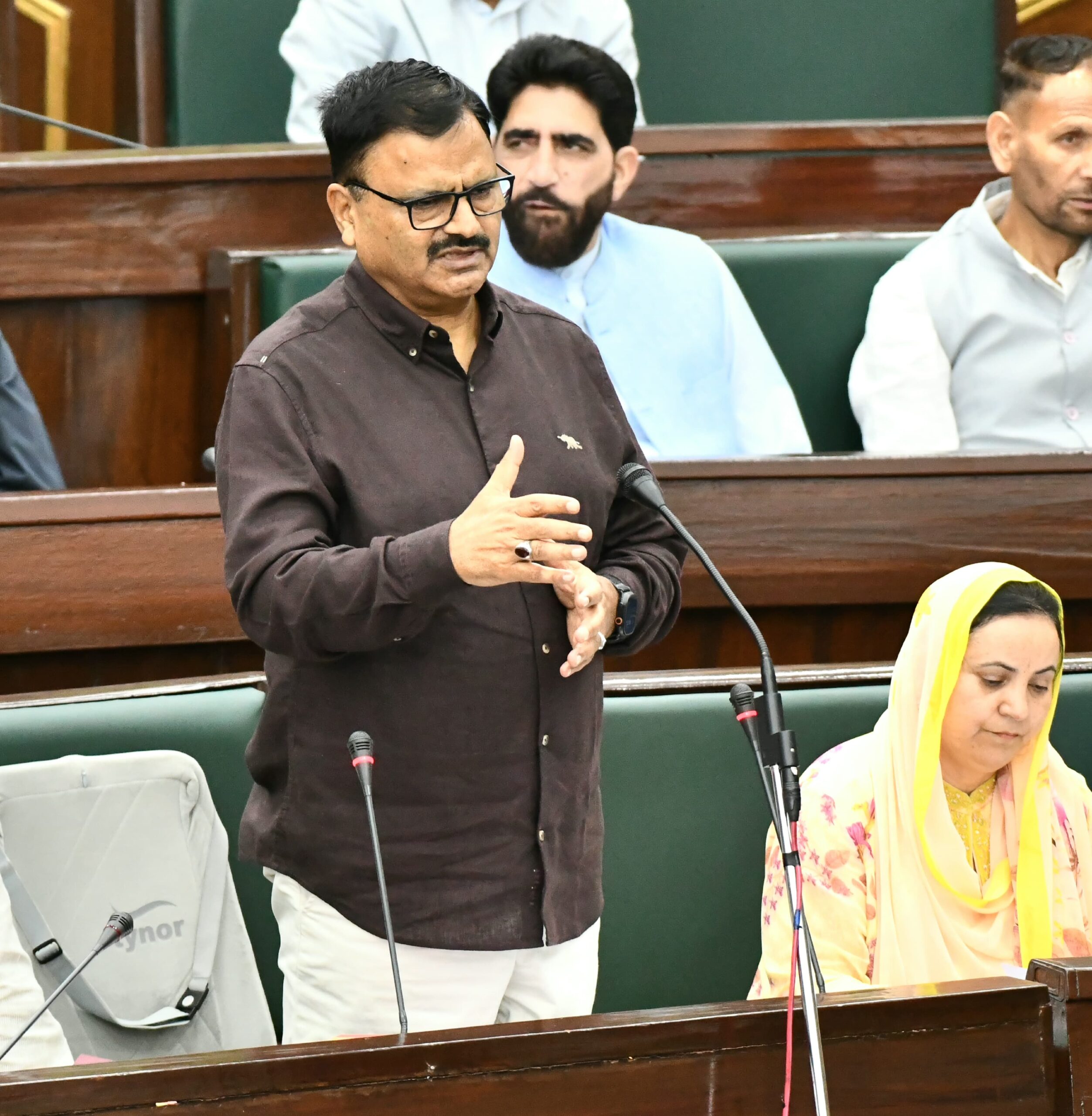
Jammu, Mar 30: Minister for Jal Shakti, Forest, Ecology & Environment and Tribal Affairs, Javed Ahmad Rana on Monday informed the House that Rs 14,647.00 lakh under UT Capex have been sanctioned over the last five years for conservation and management of Wular Lake.
The Minister also said that ₹1,073.69 lakh have been expended under UT Capex for works related to Soil & Water Conservation.
The Minister said this while replying to a question raised by MLA Ali Muhammad Sagar, regarding water conservation measures undertaken by the government in the Union Territory.
Elaborating, the Minister said that substantial financial allocations have been made for conservation and restoration of water bodies across the Union Territory.
He said that during the last five years, ₹900.00 lakh under the Centrally Sponsored Scheme “National Plan for Conservation of Aquatic Ecosystems (NPCA)” have been sanctioned during the last five years for the conservation and management of Wular Lake. He said that several measures are being undertaken for the conservation and management of notified wetlands and water bodies, including five sites designated as Ramsar Sites of international importance.
He informed the House that there are 1810 identified existing water bodies in the Union Territory, including Dal Lake, Anchar Lake, Wular Lake, Khushal Sar and Hoker Sar.
The Minister elaborated that key conservation interventions included de-weeding of wetlands, strengthening and construction of embankments, restoration of hydrological channels, development of patrolling infrastructure, installation of trash barriers and regular clearance of excessive aquatic vegetation.
To address solid waste dumping in and around Wular Lake and improve its ecological health, the department has taken multiple measures. These included closure of dumping sites near the lake, implementation of solid waste management initiatives, awareness campaigns, boundary demarcation, dredging for lake restoration, willow removal and regular water quality monitoring.
He further informed that the Ecology, Environment & Remote Sensing wing has undertaken detailed survey and mapping of wetlands (above one hectare) using remote sensing data, followed by ground-truthing and boundary demarcation in coordination with Revenue, Wildlife and Forest Departments.
During this exercise, 170 wetlands have been GIS-corrected and uploaded in KML format on the National Wetland Portal, enhancing transparency and legal protection. Brief documents for six priority wetlands have been prepared, of which, four have been submitted for notification to the J&K Wetland Authority, while two are under technical examination.
The Minister added that this scientific mapping and documentation will facilitate formal notification, regulation and long-term management of wetlands across Jammu & Kashmir.
He also highlighted additional measures such as Soil & Moisture Conservation works to reduce erosion, afforestation of degraded catchments to check silt inflow, construction of check dams and gabion structures, promotion of sustainable land-use practices and inter-departmental coordination for integrated watershed management.