
Key Takeaways
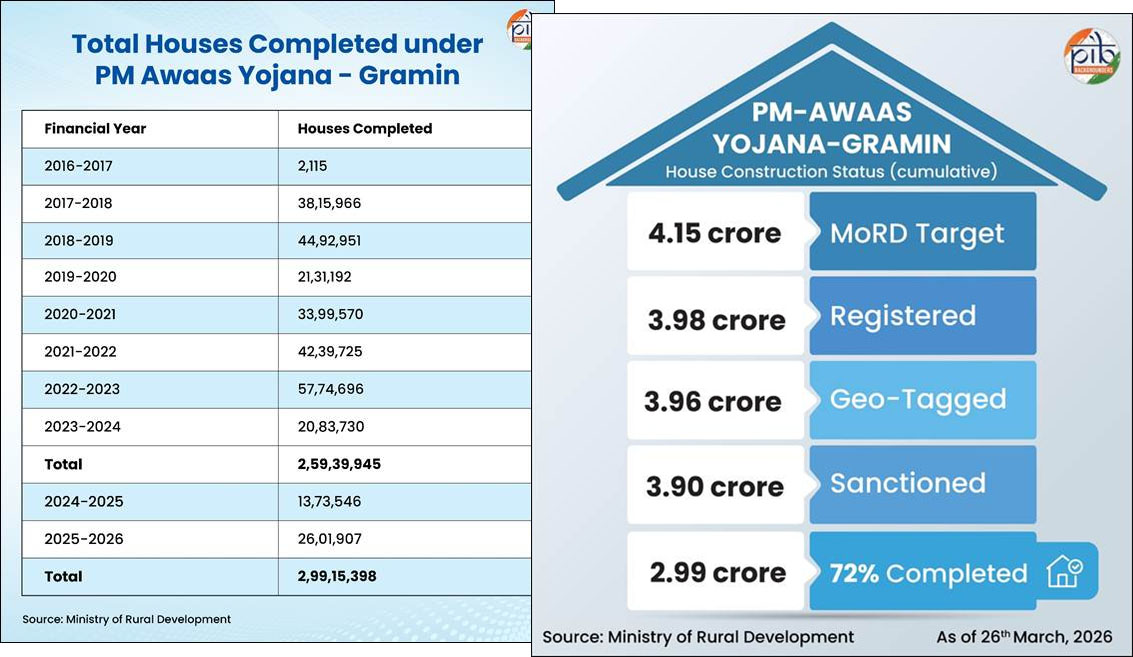
- Under PMAY‑Gramin Phase I & II, 4.15 crore houses allocated to states, 3.90 crore sanctioned, 2.99 crore houses completed.
- The cumulative target aims to achieve 4.95 crore rural houses by the year 2029.
- A total of ₹4,03,886.12 crore has been transferred to beneficiaries, ensuring timely construction support nationwide.
- AI‑driven monitoring tools like geo‑tagging, anomaly detection, and Aadhaar face authentication strengthen transparency and credibility.
- Seamless convergence with Swachh Bharat Mission-Gramin, Jal Jeevan Mission, PM Ujjwala Yojana, and PM Surya Ghar: Muft Bijli Yojana has enhanced rural living standards.
The journey of rural housing in India over the past decade is a story of transformation and dignity. What began as a vision to ensure that every rural family has a secure home has grown into a nationwide movement that has touched millions of lives. A permanent (pucca) house is not just a shelter – it is a foundation for stability, opportunity, and hope for the future.
Pradhan Mantri Awaas Yojana – Gramin, being implemented since 1st April 2016, has steadily evolved into one of the largest social welfare initiatives in the country. It seeks to provide permanent houses with basic amenities to all houseless households and those living in temporary (kutcha) or dilapidated homes. By addressing the rural housing shortage and reducing the housing deficit, the scheme plays a vital role in advancing the mission of “Housing for All.” The minimum size of the houses under PMAY-G is 25 sq. m., including a dedicated area for hygienic cooking. The scheme has been implemented in multiple phases to progressively achieve its goals.
By combining housing with access to sanitation, clean cooking energy, electricity, and drinking water, it has improved the quality of life in villages across India. Over the years, the scheme has embraced technology, transparency, and convergence with other national programmes, becoming a symbol of inclusive growth and rural empowerment.
A HOME THAT CHANGED EVERYTHING:
Taid’s Journey to Safety and Stability
Taid, a widow from the Titabor area of Jorhat district in Assam, lived for years in a flood‑prone area where her fragile home offered little protection. Life was uncertain, but in 2016–17, her dream of a permanent house became a reality through Pradhan Mantri Awaas Yojana – Gramin (PMAY-G). With support, she built a strong home that provided her family with safety and dignity. Today, her permanent house stands as a symbol of resilience, protects her family against floods, and offers stability for the future. Taid’s journey reflects how PMAY‑G is transforming rural lives, ensuring even the most vulnerable households step into a brighter tomorrow.
A Decade of Progress and Achievements
Over the past ten years, PMAY‑G has steadily expanded its reach and delivered housing at scale. The scheme has demonstrated consistent performance, with year-wise completions indicating its capacity to maintain steady progress across various phases. PMAY‑G has empowered beneficiaries through seamless convergence with the Viksit Bharat-Guarantee for Rozgar and Ajeevika Mission (Gramin) (erstwhile MGNREGA), Swachh Bharat Mission ‑ Gramin, Self-Help Groups, Jal Jeevan Mission, and PM‑Surya Ghar: Muft Bijli Yojana.
Allocated Target and Achievements
As of 26 March 2026, a target of 4.15 crore houses has been allocated under phases I and II. In total, 3.90 crore houses have been sanctioned, and 2.99 crore houses have been completed. To support this scale of implementation, a cumulative fund transfer of ₹4,03,886.12 crore has been made, ensuring timely resources for construction and beneficiary support across states.
Collectively, these milestones reflect the sustained momentum and wide-scale impact of PMAY-G, highlighting its effectiveness in moving toward universal housing in rural areas.
Implementation Framework and Reforms
PMAY‑G has been designed as a beneficiary‑led programme, where families take ownership of building their homes. Over the years, several reforms have been introduced to strengthen transparency, efficiency, and quality in implementation.
Direct Benefit Transfer (DBT): Financial assistance is released directly into the beneficiary’s bank account. This ensures that funds reach households without delay or leakage, strengthening financial inclusion.
Geo‑tagging of Houses: At every stage of construction, time and date-stamped photographs are uploaded. This digital record allows real‑time monitoring of progress and ensures that houses are built as per guidelines.
Village‑level Functionaries: Each sanctioned house is tagged to a local functionary who follows up with the beneficiary. This system provides hands‑on support and ensures that construction is completed in a timely manner.
Block and District Inspections: Officers at the block level inspect around 10% of houses, while district officers inspect 2% at each stage of construction. These inspections add an additional layer of quality assurance and oversight.
Social Audits: Every Gram Panchayat conducts a formal social audit at least once a year. This involves community participation and review of all aspects of the scheme, reinforcing transparency and accountability.
National‑level Monitoring: Officers and National-level monitors from the Ministry of Rural Development visit houses during field inspections. They assess progress, verify beneficiary selection, and ensure that procedures are being followed correctly.
AwaasSoft MIS Platform: AwaasSoft is a bilingual, web‑based platform that integrates all functions of PMAY‑G. From beneficiary identification and sanction orders to fund release and construction monitoring, it provides a single source of information for all stakeholders.
These reforms have created a strong framework that combines technology, community participation, and institutional oversight. This has enabled PMAY‑G to deliver housing transparently and efficiently.
Impact on Rural Households
Rural households have experienced profound transformation – secure homes, better services, and empowerment. PMAY-G has driven this by strengthening social inclusion and access to essentials.
Improved Living Conditions: Families now live in permanent houses that are durable, safe, and weather‑resistant. This shift from temporary to permanent housing has enhanced security and dignity for millions of households.
Access to Sanitation: Through convergence with various other schemes, PMAY-G beneficiaries get assistance of ₹12,000 from Swachh Bharat Mission- Grameen [SBM(G)], MGNREGA (Now VB: G RAM G) or any other dedicated funding source for the construction of toilets. This has promoted hygiene, reduced health risks, and contributed to cleaner villages.
Employment Support: The scheme ensures 90–95 person‑days of unskilled labour wages under MGNREGA (now VB: G RAM G). This not only supports construction but also provides livelihood opportunities for rural workers.
Clean Cooking Energy: Convergence with the Pradhan Mantri Ujjwala Yojana has enabled households to access LPG connections. This has reduced dependence on traditional fuels, improved health, and promoted cleaner energy use.
Electricity and Water Supply: Beneficiaries gain access to electricity connections and piped drinking water through linked government programmes. These amenities have improved daily living standards and reduced drudgery.
Renewable Energy Options: Solar lanterns and rooftop systems have been introduced to promote sustainable energy use. This supports environmental goals while providing reliable power in rural areas.
Building Skills for Quality Homes: The Rural Mason Training program under PMAY‑G addresses the shortage of skilled masons, ensuring quality housing and creating rural livelihoods. Supported by the National Skill Development Corporation (NSDC), it has enrolled 3,75,265 candidates and certified 3,02,377 masons as of 25.11.2025.
Women’s Empowerment: By encouraging house ownership in women’s names or jointly with spouses, PMAY-G enhances women’s property rights and social standing. The National Institute of Public Finance & Policy (NIPFP) Study Report (2019) notes that this approach contributes to India’s Sustainable Development Goals (SDGs), particularly advancing SDG 5a by supporting gender equality and sustained empowerment.
AI‑Driven Monitoring in Rural Housing
Modern technology has added a new dimension to rural housing delivery. By using Artificial Intelligence and Machine Learning tools, monitoring has become sharper, fraud prevention stronger, and implementation more credible. These innovations ensure that every house built is genuine and every beneficiary verified.
Recommendation System: AI models identify attributes of houses such as walls, roofs, doors, and windows from uploaded photographs. Based on these attributes, the system recommends the most appropriate final photograph for approval, ensuring that only genuine and complete houses are marked as finished.
Anomaly Detection and Fraud Prevention: Machine learning algorithms compare photographs of houses with others in the same locality. If similarities are detected, the system raises alerts to prevent duplication or fraudulent reporting. This adds a strong safeguard against misuse of resources.
Face Authentication and e‑KYC: Beneficiaries are verified through Aadhaar‑based, AI‑enabled face authentication, ensuring that only eligible households receive support and strengthening the credibility of the database. The Awaas+ 2024 mobile app further enhances transparency in beneficiary identification by integrating Aadhaar face authentication with innovative features such as 3D house designs developed in collaboration with the Central Building Research Institute. This combination of technology and research ensures accuracy, fairness, and accountability in the delivery of benefits.
Liveliness Detection: Advanced features such as eye‑blink and motion detection are used during beneficiary verification. These checks confirm that the authentication process is live and genuine, preventing impersonation or misuse.
The Road Ahead
The coming years mark a decisive phase in achieving universal rural housing. With 2.99 crore houses already completed out of 3.90 crore sanctioned under Phase I and II, the programme is steadily advancing toward its cumulative target of 4.95 crore houses by 2029. This progress sets the stage for saturation coverage, ensuring that every eligible household will have a permanent home.
PMAY‑G has evolved into one of India’s most impactful rural development programmes. By combining housing delivery with dignity, empowerment, and convergence of amenities, it has transformed millions of lives. With a clear roadmap to 2029, the scheme continues to embody the vision of “Housing for All” in rural India.