Production linked incentive scheme for the food processing industry
Key Takeaways
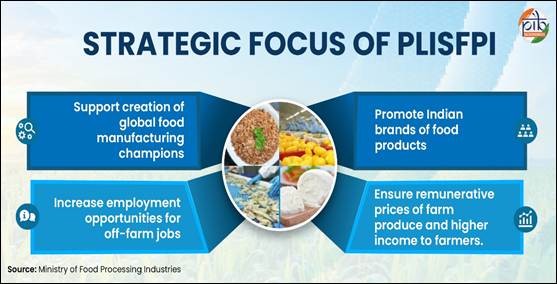
- PLISFPI (outlay ₹10,900 crore; 2021-22 to 2026-27) aims to create global Indian food manufacturing champions by incentivising incremental sales and brand promotion.
- Under the scheme (as of Feb 2026):
- 165 applications have been approved, corresponding to 274 project locations.
- Beneficiaries have received an incentive of ₹2,162.55 crore
- ~3.39 lakh jobs have been created, outperforming employment target of 2.5 lakh.
- Food processing and preservation capacity has grown by 34 lakh MT per annum
- Total export of agricultural processed food products has grown at a CAGR of 13.23% (2024-25 compared to 2019-20).
India’s food processing sector has emerged as a critical pillar of the agricultural and manufacturing ecosystem, driving value addition, strengthening market linkages, and enhancing the availability of processed foods. The sector has witnessed steady growth in recent years, with Gross Value Added (GVA) increasing from ₹1.34 lakh crore in 2014-15 to ₹2.24 lakh crore in 2023-24 as per the first revised estimates. Its rising global footprint is reflected in the share of processed food exports in agricultural exports, which grew from 13.7 percent in 2014-15 to 20.4 percent in 2024-25.
With its strong resource base as the world’s second-largest producer of fruits and vegetables, India holds significant potential to emerge as a global hub for food processing. However, realizing this potential requires enhanced competitiveness in terms of scale of production, productivity, value addition, and integration with global value chains. Recognizing these imperatives, the Government introduced the Production-Linked Incentive Scheme for the Food Processing Industry (PLISFPI) to catalyse growth and position India more strongly in global markets.
Understanding the Conceptual and Policy Framework of PLISFPI
The Production-Linked Incentive Scheme for the Food Processing Industry, approved by the Union Cabinet on 31 March 2021, falls within the broader Production-Linked Incentive Scheme.
The Production Linked Incentive (PLI) Scheme was launched in April 2020 to boost domestic manufacturing capabilities by offering financial incentives to eligible companies based on their incremental sales. It was introduced to enable the country to achieve more balanced and resilient progress by strengthening the manufacturing sector.
Aligned with the vision of Atmanirbhar Bharat and the broader Make in India initiative, the PLI Scheme was initially introduced for sectors such as Mobile Manufacturing and
Specified Electronic Components, Critical Key Starting materials/Drug Intermediaries and Active Pharmaceutical Ingredients, and Manufacturing of Medical Devices. Over time, the PLI framework has been expanded to cover 14 strategic sectors, with an incentive outlay of ₹1.97 lakh crore, with food processing among the key sectors.
With an outlay of ₹10,900 crore, PLISFPI is being implemented from 2021-22 to 2026-27. The scheme seeks to generate processed food output of ₹33,494 crore and create employment for nearly 2.5 lakh persons by the year 2026-27.
From Production to Branding: The Integrated Framework of PLISFPI
The Production Linked Incentive Scheme for Food Processing Industry (PLISFPI) is structured around three core components designed to promote manufacturing, encourage innovation among SMEs, and support the global branding of Indian food products.
First component (Category I): Incentivising the manufacturing of four major food product segments, viz. Ready-to-Cook/Ready-to-Eat (RTC/RTE) foods, including millet-based products, Processed Fruits & Vegetables, Marine Products, and Mozzarella Cheese.
Second component (Category II): Incentivising Innovative/ Organic products of SMEs across all four food product segments, including Free Range- Eggs, Poultry Meat & Egg Products.
Third component (Category III): Support for branding and marketing abroad to incentivise the emergence of strong Indian brands, including in-store branding, shelf space rental, and marketing.
Additionally, from the savings under PLISFPI, a new component- the Production Linked Incentive Scheme for Millet-Based Products (PLISMBP)- was carved out in FY 2022-23 with an outlay of ₹800 crore. It aims to encourage the use of millets in RTC/RTE products and to incentivize their use under the scheme to promote their production, value addition, and sale.
Rewarding Growth: The Incentive Structure of PLISFPI
Under the Production Linked Incentive Scheme for Food Processing Industry (PLISFPI), the manufacturing components of the scheme (Category I and Category II) provide incentives to eligible food processing companies based on incremental sales of specified food products. Under these components, applicants must meet minimum sales thresholds in the base year (2019-20) and undertake prescribed investments in plant and machinery, technical civil works, and associated infrastructure in segments such as ready-to-eat/ready-to-cook foods, processed fruits and vegetables, marine products, and mozzarella cheese.
Under Category III, the government provides financial incentives to support branding and marketing activities for Indian-branded consumer food products in global markets. Applicants are reimbursed 50% of their branding and marketing expenses abroad, capped at 3% of their annual food product sales or ₹50 crore per year, whichever is lower. Only Indian brands selling food products that are entirely manufactured in India are covered under this component. To qualify, applicants must spend a minimum of ₹5 crore over a period of five years.
Institutional Mechanism and Implementation Framework of PLISFPI
The scheme is implemented through a Project Management Agency (PMA). The Industrial Finance Corporation of India Limited (IFCI), a Government of India undertaking, has been appointed by the Ministry of Food Processing Industries as the PMA. Applications under PLISFPI are invited through an Expression of Interest (EOI) mechanism and submitted on an online portal (https://plimofpi.ifciltd.com), where they are examined and appraised by the PMA within a defined timeline. Upon successful submission, a unique Application ID is issued for all future correspondence. A web-based MIS system is used for continuous online monitoring of project progress and for taking interim corrective measures, where required.
Transformational Impact of PLISFPI: Strengthening Manufacturing, MSMEs, and Global Competitiveness
The scheme has facilitated the adoption of advanced technologies and the establishment of multiple production lines. It has resulted in the creation of 34 lakh MT per annum of processing and preservation capacity as of February 2026.
PLISFPI has also attracted strong industry participation and investment:
A total of 165 applications has been approved by the Ministry of Food Processing Industries across various categories.
These approvals correspond to 274 project locations.
Beneficiaries have reported investments amounting to ₹9,207 crore under the scheme.
Incentives worth ₹2,162.55 crore have been disbursed as of February 2026.
Overall, these outcomes underscore the scheme’s effectiveness in catalysing capacity expansion, mobilising private investment, and strengthening the technological and operational capabilities of India’s food processing sector.
The scheme has also played a significant role in promoting MSMEs. Out of the 165 approved applications, 69 applicants are MSMEs (as of February 2026). Additionally, 40 contract manufacturing units associated with the main approved applicants fall within the MSME category, indicating their integration across the value chain. Furthermore, incentives amounting to ₹13.266 crore have been disbursed to 20 eligible MSMEs as of 28 February 2025.
This expansion in capacity and investment has translated into substantial employment generation. Around 3.39 lakh direct and indirect jobs have been created by February 2026, far surpassing the scheme’s target of 2.5 lakh jobs by 2026-27.
In addition, PLISFPI has contributed to strengthening India’s presence in global processed food markets:
Exports of agricultural processed food products approved under the scheme have grown at a Compound Annual Growth Rate (CAGR) of 13.23% as on 2024-25, with reference to 2019-20.
The cumulative export sales of PLISFPI beneficiaries reached ₹89,053.44 crore during the period from FY April, 2021 to FY September, 2025.
Conclusion
The Production-Linked Incentive Scheme for the Food Processing Industry (PLISFPI) has emerged as a key driver of growth in India’s food processing sector. By linking incentives to increased sales, it has encouraged investment, expanded production capacity, and strengthened the global presence of Indian food products. Its emphasis on value addition, MSME participation, and millet-based products has contributed to inclusive growth.
The scheme has also strengthened the connection between agriculture and industry and generated employment across the value chain. Collectively, these outcomes position PLISFPI as a strong foundation for building a more competitive, resilient, and inclusive food processing ecosystem in the country.