Rising exports and expanding specialty steel output are further reinforcing India’s global position. With clear pathways for green steel and decarbonisation, the industry is aligning with long term sustainability goals.
India’s steel sector is a key “sunrise sector” with strong and steady growth. It became the world’s second-largest steel producer in 2018 and has retained this position. At the same time, steel consumption has more than doubled over the past 12 years. As demand increased, exports rose while imports declined, improving self-reliance. To support this growth, the government ensured raw material availability and reduced production costs. It also improved access to global markets for Indian steel producers. Under the PLI scheme, ₹23,022 crore investment supported specialty steel production and job creation. This resulted in 2.4 million tonnes of output and over 13,000 new jobs. India has achieved about 66% of its National Steel Policy production target. Going forward, green steel aims to reduce emissions by avoiding use of fossil fuels to reduce the carbon footprints. India is also committed to decarbonising the sector and achieving net zero emission by 2070.
Steel Sector Momentum
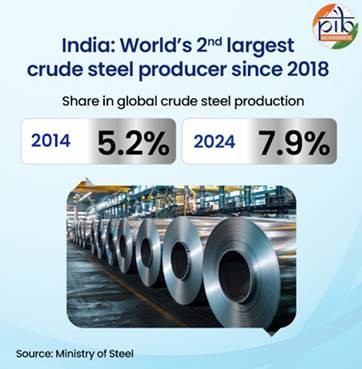
India’s steel sector, the backbone of India’s growth story, continues to strengthen its march towards domestic reliance. India became the world’s second largest steel producer in 2018 and has retained this position since then. Share of global crude steel production rose from 5.2% in 2014 to 7.9% in 2024. This reinforces India’s position as a competitive and expanding global player.
The country is also the 2nd largest consumer of finished steel as per the World Steel Association. India’s finished steel consumption has witnessed a significant rise. It increased from 77 million tonnes (MT) in 2014–15 to 163.7 MT in 2025–26. This growth reflects the rapid pace of infrastructure development, expanding urbanisation. It is also driven by robust growth in manufacturing, and a sustained increase in domestic demand. Collectively, these trends underscore steady evolution of India’s steel sector as a key contributor to industrial growth and economic development.
Aligning with the broader vision of Atmanirbhar Bharat and greater self-reliance, India is working to reduce dependence on foreign sources. A strong domestic steel ecosystem will create new business opportunities, boost industrial growth and support the country’s infrastructure push. In this direction, India is working towards achieving 500 MT of steel production capacity by 2047. At the same time, it is pursuing decarbonisation of the steel sector to meet net-zero emission intensity target by 2070.
Robust Steel Sector Performance
As world’s most widely used engineering and construction material, steel has been recognised as one of India’s ‘Sunrise Sectors’. It plays a pivotal role in driving domestic consumption and industrial growth.
Steel production in India continues to show strong and sustained momentum. In March 2026, steel output rose by 2.2% over March 2025. Meanwhile, the cumulative index for FY 2025-26 registered a robust 9.1% growth compared to the same period last year. This reflects enhanced production and demand base.
Steel is an alloy primarily composed of iron, carbon (< 2%) and manganese (1%), along with small quantities of silicon, phosphorus, sulphur and oxygen.
There are different forms of steel and iron which are vital for the steel sector. Some of them are:
Crude steel – first solid steel product formed upon solidification of liquid steel.
Finished steel – product obtained upon hot rolling/forging of Semi-finished steel.
Hot metal, pig iron and sponge iron – key forms of iron that constitute important categories within the steel industry.
Crude Steel
Crude steel, which serves as a raw material for other steel products, has shown significant growth over the years. It increased from 43.44 million tonnes (MT) in 2004-05 to 88.98 MT in 2014-15, and further expanded to 168.4 MT in 2025-26. This progression highlights India’s resilience and steady expansion in the global steel industry. The production of crude steel recorded a compounded annual growth rate (CAGR) of approximately 9% between 2021-22 and 2025-26. Additionally, during FY 2025-26, crude steel production rose by 10.7% compared to the same period last year, reflecting continued strong growth. In recent years, crude steel production was 127.2 MT in FY 2022-23, increased to 144.3 MT in FY 2023-24, then to 152.2 MT in FY 2024-25, and reached 168.4 MT in FY 2025-26.
Hot Metal, Pig Iron, and Sponge Iron
During April to September 2025-26, Hot Metal, which is the liquid iron produced in blast furnaces, saw a 7.3% increase in production compared to the same period last year, rising from 43.99 million tonnes (MT) to 47.21 MT. Similarly, pig iron, another direct output from blast furnaces, experienced a 6.6% rise in production, increasing from 4.04 MT to 4.31 MT during the same period. Sponge Iron, also known as direct-reduced iron, posted a strong performance with a 9.1% growth, going from 27.00 MT to 29.46 MT. This overall growth indicates a broad-based expansion across the industry’s core segments.
Finished Steel
The production of finished steel, which is a vital material for modern infrastructure and manufacturing, was 160.9 million tonnes (MT) in FY 2025-26. This represents a 9.7% increase compared to the previous year. Meanwhile, the consumption of finished steel remained strong at 163.7 MT, reflecting a 7.6% growth and indicating sustained domestic demand. Over the recent years, finished steel production has increased from 123.2 MT in FY 2022-23 to 139.2 MT in FY 2023-24, then to 146.7 MT in FY 2024-25, and finally reaching 160.9 MT in FY 2025-26. Similarly, steel consumption grew from 119.9 MT in FY 2022-23 to 136.3 MT in FY 2023-24, then to 152.1 MT in FY 2024-25, and finally to 163.7 MT in FY 2025-26.
Trade Story of Steel
India’s steel trade performance reflects a strengthening and increasingly competitive domestic industry. Exports of steel rose by 29.1% in March 2026 (year-on-year), while imports declined sharply by 9.5%. This signal enhanced domestic capacity and reduced reliance on foreign supply. The positive shift underscores India’s emergence as reliable global steel supplier. It also demonstrates the country’s improved ability to meet rising domestic demand.
India has also established itself as a leading exporter of iron and steel alloys. Rising exports of steel and related products contribute to higher foreign exchange earnings. This, in turn, helps improve the trade balance. It supports the broader vision of a self-sustained and resilient industrial ecosystem under Atmanirbhar Bharat.
Top destination for India’s finished steel exports in March 2026 were Vietnam, Belgium and Taiwan. Together, they comprise of more than 50% of India’s total finished steel exports.
Besides, exports of finished steel increased by 35.80% in FY 2025–26 compared to the same period last year. Meanwhile, imports declined by 46.47% during the same period.
Government Reforms Supporting Steel Sector
The Government has implemented several measures to strengthen raw material availability, ensure global market access, and reduce import dependence. These steps have lowered production costs, driven growth in the steel industry, and supported MSMEs and small steel producers.
Steel is a de-regulated sector, with the Government playing a facilitative role by fostering a conducive policy framework for its growth and development.
Production Linked Incentive (PLI) for Specialty Steel
The Production Linked Incentive (PLI) scheme is a government initiative. The primary aim was to strengthen India’s manufacturing capabilities by offering financial incentives to eligible companies based on their incremental sales.
Specialty steel, the downstream, value-added product of steel manufacturing process. It is one of the 14 sectors covered under PLI Scheme, which aims to boost domestic production of high-value steel. It was launched in 2021, with a financial outlay of ₹6,322 crore. It will improve the trade balance, raise export value realisation. It will also help the Indian steel industry upgrade technology and move up the value chain.
The scheme offers incentives for 5 years (FY 2024-25 – FY 2030-31) to companies that meet specified investment and production targets. Under the scheme, export volumes are projected to rise more than threefold. Meanwhile import volumes are expected to decline by nearly four times from 2023-24 to 2029-30.
The Steel Ministry’s PLI 1.0 and PLI 1.1 Scheme had the investment commitment of ₹44,106 crore. They also guarantee direct employment of 33,460 people and incremental production of 14,340 thousand tonnes.
Key achievements of PLI scheme are:
₹23,022 crore investment realized
2.4 million tonnes specialty steel production
13,264 direct jobs created
₹236 crore incentives disbursed
24 million tonnes specialty steel capacity created
₹6,000 crore import substitution achieved
The third round (PLI 1.2), announced in November 2025, targets investments in advanced and emerging steel products. PLI 1.2 covers 85 applications across 4 product categories, namely
Steel Grades for Strategic Sector,
Commercial Grades – Category 1,
Commercial Grades – Category 2, and
Coated & Wire Products.
The scheme offers incentive rates ranging from 4% to 15% for a period of five years, commencing from FY 2025–26. However, incentive disbursement will begin from FY 2026–27.
Recently, the Government also singed Memorandum of Understanding (MoUs) for 85 speciality steel projects of 55 companies under PLI 1.2. The projects involve investment of ₹11,887 Crore and a committed capacity addition of ~8.29 MT.
Promoting Domestic Production
The government follows a policy-driven approach to promote domestic steel manufacturing and enhance long-term sectoral resilience.
Domestically Manufactured Iron and Steel Products (DMI&SP) Policy: The policy, revised in May 2025, provides preference for DMI&SP in Government procurement. It covers notified iron and steel products, specifies minimum domestic content requirements. In addition to this, it also lists exempted capital goods for manufacturing iron & steel products which can be imported. It also includes provisions to encourage adoption of indigenous technologies and reduce import dependency. The continuous monitoring and feedback mechanisms ensure transparency, accountability, and long-term sustainability of the policy outcomes.
To augment domestic production, “Melt and pour rule” was introduced. Herein, all steel should be manufactured entirely in India from start to finish, including the initial melting and pouring of crude steel. By promoting indigenous technology and reducing import dependence, it strengthens self-reliance.
National Steel Policy: The National Steel Policy 2017 envisions expanding crude steel capacity to 300 MTPA and production to 255 MTPA by 2030–31. Additionally, raising per-capita finished steel consumption to 158 kg from the current 61 kg. The policy also aims to meet domestic demand for high grade automotive, electrical and special steels. It also seeks to reduce coking coal import dependence from 85% to 65% by 2030–31.
India has already achieved 168 MTPA of crude steel production in FY 2025-26. This implies that ~66% of crude steel production capacity under National Steel Policy 2017 has been achieved. This marks progress toward the long-term capacity target.
Infrastructure Projects
In FY 2023-24, construction and infrastructure remained the primary drivers of steel demand, accounting for about 68% of total consumption. Meanwhile, the engineering and packaging sectors contributed around 22%, and the automobile industry about 9%.
Did You Know?
Major steel zones are located in Kalinganagar, Angul, Rourkela, Jharsuguda, Nagarnar, Bhilai, Raipur, Jamshedpur, Bokaro, Durgapur, Kolkata and Vizag.
Identification of Steel Zones: The Government is fast-tracking key logistics and infrastructure projects across 12 major steel zones. Priority rail, road and port expansions are underway to ease bottlenecks and develop world-class multimodal connectivity supporting the sector’s growth.
PM GatiShakti Masterplan (October, 2021): The Ministry of Steel has uploaded geolocation data of over 2,100 functioning steel units onto the PM GatiShakti platform. It includes their products and capacities to support coordinated, data-driven logistics planning in the sector.
Reduced Import Dependency
The Government has introduced several measures to strengthen raw material security, improve quality standards, and enhance competitiveness of steel sector.
The Basic Customs Duty on Ferro Nickel and Molybdenum ores has been reduced to zero in the Union Budget 2024–25. These materials are key raw inputs for the steel industry. .
The Steel Scrap Recycling Policy (2019) has been notified to boost the availability of domestic scrap. It also aims to produce high quality ferrous scrap for quality steel production thus minimizing the dependency on imports.
Steel Quality Control Orders (QCOs) ensure that only BIS compliant steel is made available to the end users. They ban sub-standard/ defective steel products in the domestic market as well as imports, safeguarding industry and consumer interests. The Government has mandated 143 QCOs of 723 products (as of 31 December 2025). This ensures compliance with quality standards, while avoiding market distortions and protecting consumer requirements.
The Ministry of Coal is advancing Mission Coking Coal, launched in 2024. It significantly ramps up domestic coking coal production to reduce import of coking coal. This will reinforce long term self-sufficiency in this critical input. This mission aims to increase domestic raw coking coal production up to 140 MT by FY 2029-30.
In April 2025, the Government imposed a 12% safeguard duty on select non-alloy and alloy steel flat products. This protects domestic manufacturers from import surges and maintain fair market competition.
In addition, the SARAL-SIMS system was introduced in November 2025 as a simplified registration process under the Steel Import Monitoring System (SIMS). It strengthens import monitoring and enables more effective oversight, addressing the concerns of the domestic steel industry.
International Market Reach
The Government’s efforts to reform Foreign Direct Investment (FDI) policies have significantly contributed to increase FDI inflow. This has resulted in increase in FDI inflow by 120% between 2014 and 2024, compared to 2004–2014. FDI equity inflows into the manufacturing sector also rose by 69% in the similar years.
Government supported via provision of 100% FDI under automatic route. This resulted in attracting ₹1,60,000 crore (USD 18.67 billion) between April 2000 and June 2025 by metallurgical industries.
Furthermore, Free Trade Agreements with United Kingdom, European Union, and others are likely to expand market access for the sector.
De-carbonisation In Steel Industry: The Way Ahead
Commitment of Ministry of Steel to Decarbonise the Steel Sector in India
In the short term (FY 2030), the focus is on reduction of carbon emissions in the steel industry. This will be achieved through promotion of energy and resource efficiency, greater use of renewable energy etc.
For the medium term (2030-2047), Green Hydrogen based steel making and Carbon Capture, Utilisation and Storage are the focus areas.
For the long term (2047-2070), disruptive alternative technological innovations can help achieve the transition to net-zero.
Under decarbonisation, CO2 emissions (or its equivalents) are reduced to achieve a lower output of greenhouse gases. As per the Paris Agreement, reducing CO2 from transport and power generation is essential to meet global temperature standards.
Green steel is the manufacturing of steel without the use of fossil fuels. So-called “green hydrogen” is one solution that could help reduce the steel industry’s carbon footprint
The future of India’s steel industry is being shaped by a strong push towards low carbon and sustainable production. In 2024, India became the first country to introduce an official Green Steel Taxonomy. It defines Green Steel in terms of percentage greenness of the steel. It is produced from the steel plant with CO2 equivalent emission intensity less than 2.2 tonnes of CO2e per tonne of finished steel. As of 31 March 2026, 89 steel units have been awarded green steel certification, covering a production volume of 12.34 MT.
In a step towards achieving the larger goal of decarbonisation, some of the defined targets are:
Standards & Procurement: Set green steel standards, monitor emissions across steel plants, and adopt green public procurement.
Technology & Efficiency: Deploy best-available technologies, raise pellet use, and promote circular economy by increasing scrap utilisation.
Clean Energy Shift: Reach 45% renewable energy penetration by 2030, create aggregator model for renewable energy, expand natural gas availability, and scale biochar.
Green Hydrogen & Carbon capture, utilisation and storage (CCUS): Demonstrate pilot projects for use of green hydrogen in DRI (Direct Reduced Iron) and BF (Blast Furnace) processes and establish CCUS pilot plants by 2030.
R&D & Innovation: Launch a national steel decarbonisation R&D roadmap and priority projects.
Finance & Global Linkages: Improve access to funding, technology, and international collaboration.
Just Transition: Upskill and reskill the steel workforce for a low-carbon transition.
Government Measures for Low Carbon Steel
To promote low carbon steel making, the Government has undertaken several other key initiatives.
The Union Budget 2026-27 proposed CCUS technologies for steel and other industries with ₹20,000 crore outlay over 5 years.
Carbon Capture, Utilization and Storage (CCUS) comprise a set of technologies designed to capture CO₂ emissions from large, stationary sources. This includes fossil fuel-based power plants and other industrial facilities.
It also involves the transportation of the captured CO₂ (typically via pipelines, and in certain cases through shipping, rail, trucks). The CO2 is transported to designated sites for either utilisation in various applications. It can also be injected into geological formations and depleted oil and gas fields. This enables its permanent storage and trapping of the CO2.
The Steel Scrap Recycling Policy, 2019 is also boosting domestic scrap availability. India’s total steel scrap consumption stands at about 30 MT, with around 5 MT imported. This makes the availability of high-quality domestic scrap essential for the transition to green steel. Increased scrap usage lowers specific energy requirements, reduces water consumption by 40% and greenhouse gas emissions by 58%. As a result, this strengthens India’s decarbonisation efforts (January, 2025).
Ministry of Steel constituted 14 Task Forces in February, 2025 to recommend measures across the steel industry decarbonisation chain.
Under the National Green Hydrogen Mission, Ministry of Steel has awarded 4 pilot projects for use of hydrogen in steel sector. These projects are being implemented in 3 areas including partial hydrogen injection in vertical shaft based DRI to substitute natural gas. They also involve using hydrogen in existing blast furnace to reduce coal and coke consumption.
Measures such as the Motor Vehicles (Registration and Functions of Vehicles Scrapping Facility) Rules (2021) support emission reduction. The National Solar Mission (2010), and the Perform, Achieve and Trade (PAT) energy-efficiency scheme (2012) further improve energy efficiency.
The steel sector has adopted the Best Available Technologies (BAT) available globally, in the modernization & expansions projects.
Japan’s New Energy and Industrial Technology Development Organization (NEDO) Model Projects for Energy Efficiency Improvement have also been implemented in steel plants.
These measures reinforce India’s commitment to de-carbonising the steel sector and achieving net zero emission intensity by 2070. In line with its vision of a future-ready steel sector, the Government has taken a major step to integrate advanced technologies.
AI in Steel Pavilion, is first-of-its-kind collaborative platform which is designed as problem-to-solution marketplace. It brings together real-time industry challenges and connects them with AI solution providers, startups, technology firms, and research institutions. This supports in developing practical, scalable solutions.
It presents specific operational, logistical, safety, quality control, sustainability, and marketing challenges faced by steel producers and mining companies. This initiative marks a clear shift from gradual digitization to a mission-mode adoption of AI across the entire steel value chain. It covers mining, logistics, production, quality assurance, marketing, and corporate governance.
Steel Sector Outlook
India’s Steel sector is rapidly strengthening its capacity, competitiveness, and self-reliance. Government reforms in raw material security, logistics, quality control, and PLI incentives are driving higher production and reduced import dependence. Rising exports and expanding specialty steel output are further reinforcing India’s global position. With clear pathways for green steel and decarbonisation, the industry is aligning with long term sustainability goals. Together, these steps are building a resilient, future ready steel ecosystem that will support India’s growth in the years ahead.