BLURB/SUBHEAD
India’s space journey over the last 12 years reflects the spirit of Vishwas, Vikas and Jan Kalyan. Driven by Aatmanirbhar Bharat, Make in India and the vision of Viksit Bharat 2047, the nation has emerged as a leading space power. Landmark achievements include Chandrayaan-3’s lunar south pole landing, Aditya-L1’s solar mission, and preparations for Gaganyaan and a national space station.
India’s space journey over the last 12 years reflects the spirit of Vishwas, Vikas and Jan Kalyan. Driven by Aatmanirbhar Bharat, Make in India and the vision of Viksit Bharat 2047, the nation has emerged as a leading space power. Landmark achievements include Chandrayaan-3’s lunar south pole landing, Aditya-L1’s solar mission, and preparations for Gaganyaan and a national space station. Space startups have grown from one in 2014 to over 400 as of February 2026. Liberalised FDI norms, greater private participation, and NSIL-led commercialisation have accelerated growth.
The Rise of a Global Space Power
Over the last twelve years, India’s space programme has emerged as a symbol of national confidence, technological self-reliance, and global ambition. Three defining pillars have shaped this transformation: India’s Space Capability through landmark missions and indigenous technologies; building National Capacity through space-based applications for governance, connectivity, disaster management, agriculture, healthcare, and education; and global partnerships that have enhanced India’s credibility as a trusted space partner.
India’s Space Capability: Reaching Beyond Earth
Lunar Exploration – The Chandrayaan Programme
Chandrayaan-1 in 2008 discovered evidence of water molecules on the Moon’s surface. Chandrayaan-2, launched in 2019, provided some of the highest-resolution images of the lunar surface. On 23 August 2023, Chandrayaan-3 made India the first country to achieve a soft landing near the Moon’s south pole and the fourth nation to successfully soft-land on the lunar surface. Scientific instruments confirmed the presence of Sulphur through direct elemental analysis. Chandrayaan-4, planned for 2027, aims to land on the Moon, collect samples, and return them to Earth. Chandrayaan-5/LUPEX will explore water and other volatile materials near the lunar south pole.
The Mars Orbiter Mission (Mangalyaan)
On 24 September 2014, Mangalyaan successfully entered Martian orbit, making India the first country to reach Mars on its maiden attempt. Originally designed for a six-month mission, it remained operational for more than eight years.
Aditya-L1: India’s First Solar Observatory
Launched in 2023, Aditya-L1 was successfully placed in a halo orbit around the Sun-Earth L1 Lagrange Point. More than 27 TB of solar observation data have already been disseminated.
Space Astronomy and Space Docking
AstroSat completed a decade in orbit in September 2025. XPoSat, launched on 1 January 2024, expanded India’s capabilities in X-ray astronomy. The Space Docking Experiment (SPADEX) in January 2025 made India the fourth nation to demonstrate autonomous docking and undocking in space.
Venus Orbiter Mission
Approved by the Government of India, the mission is targeted for launch in March 2028 to study Venus’ geology, surface composition, atmosphere, and ionosphere.
Gaganyaan: India’s First Human Spaceflight Programme
Approved in January 2019, the mission aims to send up to three Indian astronauts into a 400-kilometre orbit. The programme includes two uncrewed missions and one crewed mission and entered its final phase in 2025. As part of preparations, Group Captain Shubhanshu Shukla participated in the ISRO-NASA supported Axiom-4 mission to the International Space Station in 2025.
National Space Station
The Bharatiya Antariksh Station (BAS) will be a five-module space station in Low Earth Orbit. In September 2024, the Union Cabinet approved the development and launch of the first module, BAS-01, by 2028.
Building Capacity Through Private Participation, Innovation, and Technological Development
Private Sector Powering India’s Space Transformation
The opening of the space sector for private players in 2020, followed by the Indian Space Policy 2023, enabled greater private participation. Government initiatives such as liberalised FDI policy, the IN-SPACe Seed Fund Scheme, the ₹1,000 crore Venture Capital Fund, and the ₹500 crore Technology Adoption Fund have strengthened the ecosystem.
In February 2024, FDI policy was liberalised allowing up to 100% FDI in selected activities. Up to 74% FDI is permitted under the automatic route for satellite manufacturing and operations. Up to 49% FDI is allowed for launch vehicles, while 100% FDI under the automatic route is permitted for manufacturing satellite components.
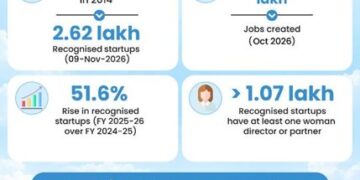
In 2014, India had just one registered space start-up. As of February 2026, that number had crossed 400. Investment in Indian space start-ups exceeded $500 million.
Commercialisation: Expanding India’s Space Economy
India’s space economy, currently valued at $8 billion with a 2–3% share in the global space economy, is projected to grow five-fold to $40–45 billion over the next decade. NewSpace India Limited (NSIL), established in 2019, and IN-SPACe established in 2022, have created a strong institutional framework. NSIL revenues increased from ₹321.77 crore in FY 2021-22 to ₹3,246.09 crore in FY 2024-25.
Self-Reliant Space Transportation
India has achieved self-reliance in space transportation systems through PSLV, GSLV and LVM3 launch vehicles. The government has approved the development of a Next Generation Launch Vehicle (NGLV) with a maximum payload capability of 30 tons to Low Earth Orbit. Reusable launch vehicle technologies are also being developed.
Indigenous Electronics and On-board Systems
ISRO jointly with Semiconductor Laboratory, Chandigarh developed VIKRAM3201, India’s first fully indigenous 32-bit space microprocessor, along with KALPANA32 for high-reliability space missions.
Indian Space Sector Credibility on the Global Stage
ISRO launched 35 foreign satellites between the 1990s and 2014. After 2014 and as of March 2026, the number increased sharply to 399 foreign satellite launches. India has signed more than 300 space cooperation agreements with 61 countries and 5 multilateral organisations.
Key International Collaborations:
– NASA-ISRO NISAR: Launched on 30 July 2025, the mission monitors changes in land, glaciers, forests, and oceans.
– TRISHNA (ISRO-CNES): Scheduled for launch in 2026, providing high-resolution thermal imaging for natural resource assessment.
– Chandrayaan-5/LUPEX (ISRO-JAXA): Scheduled for launch in 2027–28 to explore the Moon’s polar region.
– ESA-ISRO Partnership: Signed Joint Statement of Intent on 7 May 2025 for future human space missions.
– India-Germany: Identified new opportunities in satellite communications, human spaceflight, and microgravity research.
– India-Italy: Elevated space cooperation under the Joint Strategic Action Plan 2025-2029.
– ISRO-Saudi Space Agency: MoU signed on 23 April 2025.
Space for Citizens – Applications That Touch Everyday Life
NavIC – India’s Indigenous Navigation System
NavIC provides accurate positioning, navigation, and timing services across India and up to 1,500 kilometres beyond its borders. Five second-generation satellites (NVS-01 to NVS-05) are planned to enhance reliability.
Data-Driven Governance
Satellite-based data supports improved planning, real-time monitoring, and resource management across agriculture, water resources, rural development, and other sectors.
Disaster Management & Early Warning
Satellites support monitoring of cyclones, floods, landslides, forest fires, and other natural hazards. The National Database for Emergency Management (NDEM 5.0) provides real-time geospatial information.
Supporting Coastal Communities
Potential Fishing Zone (PFZ) advisories help fishermen identify productive fishing areas, reducing fuel consumption and search time.
Satellite-Based Solutions in Health and Education
ISRO provides telemedicine services in remote and high-altitude regions, with around 179 telemedicine nodes operational. Under PM e-VIDYA, 370 educational television channels are delivered through GSAT-15 and GSAT-9 satellites.
South Asia Satellite (GSAT-9)
Launched on 5 May 2017, the satellite provides coverage over Afghanistan, Bangladesh, Bhutan, Maldives, Nepal and Sri Lanka, supporting DTH broadcasting, telemedicine, tele-education, banking connectivity, weather forecasting, and disaster management.
Towards Becoming a Responsible Space Power
Over the last twelve years, India’s space programme has shown how technological advancement can directly support national development. India has emerged as a trusted global space partner through international cooperation, commercial launches, and knowledge sharing. As India advances towards Space Vision 2047, the focus remains on expanding scientific frontiers while creating benefits for society.
Disclaimer: This is an abridged version of the original PIB article “India’s Space Odyssey: Building India’s Space Future” (June 21, 2026). Key facts and data have been retained. For the complete article, please refer to the official PIB website.