
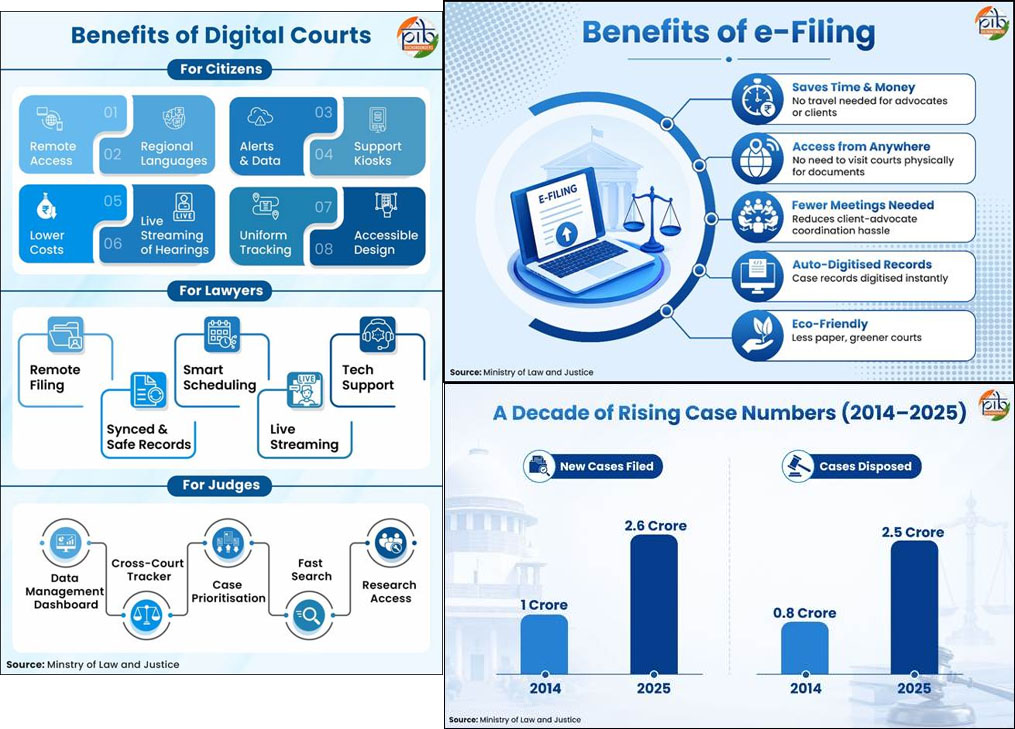
The e-Courts Mission has transformed a traditionally paper-heavy, process-driven and opaque judiciary into a more accessible, transparent, and technology-enabled online system
The e-Courts Mission Mode Project has transformed India’s paper-based judiciary into a digitally enabled and trackable justice delivery system. Since 2014, both case filings and disposals have nearly tripled, with courts consistently disposing of more cases than are filed each year. Over 753 crore pages of court records have been digitised, while thousands of e-Sewa Kendras are helping bridge the digital divide by expanding access to judicial services. Together, these reforms are making the justice system faster, more transparent, and more accessible to everyone.
Digitising India’s Judiciary
India’s judiciary, which serves over a billion people, has long relied on paper records and brick-and-mortar infrastructure. Many citizens incurred excessive travel and other expenses visiting courts and other establishments for their matters and documents. This archaic system made the delivery of justice slow, cumbersome and expensive for the people it served.
The Government launched the e-Courts Mission Mode Project in 2007 to address these challenges. This Mission aims to systematically speed up proceedings by digitising various court proceedings and documents. It is also making the judicial process more affordable, accessible and transparent for all involved, including lawyers, judges and clerks. Now in its third phase, the Mission has transformed the judicial system using technology.
Phase I (2011–2015) laid the foundation of this Mission by computerising over 14,000 courts and building basic network infrastructure needed to support technology-enabled judicial services.
Phase II (2015–2023) built on this with a range of citizen-centric services, introducing the National Judicial Data Grid (NJDG), eFiling, and eSewaKendras (a physical help desk providing digital court services). The phase also expanded video conferencing infrastructure more than fivefold, significantly enhancing virtual access to judicial proceedings.
The project is now in its third phase (2023–2027) . This phase envisions a transition towards digital, paperless and more intelligent courts through large-scale digitisation of records, wider use of virtual hearings, deeper interoperability across justice institutions and adoption of emerging technologies including Artificial Intelligence (AI), analytics and Optical Character Recognition (OCR).
Key Achievements of Phase III
The third phase of the e-Courts Mission has recorded significant achievements across multiple components. Fully functional e-Sewa Kendras have been established at 1,806 locations across court complexes. The infrastructure for paperless courts has been set up in 474 courts, while the expansion of virtual courts for hearing cases through robust digital infrastructure has been achieved in 538 courts. Implementation of e-filing of court cases is now available in 4,519 courts. Video conferencing facilities have been enhanced and upgraded, with 7,553 establishments—including courts, jails and hospitals—now equipped with VC facilities. Solar facilities for ensuring seamless availability of ICT infrastructure have been provided to 1,626 court complexes. The National Service & Tracking of Electronic Processes (NSTEP) facility is now available in 6,895 courts. Migration of all High Court and District Court websites to the S3WAAS platform has been completed for 734 court sites. Additional hardware has been provided to 18,380 courts and judicial officers under Phase II. Integration with the Inter-operable Criminal Justice System (ICJS) to enable seamless transfer of data and information among different pillars like courts, police, jails and forensic labs has been implemented in all High Courts. A total of 2,372 training sessions have been held for all stakeholders. Under knowledge management, the Indian Institute of Technology, Madras is developing a Learning Management System (LMS). Connectivity has been established at 174 sites using Software Defined Wide Area Network (SDWAN) technology.
Benefits of Court Digitisation
Virtual courts, video conferencing facility, case trackers and dashboards showing pending and disposed cases, among other digital tools, have organised and sped up court proceedings. These reforms benefit all stakeholders involved.
Transparency in pending and disposed cases through National Data Judicial Grid: The National Judicial Data Grid (NJDG), launched under Phase II, is an online public dashboard that tracks court orders, judgements and case details in real time, including pending cases across all levels of the judiciary. The NJDG comprises three dedicated dashboards for the Supreme Court, High Courts and District Courts. Together, they provide insightful details on the functioning of courts across the country by tracking the number of pending and disposed cases in High Courts and Subordinate Courts, the distribution of cases by category and stage of proceedings, and the reasons for case delays along with the duration of such delays. The NJDG aims to improve transparency and accountability in the system by making data on pending court cases public. It has also helped in judicial planning, monitoring and remote administration by the High Court judges, District Judges and High Court Registry.
Speeding up of processes through e-Filing of documents: Previously, citizens and lawyers had to file court documents in person. The e-Filing system now removes this need, allowing documents to be filed online from anywhere. It supports English as well as regional languages, and works across District Courts, High Courts and the Supreme Court. The system provides for online payments, online submission of Vakalatnamas, e-signing of documents, online video recording of oaths, application filings, portfolio management for advocates and litigants, adding colleagues and juniors as partners to manage cases collaboratively, dashboards tracking the status of all completed or pending cases, and readymade templates for various commonly filed pleadings. Since inception till June 30, 2026, more than 1.25 crore cases have been filed through the e-filing platform, and the e-payments system has processed transactions worth Rs. 1,404 crore in court fees and Rs. 75 crore in fines.
Digitising legacy court records for efficient case retrieval and storage: Crores of older court records are being digitised under Phase III of the mission. This helps preserve valuable records from physical damage and makes retrieval and research faster and more efficient.
Affordable access to court proceedings through remote hearings: Litigants, lawyers, witnesses, and other stakeholders can now participate in hearings remotely through video conferencing. This has eliminated the need for travel, enabling easier access to courts across cities and states and improving access to justice. Video conferencing facilities have been expanded across 7,553 establishments including courts, jails and hospitals. Courts across the nation have conducted over 4.18 crore remote hearings through this method. Livestreaming of court proceedings is operational in 11 High Courts. Thirty-one Virtual Courts have been established to enable online adjudication of traffic challans, which have received 11.33 crore challans amounting to Rs. 1,135.79 crores. Nyaya Shruti, launched in 2024 under the Inter-operable Criminal Justice System (ICJS), enables accused persons, witnesses, police officials, prosecutors, scientific experts, and prisoners to appear and testify virtually via video conferencing, saving time and resources while speeding up case resolution.
Connecting Police, Courts, Prisons and Forensics
Digitisation now links the entire criminal justice chain, not just the courts. ICJS (Interoperable Criminal Justice System) is a platform letting police, courts, prisons, forensics and prosecution exchange FIRs, charge-sheets, orders and reports electronically. CCTNS (Crime & Criminal Tracking Network and System) computerises police processes from FIR to charge-sheet, with Nyaya Sanhita-linked deadline alerts for investigating officers. ITSSO (Investigation Tracking System for Sexual Offences) is a dashboard tracking investigations in women and child sexual-offence cases against charge-sheet deadlines. e-Sakshya is a secure app for capturing and managing digital evidence, preserving its integrity from collection to court. e-Summons enables electronic generation, transmission and execution of court summons. MedLEaPR (Medico Legal Examination and Postmortem Reporting) is a hospitals’ online system for medico-legal exams and postmortem reports. Nyaya Shruti is a video-conferencing platform for virtual testimony by the accused, witnesses, police, prosecutors and forensic experts. e-Forensic enables end-to-end digital case handling across forensic labs. e-Prison is a cloud-based national network for prison and prisoner management. e-Prosecution is a digital workflow linking police and prosecution for timely legal opinions. NAFIS (National Automated Fingerprint Identification System) is a centralised biometric database for real-time fingerprint matching against criminal records.
Enabling Seamless Tracking of Judicial Business Through Digital Platforms
Lawyers, litigants, judges and others can now track case status and updates through digital platforms such as apps, the multilingual e-Courts Services Portal, email and SMS. These services have enhanced tracking and transparency, reducing the need for physical visits to courts and easing judicial service delivery. Over 4 lakh SMSs and 6 lakh emails are sent daily. The multilingual e-Courts services portal records about 35 lakh hits daily. The e-Courts Services mobile app, with 3.84 crore downloads, provides lawyers and litigants relevant information about case status and cause lists. The JustIS app, with 22,594 downloads, is a management tool for the judges, assisting them to effectively organise and monitor their judicial business. Under the National Service and Tracking of Electronic Processes (NSTEP), bailiffs use a centralised, GPS-enabled web and mobile app to serve summons and notices electronically and in real time. NSTEP replaces the erstwhile slow, paper-based process with a transparent, trackable digital system, enabling faster service across districts and states.
Improved Understanding of Legal Process Through e-SEWA Kendras
E-Sewa Kendras established within court complexes serve as citizen-friendly assistance centres where people can get guidance on various legal procedures and processes. These kiosks provide facilities including answering queries on case status and next hearing dates, processing online applications for certified copies, handling e-filing of petitions, assisting with online purchase of e-stamp papers and e-payments, helping litigants apply for and obtain Aadhaar-based digital signatures, promoting and assisting with downloading the eCourts mobile app, booking eMulakat appointments for jail visits, answering queries on judges’ leave schedules, guiding litigants to free legal aid, facilitating traffic challan disposal through virtual courts, explaining how to set up and join a video-conference hearing, and sharing judgment and order copies via email, WhatsApp or other digital channels. There are 49 e-Sewa Kendras functional across all High Courts and 2,535 e-Sewa Kendras across District Courts as on June 30, 2026.
Advancing Digital Justice Through Artificial Intelligence and Machine Learning
AI and Machine Learning in High Courts through 2027 is the next step under Phase III of the Mission. Rs. 53.57 crore of the total Rs. 7,210 crore outlay has been earmarked for this development. Legal research, case management, transcriptions, translations, and judicial decision-making support get enhanced with the integration of these technologies.
Key initiatives which are under pilot testing include AI and ML tools transcribing oral arguments in Constitutional Bench matters, with transcripts published on the Supreme Court’s website. LegRAA (Legal Research and Analysis Assistant) helps judges with legal research and document analysis. Digital Courts 2.1 lets judges and judicial officers manage cases in a paperless format, giving them a single window for all case-related information and tasks. It includes voice-to-text (ASR-SHRUTI) and translation (PANINI) tools to assist with order and judgment dictation. Judgments are being translated into 18 Indian languages through the eSCR portal, with the National Informatics Centre having translated over 83,000 so far, including 36,344 into Hindi as of March 2025. An AI tool built with IIT Madras automatically flags defects in e-filed petitions and extracts case data and metadata; prototype access has been granted to 200 Advocates-on-Record, with integration into the e-filing system and the Court’s case management software (ICMIS) underway.
An Overhauled Judicial System
The e-Courts Mission has modernised and digitised India’s judicial system. It has replaced tedious processes—in-person court visits and physical paperwork—with something far easier, more trackable and more efficient. New AI tools are helping various stakeholders work more effectively. Through these interventions, anyone can access judicial services from anywhere. Justice delivery is now more transparent, faster and more affordable for the public.
A More Accessible, Transparent and Efficient Judiciary
The e-Courts Mission has transformed a traditionally paper-heavy, process-driven and opaque judiciary into a more accessible, transparent, and technology-enabled online system. The National Judicial Data Grid has made pending cases visible for the first time. Over 753 crore pages of old court records have been digitised and made searchable.
With these new tools and technology, the judiciary can handle increased caseloads in an efficient manner. As Phase III progresses through 2027, it is further advancing the vision of a justice system that works for all, regardless of thei