
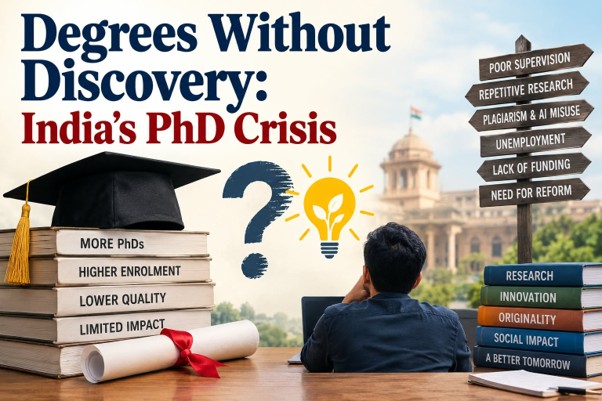
The future of Indian research will not be determined by how many PhD certificates its universities award, but by how much new knowledge its researchers create. Degrees must lead to discovery; otherwise, the promise of doctoral education will remain unfulfilled.
India is producing an increasing number of doctoral degree holders, but a fundamental question remains unanswered: how much new knowledge is this expanding system creating? A PhD is supposed to represent the highest level of academic inquiry, intellectual independence and original contribution to knowledge. Yet, when research becomes a routine exercise in obtaining a qualification rather than solving meaningful problems, the purpose of doctoral education is seriously undermined. India does not merely need more PhDs; it needs better researchers, stronger research institutions and discoveries that make a difference to society.
The PhD is not an ordinary academic degree. It is a commitment to questioning established ideas, investigating unanswered questions and developing new explanations or solutions. A successful doctoral thesis should contribute something original to its discipline, however modest that contribution may be. Unfortunately, concerns about repetitive topics, weak research methodologies, inadequate supervision and limited practical relevance raise important questions about the quality and impact of doctoral research in India.
One major problem is the growing emphasis on the number of degrees awarded rather than the quality of knowledge created. Universities are evaluated through various indicators, including enrolment, research publications, patents and doctoral completions. Such measures have their place, but they can become counterproductive when institutions focus on numerical targets at the expense of intellectual substance. The number of PhDs awarded cannot, by itself, establish the strength of a country’s research ecosystem. The real test is whether doctoral research generates credible evidence, advances understanding, informs public policy or contributes to technological, economic and social progress.
Another concern is the originality of research. Repetition of existing studies, superficial literature reviews and minor variations on familiar topics can weaken the value of doctoral work. Plagiarism and inappropriate use of artificial intelligence present additional challenges. AI tools can assist researchers with language, data organization and preliminary analysis, but they cannot replace independent thinking, sound judgment or responsibility for research findings. The use of technology must therefore be governed by transparent institutional policies that protect academic integrity without discouraging legitimate innovation.
The quality of doctoral supervision is equally important. A research scholar needs more than a supervisor’s signature and periodic formal meetings. Effective supervision involves intellectual guidance, methodological training, constructive criticism, ethical standards and professional mentorship. Supervisors must help scholars develop independent thinking rather than encourage dependence or compliance. Universities should also establish accessible mechanisms for addressing grievances, conflicts of interest, harassment and unreasonable delays in thesis evaluation. Accountability must apply to supervisors and institutions as well as research scholars.
A comprehensive reform agenda is urgently required. First, doctoral programmes should place greater emphasis on research questions, originality, methodological rigour and demonstrable contributions to knowledge. Thesis evaluation should assess the quality of the research rather than rely excessively on publication counts or journal rankings. Independent external assessment, transparent evaluation criteria and appropriate scrutiny of research integrity can improve credibility.
Second, universities should invest in supervisor development and periodic performance reviews. Supervisory responsibilities must be clearly defined, and the number of scholars assigned to each supervisor should reflect available time and expertise. Research scholars should receive structured training in research design, statistics, academic writing, data management, intellectual property and publication ethics.
Third, funding agencies and universities should reward meaningful research outcomes rather than volume alone. Relevant indicators may include reproducibility, policy influence, technological applications, social impact, high-quality datasets and contributions to established knowledge. Evaluation systems must remain sensitive to differences among disciplines because a significant contribution in economics or literature may not take the same form as a scientific invention.
Fourth, doctoral programmes should become more interdisciplinary and problem-oriented. Indian scholars must be encouraged to investigate challenges such as agricultural productivity, public health, financial inclusion, environmental sustainability, educational inequality and technological development. Collaboration among universities, businesses, government agencies and communities can help ensure that research addresses genuine national needs.
Finally, universities must build a culture in which intellectual honesty is valued above ceremonial recognition and original thinking is encouraged rather than penalized. Quality assurance should be continuous, transparent and supportive of academic independence. The objective must not be to restrict access to doctoral education arbitrarily, but to ensure that admission, supervision, assessment and degree completion meet credible academic standards.
India’s aspiration to become a knowledge-driven economy cannot be fulfilled through qualifications alone. It requires researchers who can challenge assumptions, test evidence, develop solutions and contribute to global scholarship. A doctoral degree should signify the ability to conduct independent research, not merely the successful completion of academic formalities.
The choice before Indian higher education is clear: continue measuring progress predominantly through the production of degrees, or build a doctoral system that places discovery, integrity and social relevance at its centre. India needs neither fewer opportunities for deserving scholars nor a mechanical expansion of PhD programmes. It needs a system in which every doctorate is earned through rigorous inquiry and contributes genuine intellectual value.
The writer can be reached at [email protected]