India does not need higher education reforms merely on paper; it needs transformation in classrooms, laboratories, libraries and research institutions. The time has come to move from policy promises to institutional performance, from degree production to knowledge creation, and from educational expansion to genuine academic excellence.
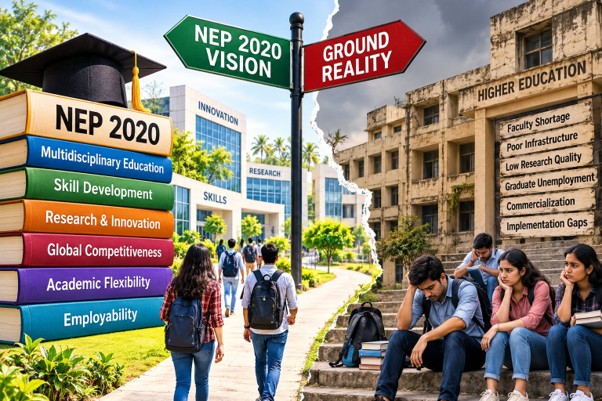
India’s higher education system stands at a critical crossroads. The introduction of the National Education Policy (NEP) 2020 generated considerable expectations of transforming the country’s educational landscape through multidisciplinary learning, skill development, research innovation, academic flexibility and global competitiveness. It promised to make Indian universities centers of excellence and prepare young people for the emerging demands of the 21st century. However, despite these ambitious objectives, the ground realities of higher education continue to raise serious concerns. The gap between policy vision and institutional performance remains a major challenge.
The fundamental question is whether Indian higher education is moving towards meaningful transformation or merely witnessing policy announcements without corresponding institutional improvements.
One of the most serious challenges confronting higher education institutions is the shortage of qualified faculty members. Thousands of teaching positions remain vacant across universities and colleges. Educational institutions cannot achieve academic excellence without adequate, qualified and motivated teachers. Faculty members are the backbone of any educational system, yet recruitment delays, contractual appointments, inadequate remuneration and increasing administrative responsibilities are affecting teaching quality. How can institutions deliver quality education when classrooms lack sufficient permanent teachers?
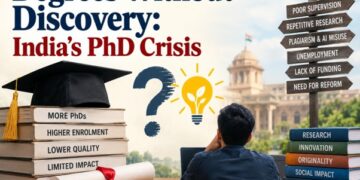
The situation becomes even more concerning when we examine the quality of research and innovation. India has witnessed an increase in PhD enrolments and doctoral degree production, but the expansion of research qualifications does not automatically translate into meaningful discoveries, technological advancement or intellectual contributions. In several institutions, research is increasingly evaluated through publications, citations and degrees rather than originality, social relevance and innovation. The country needs research scholars who can solve real-world problems, develop new technologies and contribute to national development rather than merely fulfil academic requirements.
Another major concern is the employability of graduates. Every year, universities produce a large number of degree holders, but a considerable section of graduates continues to struggle to secure suitable employment. The disconnect between academic curricula and industry requirements remains evident. Many students complete their undergraduate and postgraduate education without acquiring adequate communication skills, critical thinking, digital competence, problem-solving abilities and practical exposure. A degree should open doors to opportunities, not become merely a certificate of academic attendance.
Although NEP 2020 emphasizes skill-based education, vocational training and multidisciplinary learning, implementation requires substantial investment, institutional preparedness and qualified human resources. Merely introducing new courses or modifying curricula cannot guarantee employability. Universities must establish meaningful industry partnerships, strengthen internships, promote entrepreneurship and ensure that students acquire practical competencies alongside theoretical knowledge.
The commercialization of higher education is another issue demanding urgent attention. Education is increasingly becoming expensive, particularly in institutions where financial considerations dominate academic Reform on Paper, Crisis on Campus: India’s Higher Education Challengeiorities. High tuition fees, additional charges and the growing dependence on self-financing programmes can restrict access for economically weaker sections. The purpose of higher education should be knowledge creation, intellectual development and social transformation, not simply revenue generation. Educational institutions must maintain a balance between financial sustainability and their fundamental academic responsibilities.
The digital transformation of education has created new opportunities, but it has also exposed inequalities. Students from rural and economically disadvantaged backgrounds often face difficulties accessing reliable internet connectivity, modern devices and quality digital learning resources. Digital education can become a powerful instrument of inclusion only when the digital divide is effectively addressed.
The international competitiveness of Indian higher education also deserves serious consideration. India has enormous demographic potential, a large pool of talented young people and considerable intellectual resources. Yet, attracting international students, retaining outstanding researchers and developing globally recognized research institutions remain important challenges. Brain drain continues to raise questions about the research environment, professional opportunities and institutional support available to talented individuals within the country.
NEP 2020 provides an important framework for addressing many of these challenges. However, a policy document, irrespective of how ambitious its objectives may be, cannot transform the education system independently. Its success depends on effective implementation, adequate funding, institutional accountability, faculty development and sustained political and administrative commitment.
The government, regulatory authorities, universities and colleges must collectively accept responsibility for translating educational aspirations into measurable outcomes. Vacant faculty positions must be filled through transparent and timely recruitment. Research funding should encourage originality and innovation. Universities must strengthen their industry linkages, improve infrastructure and ensure that academic programmes remain relevant to changing employment requirements.
Equally important is the need to restore dignity, professional security and financial recognition to teachers and researchers. A country cannot aspire to become a global knowledge leader while its intellectual workforce struggles with inadequate salaries, uncertain employment and limited research opportunities.
India’s demographic dividend can become a demographic challenge if its young population receives degrees without the knowledge and skills required to participate meaningfully in economic development. Higher education must therefore move beyond enrolment figures, institutional expansion and degree production. Its real success should be measured through the quality of graduates, research contributions, innovation, employment outcomes and its impact on society.
Ultimately, the challenge before India is not merely to introduce another educational reform but to ensure that existing reforms produce visible results. NEP 2020 has outlined an ambitious vision, but the distance between that vision and institutional reality remains a matter of serious concern.
About the author
Dr. Rajinder Kumar Uppal is an academician, economist, author and researcher with 39 years of experience in higher education and research. He holds a Ph.D. in Economics and Management and a D.Litt. in Business Administration. He has authored 85 books, published 365 research papers, completed seven major research projects and guided 21 Ph.D. scholars. His work focuses on higher education, research quality, banking and finance, and institutional reform. He currently serves as Principal of Sardar Parkash Singh Badal College of Management and Technology, Gidderbaha, Punjab.