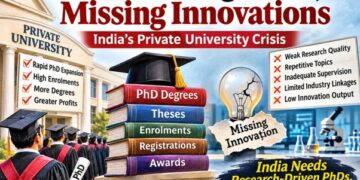

The article argues that private universities must stop exploiting professors through high admission targets, low salaries, excessive administrative duties and continuous management pressure. It calls for fair remuneration, reasonable workloads, academic freedom and professional dignity for faculty members.
The rapid expansion of private universities in India has created new opportunities for higher education, but it has also raised serious concerns about the working conditions, professional dignity and academic freedom of professors. While private universities frequently promote quality education, modern infrastructure, research excellence and professional development, the reality experienced by many faculty members is increasingly challenging. Professors who should devote their time to teaching, research, innovation and student mentoring are being burdened with multiple administrative and non-academic responsibilities. High admission targets, low salaries, excessive workloads and continuous management pressure have become major concerns in sections of the private higher education sector.
One of the most disturbing developments is the transformation of professors into multi-purpose employees. Apart from teaching their subjects, faculty members are expected to prepare compliance reports, maintain accreditation documentation, collect institutional data, update departmental records, organise seminars, coordinate events and complete numerous administrative assignments. Regulatory compliance and accreditation are essential for institutional development, but these responsibilities should be distributed appropriately between academic and administrative departments. When professors spend a substantial part of their working hours preparing files and reports, their capacity to conduct research, publish papers and improve teaching quality is seriously affected.
The situation becomes particularly difficult when high targets are combined with inadequate salaries. Faculty members possessing Ph.D. degrees, research experience and considerable teaching expertise are sometimes expected to perform numerous responsibilities without receiving appropriate financial compensation. Their workload may extend beyond regular working hours, while additional assignments are often treated as routine obligations rather than responsibilities deserving recognition or remuneration. This creates an imbalance between professional expectations and financial rewards. Institutions demanding high productivity must also demonstrate fairness in salary structures and employment conditions.
Another important concern is the increasing corporate approach towards university management. In some institutions, financial performance, enrolment figures and management targets appear to receive greater importance than academic development. Professors may face continuous pressure from management to achieve numerical targets, complete administrative assignments and fulfil institutional expectations. Such practices can create insecurity, frustration and professional dissatisfaction. When faculty members hesitate to express genuine concerns because of contractual uncertainty or fear of adverse consequences, academic freedom and institutional transparency suffer.
The excessive workload also has serious consequences for research and innovation. India aspires to become a global knowledge economy, but meaningful research requires time, intellectual freedom, institutional support and adequate funding. Professors occupied with admission campaigns, compliance documentation, event management and administrative assignments cannot devote sufficient attention to scholarly activities. Research publications, patents, consultancy projects, funded research and interdisciplinary collaborations require sustained academic engagement. If teachers are continuously diverted towards non-academic work, universities may find it difficult to develop a genuine research culture.
The students are also indirect victims of this system. Quality education depends upon meaningful classroom interaction, individual mentoring, practical exposure and continuous academic improvement. Professors who are overloaded with administrative responsibilities may have limited time for personal interaction with students, innovative teaching methods and career guidance. Consequently, the quality of the educational experience may deteriorate. A university cannot achieve academic excellence merely by increasing admissions or preparing impressive institutional reports. Its real achievement lies in developing knowledgeable, skilled and responsible graduates.
Private universities must urgently reconsider their faculty management policies. There is a need for transparent salary structures, reasonable workloads, clearly defined job responsibilities, adequate administrative staff and realistic admission expectations. Faculty evaluation should give priority to teaching quality, research, publications, innovation, student development and institutional contribution. Professors should not be treated as permanent admission agents or administrative assistants. Their qualifications, experience and intellectual contributions deserve appropriate recognition.
Regulatory authorities, particularly the University Grants Commission and other relevant agencies, should pay greater attention to faculty welfare and working conditions. Monitoring should not remain restricted to infrastructure, enrolment and institutional compliance. Salary practices, contractual arrangements, workload distribution, faculty security and academic freedom also deserve serious examination. Private universities must recognise that qualified and motivated teachers are their most valuable institutional resource.
Higher education is not simply a commercial activity; it is a mission of knowledge creation, social development and nation-building. Private universities have an important responsibility in developing India’s human capital, but this responsibility cannot be fulfilled by placing unlimited pressure on professors. High targets cannot justify low salaries, and institutional growth cannot be built upon faculty exploitation. Professors deserve fair remuneration, professional dignity, academic freedom and a supportive working environment. The future of higher education depends not merely on how many students universities admit, but on how effectively they educate, inspire and prepare them for life. A university that exploits its teachers ultimately weakens its own academic foundation.