
CONCERNS:
Low market demand
Soaring freight charges
Lack of compensation
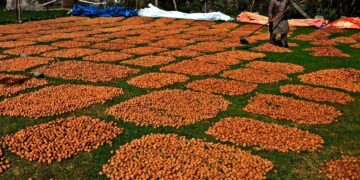
Srinagar, Dec 26: The year 2025 has gone down as the toughest and “most disastrous” year in recent memory for Jammu and Kashmir’s fruit industry, according to growers and traders. They estimated losses of nearly Rs 2,000 crore due to prolonged highway closures, erratic weather, low market demand, “exorbitant” freight charges and the “absence” of any government compensation.
The industry, as per the growers who spoke to the news agency – Kashmir News Observer (KNO), is on the brink, and immediate steps need to be taken for its revival.
August rains trigger ‘unprecedented crisis’
According to growers, the crisis began in the last week of August, when continuous and heavy rains triggered landslides at multiple locations, forcing the closure of the Srinagar–Jammu National Highway for nearly a month, right at the peak of the apple harvesting season.
“This was the worst possible time for such a disaster. Apples were ready for dispatch, orchards were full of produce, but the highway remained shut. Thousands of trucks carrying fresh fruit were stranded for days and weeks. By the time they reached markets outside the Valley, a large portion of the produce had already rotted,” they said.
Growers said apples continued to pile up in orchards and mandis as repeated highway closures due to landslides and repair works choked the only major all-weather surface link with the rest of the country. As supply chains collapsed, market arrivals became erratic, leading to a steep crash in prices.
“Farmers who invested their life savings, took loans and worked the entire year were left with no option but to sell their produce at throwaway prices. Many couldn’t even recover the cost of harvesting and packaging,” Bashir Ahmad Basheer, President of Kashmir Valley Fruit Growers Cum Dealers Union, said.
Mughal Road no match for highway closure
With the national highway closed, the Mughal Road was used as an alternative route, but growers said it proved grossly inadequate.
“Only small trucks were allowed on Mughal Road, which made large-scale transportation impossible. Even then, vehicles were given turns after two or three days,” Basheer said.
He said freight charges on the Mughal Road were three to four times higher than normal, further eating into already shrinking margins.
“In desperation, some growers even used small load carriers to transport fruit up to Rajouri. From there, the produce was reloaded onto trucks for onward transportation. This not only increased costs but also damaged the quality of fruit,” the Union leader said.
‘2025 exposed structural vulnerabilities’
Growers said they had never witnessed such a bad year for the fruit industry.
They said that even during past disruptions or political turmoil, the losses were not this massive. “In 2025, everything went wrong at once—weather, roads, markets and policy support,” they lamented.
While the industry has been grappling with multiple challenges for years, 2025 exposed its structural vulnerabilities. “Every year, new diseases are emerging in orchards. Fake pesticides and substandard fertilisers have flooded the market, damaging crops instead of protecting them. Despite all this, apple prices continue to remain low year after year,” growers said.
Cold storages a boon, but too few
Growers acknowledged that Controlled Atmosphere (CA) and cold storage units have emerged as a major relief for the sector, helping farmers store produce and avoid distress sales. However, they said the number of such units remains insufficient.
“Cold storages are a boon, but they are too few compared to the volume of production. Moreover, many units operate as per their own will rather than government guidelines,” they said.
Growers demanded that cold storage units be regulated strictly and urged authorities to establish 200–300 additional CA and cold storage facilities across the Valley.
KVFG also reminded CA store owners to adhere to the 2024 decision allowing growers to use their own packaging material (bardanna) if they wish.
No compensation despite massive losses
One of the strongest grievances raised by the growers is the “complete absence” of compensation from the government despite losses running into thousands of crores, Basheer alleged, adding that the industry suffered Rs 2,000 crore losses.
Basheer added, “The KVFG had time to time placed a detailed charter of demands before the government, including immediate Rs 2,000 crore relief package for affected growers, introduction of a crop insurance scheme for horticulture, Revival and strengthening of the Market Intervention Scheme (MIS), especially for Grade B and C produce, Declaration of Mughal Road as a National Highway and construction of additional alternative routes, waiver of Kisan Credit Card (KCC) loans and interest exemption on farmer loans, Abolition of municipal chungi on fruit transportation, Establishment of fully equipped fruit mandis, Standardisation of packaging (bardanna) and Strict quality control on pesticides and fertilizers and a ban on artificial colouring chemicals.”
We had also called for effective quarantine measures for high-density plantation rootstock to prevent the entry of infected plants into the Valley, he added.
Horticulture expansion continues despite challenges
Interestingly, despite the mounting challenges, the shift from traditional agriculture to horticulture continues unabated in Jammu and Kashmir.
According to officials, around 1,000 hectares have already been brought under high-density orchards, and the government plans to bring an additional 5,500 hectares under such plantations in the coming years.
“This shows people’s faith in horticulture as a livelihood option. But unless infrastructure, insurance and market support improve, this expansion could expose farmers to even greater risks,” growers warned.
Industry at breaking point
Growers said the fruit economy—which employs lakhs of people directly and indirectly and forms the backbone of Jammu and Kashmir’s rural livelihood—is at a breaking point.
“If urgent corrective measures are not taken now, the damage will not be limited to one season. It could permanently weaken the horticulture sector,” they said, urging the government to act without further delay. (KNO)