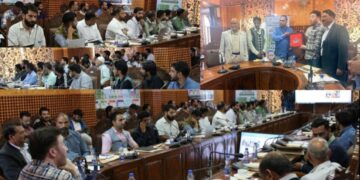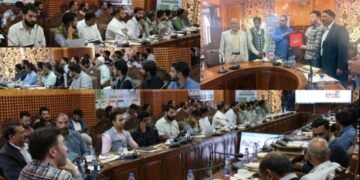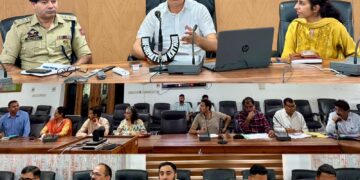

JAMMU, DECEMBER 27: Under the patronage of Chief Justice, High Court of Jammu & Kashmir and Ladakh (Patron-in-Chief, J&K Judicial Academy), Justice Arun Palli and guidance of Chairperson and members of the Governing Committee for J&K Judicial Academy, the Jammu & Kashmir Judicial Academy on Saturday began a 2 day orientation programme on Protection of Children from Sexual Offences (POCSO) Act, 2012, with reference to SAMVAD’s Training Manual on “Essential Interventions and Skills for Working with Child Sexual Abuse – Introducing Mental Health and Legal Dimensions of Forensics” and the National Judicial Academy’s Training Module for Fast Track Special Courts, at Convention Centre, Canal Road, here.
Justice Rajnesh Oswal, Judge, High Court of Jammu & Kashmir and Ladakh (Chairperson, Governing Committee for J&K Judicial Academy) inaugurated the orientation programme.
In his inaugural address, Justice Oswal, as per an official statement, underscored that children are the most vulnerable participants in the judicial system and must be dealt with utmost empathy and sensitivity.
Addressing the judicial officers and other stakeholders, Justice Oswal observed that offences against children leave deep and lasting scars. “Child trauma is not a static event; it creates ripples that affect the child’s entire future, family and society at large,” he remarked.
While stressing the importance of expeditious disposal of POCSO cases, Justice Oswal cautioned that “fast-track injustice is not justice at all”, reiterating that speed must never compromise fairness, due process or sensitivity towards the child victims. Justice Oswal called upon all stakeholders to act as guardians of child rights, ensuring that the courts remain safe, reassuring and child-friendly spaces for children seeking justice.
Justice Rahul Bharti, Judge, High Court of Jammu & Kashmir and Ladakh (Member, Governing Committee for J&K Judicial Academy), in his special address, underscored the responsibility of courts and allied stakeholders in protecting the dignity and best interests of the child.
Justice Rahul Bharti observed that we live in a society where our children need protection and the responsibility cast upon the stakeholders reflects their commitment towards this cause.
Referring to landmark judicial pronouncements, he emphasised a child-centric and sensitive approach in dealing with POCSO cases.
Citing real-life courtroom experiences, Justice Bharti highlighted that insensitive handling can aggravate a child’s trauma. He stressed the need for empathy, child-friendly courts and adherence to due process to truly safeguard child rights.
The first technical session on day one commenced with an overview of the POCSO Act, 2012, delivered by Dr. Humayun Rasheed Khan, Senior Judicial Officer and Professor, National Judicial Academy, Bhopal. He explained the main objectives of the Act, which aims to protect the children from sexual abuse, exploitation and harassment.
He highlighted the key provisions including definitions of offences, procedures for age determination, standards of consent and mandatory reporting obligations.
Subsequent sessions were conducted by Saurabh Shashi Ashok, Resource Person Health (Policy & Law), Initiative for Child Protection and Mental Health, Azim Premji Foundation. He provided a comprehensive understanding of child sexual abuse through a psychosocial lens, forensic dimensions of child sexual abuse cases and essential interventions and skills for working with child victims.
The sessions sensitized the participants to trauma-informed interviewing, rapport building, avoidance of secondary victimisation, evidence preservation, inter-agency collaboration and victim compensation mechanisms.
Naseer Ahmad Dar, Director, J&K Judicial Academy formally gave the introduction of the programme. He said that the POCSO Act embodies a solemn commitment of the legal system to protect the children from sexual abuse and exploitation, ensuring a process that is not only legally sound but also sensitive, child-friendly and trauma-informed.