Key takeaways
- The total expenditure for Biomedical Research Career Programme Phase-III amounts to ₹1500 crore
- The initiative targets training 2,000+ researchers, high-impact publications, patentable discoveries, and peer recognition.
- Aims for 10–15% more support for women scientists, pushing 25–30% projects reaching Technology Readiness Level (TRL-4) andabove, and wider Tier-2/3 outreach.
- Phase II programme had 90 international and national recognitions
Press Information Bureau
India stands at the cusp of a biotechnology-driven revolution, where biomedical research is emerging as a cornerstone for national growth and global leadership. Over the past decade, the Department of Biotechnology (DBT) has spearheaded innovation, entrepreneurship, and capacity-building in alignment with flagship national missions such as Atmanirbhar Bharat, Swasth Bharat, Startup India and Make in India.These sustained efforts have propelled India to become one of the fastest-growing bioeconomies in the world
Building on this momentum, the Union Cabinet has approved Phase III of the Biomedical Research Career Programme (BRCP), to be implemented during 2025-26 to 2030-31, with an extended service phase up to 2037-38. BRCP aims to build a world-class research ecosystem in biomedical sciences, clinical, and public health research. The programme supports scientists at different stages of their careers through fellowships and collaborative grants, encouraging high-quality, ethical research to tackle key public health challenges in India. It also promotes diversity, inclusion, and international competitiveness, while helping translate research into action, innovation, and policy change.
The Department of Biotechnology in partnership with the Wellcome Trust (WT), UK, launched the “Biomedical Research Career Programme” (BRCP) in 2008-2009 through the DBT/Wellcome Trust India Alliance (India Alliance), a dedicated Special Purpose Vehicle (SPV), with the approval of the Cabinet, offering research fellowships, based in India, for biomedical research at the world class standards. Subsequently, Phase II was implemented in 2018/19 with an expanded portfolio, and now Phase III of the programme has been approved by the Cabinet
Importance of the Biomedical Research Career Programme
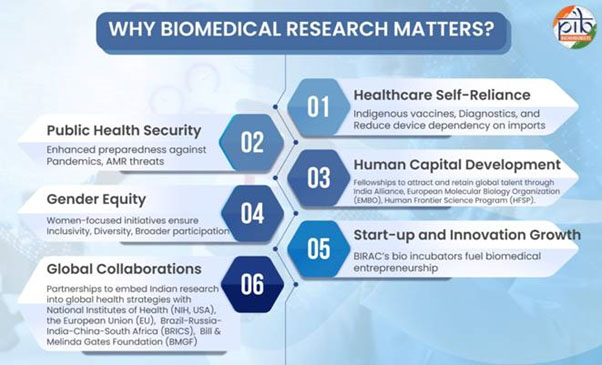
The biomedical ecosystem spans research, clinical innovation, technology, and public health, delivering benefits including affordable healthcare, better disease preparedness, improved nutrition, and personalized medicine. A pictorial representation provided below highlights the diverse benefits of the multi-dimensional biomedical ecosystem.
From Labs to Lives: Key Aims of India’s Biomedical Research Programme
BRCP supports world-class biomedical research fellowships in India. It aims to nurture top-tier scientific talent, foster interdisciplinary and translational research, and strengthen research management and systems to reduce regional disparities in scientific capacity. The main objective behind this programme are as follows:
Attract world-class researchers in biomedical and clinical sciences to establish research programmes in Indian institutions and universities, while fostering fulfilling and sustainable research careers.
Fund cutting-edge research of international standards through initiatives that promote independence and career advancement of exceptional early-career researchers in India.
Promote open and ethical research ecosystems by supporting programmes that build awareness and provide training in allied fields such as research management, science administration, and regulatory affairs.
Broaden the reach of India Alliance by expanding activities to new regions and under-served research communities across the country.
BCRP Phase II: 700+ Grants and International Recognition
BRCP Phase-II was designed to attract globally competitive researchers in biomedical and clinical sciences to India. The programme had achieved significant success in its first two phases. A total investment of ₹2,388 crore was made under the scheme, resulting in the award of 721 research grants.
The objective of the mission for the second phase was to “enable biomedical research in India through funding and engagement.”
The objectives under Phase II includes:
Empowering researchers to achieve international competitiveness and emerge as future leaders in India.
Bridging gaps in research management and fostering stronger connections between science and society.
Promoting excellence in science by ensuring diversity, inclusivity, and transparency.
Scaling India’s Biomedical Capacity: BRCP Phase-III Roadmap
The Biomedical Research Career Programme Phase-III marks a major expansion in India’s commitment to building biomedical research capacity of global standards. Key features include:
Financial Outlay & Partnership
The Programme will be implemented with a total outlay of ₹1,500 crore. Of this, the Department of Biotechnology under the Ministry of Science & Technology, will contribute ₹1,000 crore, while the Wellcome Trust (UK) will contribute ₹500 crore. This unique model of co-investment reinforces India’s commitment to fostering international collaborations in science and technology while ensuring sustained support for domestic research talent.
Timeframe & Structure
2025–26 to 2030–31: Active implementation period during which new research fellowships, collaborative grants, and capacity-building initiatives will be rolled out.2031–32 to 2037–38: Servicing period for continuing support of fellowships and grants already awarded ensuring long-term continuity and completion of projects.
Attract Talent and Career Support
Phase-III of the BRCP aims to further strengthen India’s research ecosystem through targeted support across career stages and research domains:
Early Career and Intermediate Research Fellowships: Offered in basic, clinical, and public health research, these fellowships are internationally recognized and designed to nurture scientists at the formative stages of their research careers.
Collaborative Grants Programme: Comprising Career Development Grants and Catalytic Collaborative Grants, this programme supports 2–3 investigator teams, targeting early to mid-senior career researchers with a proven research track record in India.Research Management Programme: Focused on reinforcing core research capacities, this initiative strengthens the infrastructure, administration, and management of scientific projects.
In addition, Phase-III emphasizes mentorship, networking, public engagement, and the establishment of innovative national and international partnerships to enhance the overall impact and sustainability of biomedical research in India.
Expected Outcomes
By training over 2,000 students and post-doctoral fellows, enabling high-impact publications, generating patentable discoveries, and pushing 25–30% of collaborative programmes to Technology Readiness Level (TRL-4) andabove, Phase-III is expected to set new benchmarks for biomedical excellence in India. The programme will also provide a 10–15% increase in support to women scientists, encouraging greater inclusivity in India’s research ecosystem.
The initiative is directly aligned with the national vision of Viksit Bharat 2047, positioning India as a global hub for biomedical innovation and translational research.
From Innovation to Transformation: Lasting Impacts of the Programme
Over the last two decades, India’s biomedical research initiatives have achieved significant milestones:
70+ COVID-19 projects funded
The Biomedical Research Career Programme (BRCP) supports multi-disciplinary research to develop affordable and innovative healthcare solutions in diagnostics, therapeutics, vaccines, and assistive technologies. It provided the strategic framework for India’s COVID-19 research response, which included 10 vaccine candidates, 34 diagnostic tools, and 10 therapeutic interventions—aligning the urgent pandemic response with BRCP’s long-term goal of strengthening India’s biomedical innovation ecosystem.
World’s first oral cancer genomic variant database
The DBT-National Institute of Biomedical Genomics (NIBMG) has developed dbGENVOC, the world’s first publicly accessible oral cancer genomic variant database. It hosts over 24 million variants from Indian patients, alongside global data, and includes powerful tools for searching and analysis. Updated annually with data from across India and Southeast Asia, dbGENVOC supports research into oral cancer pathways—especially important for India, where the disease is the most common cancer among men due to tobacco chewing. By identifying population-specific genetic mutations, dbGENVOC is a vital step toward better prevention, diagnosis, and treatment.
National AMR Mission
The Antimicrobial resistance (AMR) mission was launched in collaboration with World Health Organization (WHO) for pathogen surveillance. It adopts a One Health approach to combat antimicrobial resistance by supporting R&D on new antibiotics, alternatives, and diagnostics, establishing a national bio-repository of resistant microbes, creating India’s AMR pathogen priority list with WHO, and partnering globally through the AMR R&D Hub to strengthen innovation against drug-resistant infections.
Biorepositories and clinical trial networks
Biorepositories and clinical trial networks have been established across India to strengthen the ecosystem for translational research. These platforms enable systematic collection, storage, and sharing of high-quality biological samples and data. Together, they accelerate the movement of innovations from laboratory discoveries to clinical applications for patient benefit.
Women in Biomedical Research
The Department of Biotechnology (DBT) is committed to advancing women’s participation in biomedical research. The BioCARe programme offers first independent research grants to women scientists, while the Janaki Ammal Awardhonors excellence in biomedical research by senior and young women researchers. BIRAC’s WInER Award and women-focused bioincubators support women-led biotech startups. DBT also co-hosts the Women Leaders in Global Health Conference to promote leadership and collaboration. These efforts drive inclusivity, innovation, and excellence in India’s biomedical research ecosystem.
Mapping the Future of Medicine: Focus Fields in Research
India’s biomedical research spans multiple critical areas, aiming to deliver affordable, innovative, and inclusive healthcare solutions. Key focus fields include:
Human Genetics & Genomics
Programmes like GenomeIndia and UMMID are mapping India’s unique genetic landscape to improve early diagnosis and treatment of inherited diseases. GenomeIndia has sequenced 10,000 genomes, enabled precision medicine and reduced dependence on international databases. UMMID focuses on rare disorders in children and newborns. These initiatives are laying the foundation for predictive, preventive, and personalized healthcare in India.
Infectious Disease Biology (IDB)
The IDB programme targets major diseases like HIV, TB, malaria, hepatitis, and emerging infections like COVID-19 and dengue. It supports large-scale cohort studies, national biobanks, and translational research to develop timely, affordable solutions. Breakthroughs include the Dengue Day 1 test and HIV Tri-Dot+Ag test. These efforts enhance India’s preparedness for future epidemics.
Vaccines
The Indo-US Vaccine Action Programme (VAP), established in 1987, supports vaccine development for diseases like TB, dengue, malaria, and COVID-19. Landmark successes include ROTAVAC®, India’s first indigenous rotavirus vaccine, and Covaxin, developed with DBT support. The programme also strengthens clinical trial pipelines and international collaborations, advancing India’s vaccine self-sufficiency and global leadership.
Diagnostics & Devices
Innovations like CRISPR-based diagnostics, indigenous RT-PCR kits, and affordable medical devices are making healthcare more accessible. These tools support early, accurate diagnosis while reducing costs and import dependency. Rapid tests for dengue, COVID-19, and other diseases have been deployed widely. The focus is on self-reliant, scalable technologies for public health impact.
Therapeutics & Drug Repurposing
This area accelerates the development of new medicines and repurposes existing drugs for faster deployment. Drug repurposing reduces costs and shortens timelines for treatment approval. The goal is to deliver effective, affordable therapies tailored to India’s needs.
Biomedical Engineering & Biodesign (BME)
Develops affordable implants, assistive devices, and medical instruments through engineering-clinical collaboration, reducing import dependency and enhancing access to advanced care.
Stem Cells & Regenerative Medicine (SCRM)
The programme supports work on cell-based therapies, tissue regeneration, and drug delivery models to improve treatment options for patients. These approaches open new possibilities for treating chronic and hard-to-cure diseases in a safer and more efficient way.
Maternal & Child Health (MCH)
The GARBH-ini programme focuses on understanding preterm birth—a leading cause of infant mortality—and developmental diseases. It studies biological and environmental risk factors through large-scale cohort studies. The findings aim to improve clinical guidelines and public health policies. This work supports better maternal care and healthier childhood outcomes.
Marine & Aquaculture Biotechnology (MAB)
The Marine & Aquaculture Biotechnology (MAB) programme harnesses aquatic resources to improve health and sustainability. It develops fish vaccines to protect aquaculture, explores bioactive compounds from marine organisms for new drugs and therapies, and promotes nutraceuticals like omega-3 from marine sources to enhance human health.
Public Health & Nutrition (PHN)
The programme aims to improve public health by addressing key challenges like antimicrobial resistance (AMR), lifestyle diseases (diabetes, hypertension, obesity), and malnutrition. It supports research to develop affordable, science-based solutions that strengthen health systems and promote healthier communities.
Conclusion
The Biomedical Research Career Programme (BRCP) is a strategic investment in India’s health and innovation landscape, supported by a ₹1,500 crore Indo-UK partnership that aligns global expertise with national priorities. By nurturing top scientific talent, advancing interdisciplinary and translational research, and strengthening research ecosystems, BRCP Phase-III aims to bridge regional disparities and promote inclusivity—especially for women scientists.
Beyond capacity-building, BRCP’s tangible outcomes—training over 2,000 scientists, generating patentable innovations, and advancing technologies to TRL-4 and beyond—will directly contribute to India’s Viksit Bharat 2047 vision. In tandem with the BioE3 initiative, BRCP is helping to transform India’s biomedical ecosystem into a globally competitive, innovation-driven engine for health security and economic growth.
Biomedical research in India is already delivering results: low-cost diagnostics like CRISPR-based kits and dengue rapid tests, indigenous vaccines for pneumonia, measles-rubella, and COVID-19, and personalized treatments powered by the GenomeIndia project. Affordable implants, ventilators, and PPE are reducing import dependency, while national AMR tracking, disease databases, and biorepositories are strengthening public health systems. In parallel, research on nutraceuticals and bioactive compounds is enhancing nutrition and preventive care.
Together, these efforts are making healthcare more accessible, equitable, and self-reliant, and positioning India as a global leader in biomedical innovation.