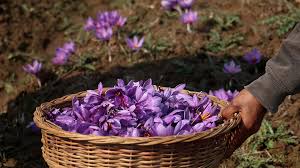
Srinagar, Nov 07: would not have collapsed like this,” said another farmer, Javaid Ahmad, from Pampore. “When the corm stays dry during spring, autumn and even summer, its root decays, and when the root is damaged, how can you expect flowers?”
Growers are now demanding that the government must investigate the much–hyped National Saffron Mission, a centrally funded project worth over Rs 400 crore, which was launched in 2010 to address issues of irrigation, quality corms and scientific cultivation.
“We want to know where this money has gone and what the outcome of this Mission actually is,” said a grower, Mohammad Iqbal. “There is nothing visible on the ground. This Mission has completely failed.”
Even though the Mission was later extended by two more years, farmers say the promised benefits never materialised and saffron land continues to be converted for other use.
Although the agriculture department data initially showed a steady rise in saffron yield between 2010 and 2014, farmers said the sector never recovered after the 2014 floods. Multiple years of severe dry spells dealt additional blows.
In 2024, production was already at just around 30 per cent of the normal crop, and this year, the production is just below 10 per cent, according to growers.
Official data also shows that land under saffron cultivation has shrunk from 5,707 hectares in 1996–97 to 2,387 hectares in 2019–20— a 65% reduction, and production fell from 17.33 MT in 2021 to 14.87 MT in 2022, and marginally improved to 14.94 MT in 2023, but last year’s real output was only around 30% of expected production.
Farmers said irrigation availability, providing quality corms and stopping land conversion are urgently needed steps if the sector is to survive. They warned that if immediate measures are not taken, there will be no saffron left here in a few years—(KNO)