
‘Modi Govt has completely modernised all five pillars of justice system’
New Delhi, Jan 03: Union Home Minister and Minister of Cooperation, Amit Shah, on Saturday highlighted the transformative impact of the recent criminal laws and forensic reforms on India’s justice system.
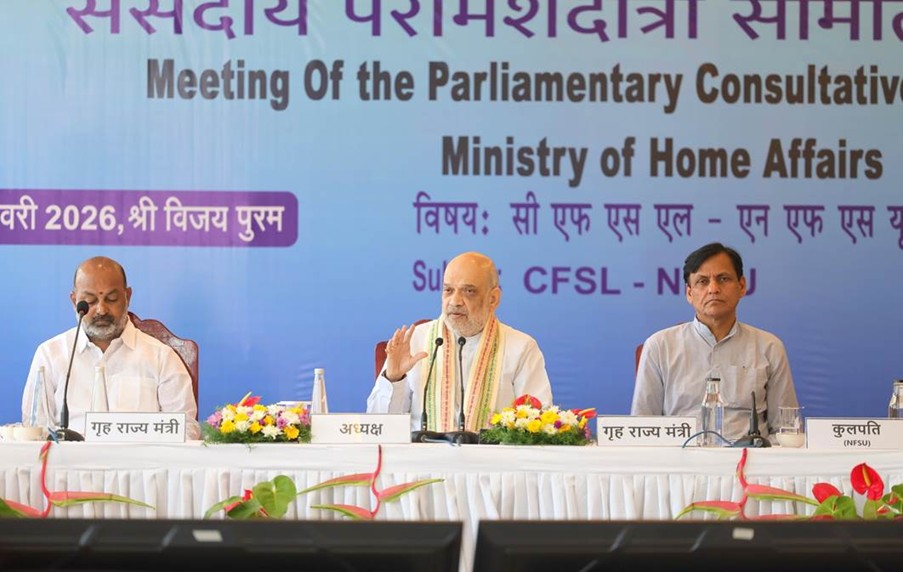
Shah was addressing a meeting of the Parliamentary Consultative Committee of the Ministry of Home Affairs at Sri Vijaya Puram in Andaman and Nicobar Islands. The meeting focused on the advancements and future plans for the Central Forensic Science Laboratory (CFSL) and the National Forensic Sciences University (NFSU).
Shah began by underscoring the government’s comprehensive efforts since 2019, emphasizing the importance of Prime Minister Narendra Modi’s vision for timely justice. He announced that the government aims to complete the entire judicial process—from FIR to the Supreme Court—within three years by 2029, a goal driven by ongoing reforms and technological advancements.
Addressing the impact of the new criminal laws, which came into effect in July 2024, the Union Home Minister pointed to the positive results seen so far. He cited cases from West Bengal and Bihar where investigations into heinous crimes, such as rape and triple murders, were concluded within 50 to 62 days, showcasing the speed and efficiency these laws have facilitated. These examples, he said, prove that the reforms are yielding tangible results, though there is still room for strengthening the system further.
Shah detailed the key criminal laws introduced, emphasizing their role in reducing legal ambiguities. He highlighted that digital evidence, cybercrime, terrorism, organized crime, and crimes against women and children have been clearly defined in the new legislation, thereby streamlining prosecution and judicial processes. The introduction of e-FIRs and Zero FIR has provided significant relief to the poor and women, ensuring faster access to justice.
The Union Home Minister also elaborated on the technological strides made under these reforms. He informed that by November 2025, every police station in India will be online via the Crime and Criminal Tracking Network and Systems (CCTNS), with data from over 36 crore legacy cases and 7 lakh FIRs now accessible on central servers. The data infrastructure encompasses fingerprints, narco offenders, human traffickers, and terrorism cases, significantly bolstering investigative capabilities.
Shah highlighted the government’s focus on forensic science, noting the establishment of eight new CFSLs and the strengthening of state forensic labs through a Rs. 1,000 crore grant. The IT platform for e-Forensics has been launched, connecting 143 laboratories nationwide. He reiterated the government’s long-term vision of creating an integrated forensic structure, with plans to train 35,000 students at NFSU by 2029 and nearly tripling trained officers in the next four years.
The Minister also lauded the role of NFSU, which has registered 46 patents and signed MoUs with 96 countries and 117 organizations, fostering innovation and global cooperation in forensic sciences.
Amit Shah reaffirmed that the recent criminal laws and forensic reforms are already showing promising results, and the government remains committed to delivering swift justice through the integration of technology, scientific advancements, and dedicated institutional efforts.