Key Takeaways
- Launched in 2018, Pariksha Pe Charcha (PPC) is an annual nationwide interactive initiative where the Prime Minister engages with students, teachers and parents on examinations, life skills and well-being.
- PPC promotes stress-free examinations, emotional resilience, and holistic development, aligning with National Education Policy 2020’s experiential and conceptual learning framework.
- PPC encourages students to view exams positively, promoting confidence, disciplined preparation, and resilience through the ‘Be a Warrior, Not a Worrier’ mindset.
- 2025 Benchmark: PPC 2025 recorded over 5 crore participants and achieved a Guinness World Record with 3.53 crore registrations, marking its largest global engagement milestone.
- Pan-India Expansion 2026: PPC 2026 introduced multi-city interactions across five regions, with interactive sessions held at Devmogra, Coimbatore, Raipur, Guwahati and 7 Lok Kalyan Marg, Delhi, strengthening inclusivity and regional representation.
Introduction: The Dawn of the “Exam Warrior”
Pariksha Pe Charcha (PPC), launched in 2018 by Prime Minister Narendra Modi, is a nationwide initiative aimed at reducing examination stress and promoting holistic learning among students. Conducted by the Department of School Education and Literacy, Ministry of Education, PPC provides a unique platform where the Prime Minister interacts directly with students, teachers and parents, encouraging a confident and positive approach towards examinations. The programme has evolved into a mass movement, with the 2025 edition witnessing participation of over 5 crore students, teachers and parents, reflecting its extensive nationwide reach. PPC promotes time management, emotional well-being, balanced lifestyles and conceptual learning, aligning with the Government’s vision of student-centric education under the National Education Policy.
The 9th edition of Pariksha Pe Charcha (PPC 2026) has further expanded participation, crossing over 4.5 crore registrations from students, parents and teachers across the country, underscoring its continued relevance in addressing examination-related stress and promoting student well-being. As part of the run-up to PPC 2026, nationwide student engagement activities were organised from 12 January 2026 (National Youth Day) to 23 January 2026 (Parakram Diwas). The activities commenced with the Swadeshi Sankalp Daud, promoting self-reliance among students, and culminated with quiz and writing competitions at selected Kendriya Vidyalayas, further strengthening student participation and awareness.
The initiative reflects the core principles of the National Education Policy (NEP) 2020, which promotes stress-free, experiential and conceptual learning in place of rote memorisation. Through interactive interactions, the Prime Minister highlights critical aspects such as effective time management, managing digital distractions, maintaining mindfulness and building emotional resilience, while providing practical and relatable guidance to students, parents and educators.
INTERESTING HIGHLIGHTS OF PARIKSHA PE CHARCHA 2026
Special Interactions at 7 Lok Kalyan Marg (LKM)
Pariksha Pe Charcha 2026 featured several memorable and engaging moments during the interaction from 7 Lok Kalyan Marg, New Delhi. The 2026 edition recorded over 4.5 crore registrations, with an additional 2.26 crore participants engaging in associated activities, taking the overall participation to over 6.76 crore individuals.
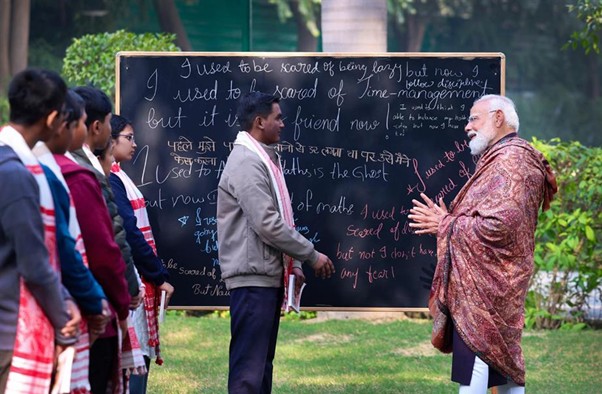
The Prime Minister surprised students during breakfast, significantly enhancing their enthusiasm and energy. He also presented Assamese gamosas to the students as a gesture reflecting India’s cultural diversity. Students actively shared their fears related to examinations and discussed strategies to overcome them. Many participants also shared insights from the Exam Warriors book, highlighting how its messages help them manage stress and improve focus. The students presented the Prime Minister with several thoughtful gifts, including handmade bouquets, a veena crafted from recycled materials, Assamese gamosas, organic tea leaves from Sikkim and traditional sweets, reflecting creativity and cultural richness.
Nationwide Expansion of PPC
The 2026 edition marks a historic expansion of PPC into a truly pan-India programme. For the first time, interactions are conducted across multiple locations covering different regions of the country, including Coimbatore (Tamil Nadu), Raipur (Chhattisgarh), Devmogra (Gujarat), Guwahati (Assam) and New Delhi.
One of the most distinctive interactions took place in Assam, where the session was conducted aboard a cruise on the Brahmaputra River, symbolising regional representation and innovative outreach.
Scale and Participation: From Initiative to Jan Andolan
PPC began modestly in 2018 as a town-hall style event at Talkatora Stadium in New Delhi, where over 2,500 students participated in person, and an estimated 8.5 crore viewers tuned in via Doordarshan, TV, and radio. The inaugural edition focused on holistic development and resilience, setting the tone for what would become an annual tradition.
By 2019, the event expanded, lasting over 90 minutes and incorporating humor to engage participants. The 2020 edition introduced an online competition with 2.63 lakh entries from India and 25 countries abroad, emphasizing challenges as opportunities for growth.
The program adapted remarkably during the COVID-19 pandemic. In 2021, it shifted entirely online on April 7, highlighting adaptability and resilience in uncertain times. Returning to in-person format in 2022 at Talkatora Stadium, New Delhi, it drew around 9.69 lakh student viewers, 47,200 employees, and 1.86 lakh parents live on TV and YouTube.
The 2023 edition, held on January 27, saw close to 7.18 lakh students, 42,337 employees, and 88,544 parents watching live, reinforcing its role in stress management.
By 2024, PPC moved to Bharat Mandapam in a town-hall format with around 3,000 participants, including 100 students from Eklavya Model Residential Schools (EMRS) for the first time, and garnered 2.26 crore registrations on the MyGov portal.
The 2025 edition marked a new benchmark with over 5 crore participants, earning a Guinness World Record for 3.53 crore registrations. It featured seven episodes with renowned personalities and 36 students from diverse schools across all states and union territories.
Now in its 9th edition in 2026, PPC has surpassed 4.5 crore registrations, with some reports indicating engagement reaching over 6.76 crore participants.
This exponential growth, from thousands to crores, illustrates PPC’s transformation into a Jan Andolan, or people’s movement, driven by PM Modi’s vision to unite society in nurturing young talent.
The Format: Engaging and Inclusive Interactions
PPC’s format is designed to be accessible and interactive, starting with an online MCQ-based competition on the MyGov portal for selection. Winners get the chance to interact directly with Prime Minister Shri Narendra Modi, sharing questions on exams, life skills, and personal growth. The main event typically unfolds in a town-hall setting, but innovations have added depth. In 2025, it began at Sunder Nursery in Delhi, an open-air venue emphasizing connection with nature, and included distributing til-gud sweets[1] for warmth during winters.
The initiative seeks to transform examination stress into confidence by promoting creativity, self-belief and a positive learning approach. It encourages participants to share ideas and express creativity, contributing to a nationwide movement that makes education more engaging and empowering.
Run-up activities for 2026, from January 12 to 23, included student-led events like the Swadeshi Sankalp Daud (a run promoting self-reliance) on Swami Vivekananda Jayanti, and quizzes on Netaji Subhas Chandra Bose Jayanti. These tie into national themes, making PPC more than an event, it’s a cultural celebration. A fresh angle in 2026 is its multi-location format of interactions, with special episodes in cities like Devmogra, Coimbatore, Raipur, Guwahati, and Delhi’s 7 Lok Kalyan Marg. This decentralized approach brings the dialogue closer to regional students, highlighting diverse experiences and fostering inclusivity.
Exploring New Dimensions: Expanding the Scope of Learning through Pariksha Pe Charcha
Pariksha Pe Charcha (PPC) has steadily evolved beyond a dialogue on examinations into a platform that connects education with life skills, social awareness and personality development. Its expanding themes reflect a broader approach to student growth, encouraging young learners to develop responsible, balanced and future-ready perspectives.
Integrating Environmental Awareness PPC increasingly emphasises environmental responsibility, encouraging students to link learning with sustainability and lifestyle choices. The “Ek Ped Maa ke Naam” campaign, highlighted during interactions, motivates students to plant trees in honour of their mothers, fostering an emotional bond with nature and promoting conservation. The initiative aligns with the Government’s Mission LiFE (Lifestyle for Environment), encouraging sustainable habits and responsible use of natural resources, while nurturing environmental stewardship among students.
Promoting Holistic Wellness PPC consistently highlights the importance of physical and mental well-being alongside academic preparation. Students are encouraged to adopt healthy dietary habits, balanced lifestyles and mindfulness practices to manage stress effectively. Wellness techniques such as breathing exercises and mindful eating are promoted to improve focus, reduce anxiety and enhance overall health, reinforcing the link between academic success, physical fitness and emotional stability.
Encouraging Responsible Use of Technology PPC recognises the growing influence of digital platforms and addresses challenges of excessive screen time and digital distractions. Students are encouraged to practise periodic digital detox or digital fasting to improve concentration, strengthen interpersonal communication and enhance family bonding. The initiative promotes technology as a constructive learning tool, encouraging purposeful use of digital resources instead of distraction.
Alignment with National Education Policy 2020 PPC strongly complements the vision of the National Education Policy (NEP) 2020, which promotes joyful, inclusive and experiential learning. The programme supports national education initiatives such as Samagra Shiksha and PM-SHRI Schools, which aim to enhance the quality and accessibility of education across the country. By encouraging conceptual understanding, creativity and equal opportunities, PPC reflects NEP’s focus on equitable and student-centric education.
Promoting Inclusivity and Regional Representation PPC promotes inclusive participation by bringing together students from diverse socio-economic backgrounds, regions and school systems, reflecting India’s educational diversity. The 2026 edition adopted a pan-India format, with interactive sessions held at Devmogra, Coimbatore, Raipur, Guwahati and 7 Lok Kalyan Marg, Delhi, enabling students to share region-specific educational challenges. The edition recorded over 4.5 crore registrations, with total engagement exceeding 6.76 crore participants, including students, parents and teachers, highlighting PPC’s growing nationwide trust and relevance.
Making Learning Relatable through Real-life Analogies PPC uses relatable examples from sports, daily life and inspirational stories to simplify complex ideas. Analogies such as maintaining focus like a cricketer or narratives highlighting cooperation among Divyang students help communicate the importance of perseverance, teamwork and healthy competition. These examples encourage students to view challenges as opportunities for growth rather than obstacles.
Nurturing Leadership and Personal Development Beyond academic guidance, PPC emphasises leadership and character-building. The initiative promotes values such as self-discipline, trust-building and organic talent development. By encouraging students to lead by example and support peers, PPC helps nurture responsible and confident individuals prepared to contribute positively to society.
Through these expanding dimensions, Pariksha Pe Charcha has transformed into a dynamic platform that addresses not only examination preparedness but also broader life skills, social responsibility and personal growth, shaping well-rounded and future-ready.
Cultivating a Positive Mindset
Psychosocial Well-being: PPC has strengthened student mental well-being by complementing the Government’s Manodarpan initiative, a national psychosocial support and mental health helpline under the Ministry of Education. By encouraging open conversations on examination anxiety and academic pressure, PPC has helped reduce stigma around seeking help and empowered students to openly discuss expectation-related stress.
Time Management and Micro-Planning: PPC interactions have promoted practical time-management techniques. The Prime Minister’s reference to “mothers as time-management role models” has encouraged students to adopt structured study planning, prioritise difficult subjects and reduce last-minute examination stress.
The ‘Exam Warrior’ Philosophy: Inspired by the book Exam Warriors, PPC promotes a positive learning mindset built on confidence, discipline and resilience. Campaign themes such as “Be a Warrior, Not a Worrier” have reinforced the message of approaching examinations with optimism and self-belief, gaining wide engagement across Government digital platforms.
Conclusion: A Lasting Legacy for India’s Youth
Pariksha Pe Charcha is no longer just a pre-exam ritual; it is a movement that celebrates the unique individuality of every child. By bridging the gap between the Prime Minister’s office and the classroom, it has created a sense of belonging and confidence among the youth. As India moves toward Viksit Bharat 2047, PPC ensures that the future of the nation, its students, is resilient, stress-free, and ready to face the world.