Collective endeavour, constructive criticism fuel progress, prosperity; Satish Sharma
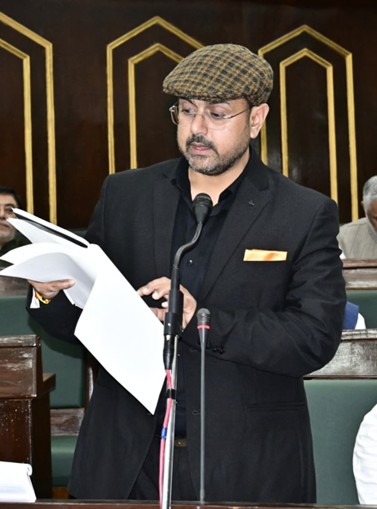
Jammu, Feb 20: The Jammu and Kashmir Legislative Assembly on Friday passed the grants for key departments through voice vote, after daylong debate by the members in the House.
The approved grants included Rs 7,462.91 Lakh for Information Technology (IT), Rs 54,389.17 Lakh for Food, Civil Supplies & Consumer Affairs (FCS&CA), Rs 3,798.68 Lakh for ARI & Training, Rs 12,646.11 Lakh for Transport, Rs 68,009.76 Lakh for Youth Services & Sports (YSS) and Rs 18,972.06 Lakh for Science & Technology (S&T) Department.
Minister Satish Sharma, who wound up the discussion, thanked legislators for their active participation and valuable inputs. He highlighted that feedback and suggestions would help strengthen policies, improve project implementation, and enhance departmental effectiveness. Sharma stressed that improvement is a collective endeavor, achievable through dialogue and constructive criticism, and pledged to address departmental issues during his presentation.
He elaborated on the role of the ARI & Training department as a catalyst for administrative reforms and innovation, promoting a “Whole-of-Government” approach. The department has launched digital initiatives like a single-window online portal for Recruitment Rules and an online NDC system, significantly reducing paperwork and increasing transparency. Regular administrative inspections aim to identify procedural delays and bottlenecks, driving systemic change.
Looking ahead, Sharma emphasized that the department will focus on capacity building, digitization, and re-engineering to improve efficiency and responsiveness. Reforms are also underway to simplify rules, update Recruitment Rules, and foster inter-departmental coordination. A proposed Jammu & Kashmir Administrative Reforms Commission will guide long-term administrative transformation.
On food security, Sharma reaffirmed that it is a fundamental right and credited Jammu and Kashmir for leading reforms in the Public Distribution System (PDS). The UT has adopted the Government of India’s SMART PDS, integrating systems like Ration Card Management and Supply Chain Management, saving approximately Rs 2 crore annually. Currently, 16.4 lakh households, covering over 67 lakh beneficiaries, receive free food grains under schemes like NFSA, PMGKAY, AAY, and PHH, ensuring no deserving family is deprived.
The department has achieved 100% FPS automation, benefiting over 102 lakh citizens. Due to Union government caps on food grain allocations, efforts are ongoing to request additional supplies and lift the embargo. The department is working to integrate Migrant Database with the Ration Card system and upgrade point-of-sale (PoS) machines with biometric and iris scanner technology, making J&K the first UT to shift from L0 to L1 under SMART PDS.
Further, the department plans to provide additional free ration under SAAY from April 2025, and initiate creation of new ration cards after April 2026, once data cleansing and e-KYC processes are completed. There are also plans to distribute pulses, oils, millets, and other commodities through NAFED and FPOS. Consumer grievance redressal has been modernized with a digital platform, e-Jagriti, launched in January 2025, enabling paperless complaints and case tracking.
The department also aims to enhance energy security through infrastructural projects like the Bajalta common user facility, a new LPG bottling plant at Jablipura, and the extension of LPG coverage under Pradhan Mantri Ujwala Yojana-2.0, which will provide free LPG connections to eligible women beyond the existing 35 lakh connections.
Plans are underway to establish a State Food Commission to oversee NFSA implementation and improve last-mile delivery with new fair price shops and sales centeRs The IT department continues to advance digital governance, focusing on reliable connectivity, data infrastructure, and secure platforms. Initiatives include establishing IT Parks, augmenting State Data Centers, integrating with government cloud platforms, and making web content multilingual through BHASHINI, ensuring accessible and inclusive digital services.
On mobility, J&K has introduced online services for license corrections, transitioned to a faceless service model, and launched the Institute of Driving Training & Research (IDTR) in Jammu. The department is adopting technology-driven vehicle fitness testing, planning vehicle scrapping centers, and installing electronic enforcement devices for traffic safety.
Transport infrastructure is also expanding, with new buses being added, including 200 more for RTC services, and procurement of 50 trucks to modernize the fleet. The department is working on a comprehensive green mobility plan, replacing diesel vehicles with zero-emission alternatives and promoting electric mobility.
The Science and Technology Department, through JAKEDA and JKSTIC, is focusing on renewable energy, research, and innovation. Significant progress includes solarizing over 7,500 government buildings with a cumulative capacity of 76 MW, and developing solar villages and agricultural pumps under government schemes. Hydropower projects are progressing, with seven projects completed and several under development.
In the field of science and innovation, the department is establishing biotech parks at Kathua and Handwara, with ongoing projects in Srinagar and Jammu, including scholarships and research programs. The department also promotes sports, organizing national and international events, strengthening infrastructure, and nurturing youth talent through initiatives like Khelo India Centers, sports academies, and development of playfields and sports facilities across the UT.
Major sports infrastructure projects include the completion of 216 playfields, the construction of indoor sports complexes, and the establishment of sports academies for cricket, kabaddi, badminton, and other disciplines. The department organized the “Rustam-e-J&K” international wrestling event to promote rural sports and aims to make Jammu & Kashmir a “Sports Capital of the Country” with upcoming projects like indoor halls, sports complexes, and talent identification centeRs
The assembly also discussed demands for regularization of sports personnel and welfare schemes. The department is working on regularization processes, and the selection of outstanding sports persons is nearing completion.
The Minister reaffirmed that all issues and demands raised will be examined objectively, and departments will continue working with commitment, innovation, and accountability. He extended gratitude to officers and officials for their efforts.
Following the Minister’s assurances, MLAs withdrew their cut motions, concluding the session on a note of consensus and shared commitment to the development agenda of Jammu and Kashmir.