
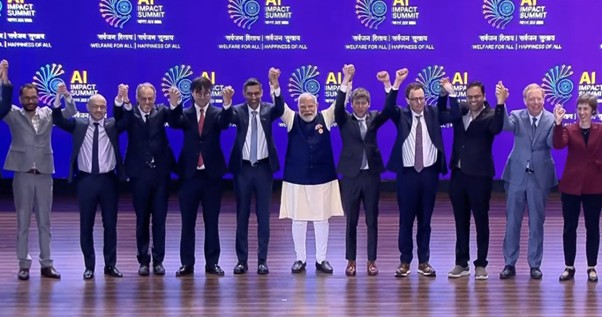
The Delhi Declaration, adopted at the summit, is being called the first major AI governance blueprint from the Global South—anchored in data sovereignty, inclusion by design, and flexible guardrails. India also launched three sovereign AI models, including Sarvam AI’s 105-billion-parameter model trained entirely on Indian compute.
Hardeep S Puri
When Panini reduced the chaos of spoken language into a compact, computable grammar, he proved something that still holds: intelligence is most powerful when it is expressed as structure. Nalanda took that instinct into institutions, building methods to debate, preserve, and transmit knowledge across borders. India’s decision to host the India AI Impact Summit 2026 draws from the same civilisational impulse, because the next leap in technology is about systems that can learn, reason, and act at scale, and the world cannot afford a future in which only a few capitals decide how those systems are built.
Held at Bharat Mandapam last week, the Summit was the first global AI summit hosted by a Global South nation, and no previous edition drew participation at this scale: over 20 heads of state, 60 ministers, more than 500 AI leaders from over 100 countries, and 300 exhibitors across ten thematic pavilions. Under Prime Minister Narendra Modi’s leadership, India is putting forward an organising idea of its own: sovereignty over data, inclusion by design, accountability by default. And it is inviting global capital to build here on those terms.
That idea finds its sharpest expression in the Prime Minister’s M.A.N.A.V. vision: ethical guardrails, accountable governance, sovereignty over data so that the raw material of intelligence is not extracted the way commodities once were, broad access so that the benefits reach a farmer in Madhya Pradesh as surely as an engineer in Bengaluru, and legal validity so that every deployed system remains answerable to democratic scrutiny. His formulation about giving AI an open sky while keeping command in human hands draws a line many advanced economies have been reluctant to draw.
Those principles now carry multilateral weight through the Delhi Declaration, adopted at the summit and already being called the first major AI governance blueprint from the Global South; taking a development-oriented view, anchored in a techno-legal approach that favours flexible guardrails over rigid compliance. It organises global collaboration around three pillars: People, Planet, and Progress. Population-scale solutions like BharatGen, which supports 22 Indian languages, address the reality that most of the world does not operate in English. A proposed global Compute Bank, modelled on India’s own subsidised GPU access at ₹65 per hour, lowers entry barriers everywhere. And the Declaration’s insistence on data sovereignty directly challenges AI extractivism: the pattern in which developing nations’ data is harvested to train models they must then pay to use.
What gives that framework its credibility is the decade of execution that precedes it, because this government did not arrive at AI through a white paper but through the most ambitious digital public infrastructure programme any democracy has undertaken. UPI processed over 228 billion transactions in 2025, worth roughly USD 3.4 trillion, nearly half the world’s real-time digital payment volume, more than Visa processes globally. The JAM trinity has delivered over ₹3.48 lakh crore in welfare savings since 2015. No other country has built identity, payments, and entitlement delivery at this scale within a single policy arc, and that is the foundation on which India’s AI moment stands.
If the logic of digital public infrastructure was to connect every citizen to the state, the logic of AI infrastructure is to connect every citizen to capability, and here the numbers reveal a striking gap: India generates nearly 20 percent of the world’s data but hosts roughly 3 percent of global data centre capacity. That gap is now being closed with the same intent that built UPI: fast, at scale, and with sovereign design.
Consider what was announced in a single week at Bharat Mandapam. Microsoft: USD 50 billion by 2030 for the Global South, with USD 17.5 billion already committed to India. Google: the America-India Connect initiative, anchored by USD 15 billion over five years. Amazon Web Services: USD 8.3 billion in Maharashtra. Adani Group: USD 100 billion toward renewable energy-powered AI data centres by 2035. Yotta Data Services: over USD 2 billion for one of Asia’s largest AI computing hubs using Nvidia’s Blackwell Ultra chips. Larsen & Toubro: a proposed venture with Nvidia to build India’s largest gigawatt-scale AI factory. The IndiaAI Mission’s national compute cluster has crossed 38,000 GPUs and is scaling to 58,000, available to startups at roughly one-third of global cost. The government’s target of USD 200 billion in AI infrastructure investment over the next two years is not aspiration; the commitments already announced bring it within reach.
Ensuring that this investment becomes long-term structural advantage is the purpose of the Union Budget for 2026-27, which extends a tax holiday until 2047 for foreign companies using Indian data centres for global cloud services and commits USD 1.1 billion to a venture capital fund for AI and advanced manufacturing startups. The National Critical Mineral Mission, at over ₹34,000 crore, secures the lithium, cobalt, and rare earths that AI and semiconductor manufacturing depend on.
None of this matters, however, unless it reaches people. On the first day of the Summit, more than 2.5 lakh students took a pledge to use AI for responsible innovation, a number submitted for Guinness World Records recognition. Thirty Data and AI Labs are operational in Tier 2 and Tier 3 cities, the first wave of a planned 570-lab network, while AIKosh offers over 7,500 datasets and 273 models as shared public infrastructure. When this government took office India had 16 IITs; today there are 23. OpenAI’s CEO disclosed that India is ChatGPT’s second largest market, with 100 million weekly active users. The consumption is here, and the production capability is catching up: three sovereign AI models were unveiled at the summit, including Sarvam AI’s 105-billion-parameter large language model trained entirely on Indian compute and BharatGen’s Param2, a 17-billion-parameter multilingual model supporting all 22 scheduled languages. These are not fine-tuned adaptations of foreign models; they are built from scratch on sovereign infrastructure.
Equally telling is how partnerships are now structured, because they are no longer about licensing foreign technology but about co-building sovereign capacity. The Tata Group’s strategic partnership with OpenAI, beginning with 100 megawatts of AI-ready data centre capacity under the Stargate initiative and scaling to one gigawatt, signals that Indian industry is moving from the demand side to the supply side of global intelligence. India’s formal signing of the Pax Silica Declaration on the sidelines of the summit places it in the US-led coalition securing supply chains for AI, semiconductors, and critical minerals alongside Japan, South Korea, the UK, and Australia. The bilateral India-US AI Opportunity Partnership, signed alongside, commits both nations to pro-innovation approaches on critical technologies, while the India-France Year of Innovation in 2026 adds another axis organised around joint skilling and measurable outcomes.
Under Prime Minister Modi’s leadership, the first Global South nation to host the global AI summit series did not merely convene a conversation but laid out the terms on which it intends to compete: a Delhi Declaration that rewrites the rules of AI governance, digital infrastructure processing nearly half the world’s real-time payments, investment commitments in the hundreds of billions, sovereign models built from scratch, and entry into the supply chain security architecture of the AI age. Panini’s lesson was never complicated. Structure is intelligence. India is building that structure now.
The author is Union Minister for Petroleum and Natural Gas