Key Takeaways
- India ranks 3rd among Global South economies in trade partnership diversity (UNCTAD Trade and Development Report 2025)
- “Mother of All Deals” India-EU FTA concluded in January 2026
- In FY 2025-26, India concluded FTAs with the United Kingdom (UK), Oman and New Zealand
- India concluded 1st round of Israel FTA and formally launched trade negotiations with GCC in February 2026
- India is expanding its trade negotiations agenda with ASEAN, Mexico and Canada
India’s role and share in global trade are poised for a major leap in line with the country’s ambition and journey towards Viksit Bharat. Over the past decades, India has significantly deepened its integration with global markets, supported by strong export performance, resilient services trade, and an expanding network of trade partnerships, reflecting growing competitiveness and adaptability to changing global demand dynamics.
The country has not only increased its share in global trade but has also diversified its trading partnerships. According to UNCTAD’s Trade and Development Report 2025, India ranks third among Global South economies in terms of the diversity index of trade partnerships. With an index score higher than that of all countries in the Global North, India’s trade ecosystem underscores resilience in the face of tariff uncertainties and emerging global challenges.
An expanding network of FTAs strengthens India’s trade strategy by ensuring reliable market access. These agreements help reinforce the country’s trajectory towards a stronger global trade presence by supporting export-oriented firms expand production and integrate more deeply into global value chains.
India’s Trade Partnerships Enter a New Phase in 2026
Bilateral and multilateral Free Trade Agreements (FTAs) constitute a key pillar of India’s trade strategy, designed to expand trade and investment through enhanced market access, greater trade in services, reduction of non-tariff barriers, promotion of investment, and strengthened economic and technical cooperation. By leveraging trade complementarities, these agreements boost export potential, create new opportunities for industry and farmers, and generate employment across sectors.
India-EU Free Trade Agreement (FTA)
Hailed as the “Mother of All Deals,” the conclusion of negotiations between India and the European Union Free Trade Agreement (FTA) in January 2026, marks a significant milestone in one of India’s most strategic economic partnerships. Structured as a modern, rules-based trade framework, the agreement aims to address contemporary global economic challenges while enabling deeper market integration between the two major economies.
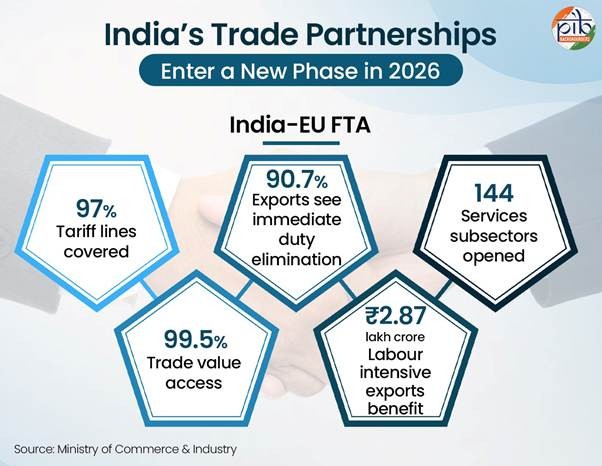
Increased Market Access: The agreement provides preferential access across 97% of EU tariff lines, covering 99.5% of trade value, while preserving policy flexibility for sensitive sectors and supporting India’s developmental priorities.
Immediate Duty Elimination: 70.4% of tariff lines, accounting for 90.7% of India’s exports, will see immediate duty elimination, benefiting labour-intensive sectors such as textiles, leather and footwear, tea, coffee, spices, sports goods, toys, gems and jewellery, and selected marine products.
Phased Duty Elimination and Preferential Access: Zero duty over three to five years will apply to 20.3% of tariff lines covering 2.9% of exports, while 6.1% of tariff lines covering 6% of exports will receive preferential access through tariff reductions or tariff-rate quotas for products including processed foods, preserved vegetables, bakery items, cars, steel, and certain shrimp and prawn products.
Boost to Labour-intensive Industries: Labour-intensive industries such as textiles and apparel, marine products, leather and footwear, chemicals, plastics and rubber, sports goods, toys, gems, and jewellery, accounting for exports exceeding INR 2.87 lakh crore (USD 33 billion), will gain competitiveness, deeper integration into European value chains, and generate employment as duties move to zero.
Market Access in Services: The EU has extended commitments across 144 subsectors, including IT/ITeS, professional, education, and business services, providing Indian service providers a stable environment to expand exports and support innovation, productivity and business growth across both economies.
India Protects what Matters
Carefully calibrated liberalisation under trade agreements is designed to support and propel initiatives such as Make in India. Accordingly, highly sensitive agricultural products along with dairy, meat, poultry and cereals continue to be fully safeguarded.
Advancing Trade Cooperation with Other Key Partnerships
In the fiscal year 2025-26, India advanced its trade engagement by concluding FTAs with the United Kingdom (UK), Oman and New Zealand marking a significant expansion of India’s economic partnerships across key global markets. Alongside these new agreements, India has, over the past few years, operationalised several major trade pacts that continue to support export growth and investment flows.
India-Oman Comprehensive Economic Partnership Agreement (CEPA)
India signed a Comprehensive Economic Partnership Agreement (CEPA) with Oman in December 2025, marking a significant step in strengthening economic engagement with the Gulf region. The agreement opens new export opportunities for India’s labour-intensive sectors- such as agriculture, textiles, leather, gems and jewellery, engineering, pharmaceuticals, and automobiles- supporting job creation and empowering artisans, women-led enterprises, and MSMEs.
Market Access for Goods: CEPA provides unprecedented market access for Indian goods, granting zero-duty access on 98.08% of Oman’s tariff lines, which together account for 99.38% of India’s exports by value.
Global Recognition and Market Access for Traditional Medicine and AYUSH
The agreement also marks the first time any country has extended commitments on traditional medicine across all modes of supply, creating significant opportunities for India’s wellness and AYUSH sectors through a structured institutional framework supporting traditional medicine.
Services and Mobility Commitments: Oman has, for the first time, offered commitments across key mode 4 categories, providing high-quality provisions for temporary entry and stay of intra-corporate transferees, contractual service suppliers, business visitors, and independent professionals.
India-New Zealand Free Trade Agreement (FTA)
Concluded in 2025, the India-New Zealand FTA stands out as one of India’s fastest-concluded trade agreements, significantly strengthening economic engagement between the two countries. The agreement enhances market access and tariff preferences for Indian exports to New Zealand while also positioning the partnership as a gateway to the wider Oceania and Pacific Island markets.
Increased Market Access for Farmers and MSMEs: Under the agreement, New Zealand has eliminated duties on 100% of tariff lines, granting zero-duty access for all Indian exports from the date of entry into force.
Through an Agricultural Productivity Partnership, the agreement aims to support farmers, improve productivity, and integrate them into global value chains.
Additionally, the agreement boosts MSMEs and employment by providing zero-duty access for labour-intensive sectors such as textiles, apparel, leather, footwear, gems and jewellery, engineering goods, and processed foods.
Investment and Workforce Opportunities: The FTA is also supported by an investment commitment of USD 20 billion over 15 years, strengthening long-term economic and strategic cooperation.
It also opens opportunities for India to emerge as a key provider of skilled workforce, alongside future cooperation in areas such as AYUSH and services including yoga instructors, Indian chefs, and music teachers, as well as priority sectors like IT, engineering, healthcare, education, and construction.
This cooperation is expected to create new opportunities for professionals and further strengthen economic ties between the two countries.
India-UK Comprehensive Economic and Trade Agreement (CETA)
India and the United Kingdom signed the Comprehensive Economic and Trade Agreement (CETA) in 2025, marking a major milestone in their long-standing economic partnership. Bilateral trade between the two countries has already reached USD 56 billion, with both sides aiming to double this level by 2030. The agreement is also expected to significantly boost India’s agriculture and processed food exports, which are projected to grow by over 50% in the next three years.
Market Access for Goods: CETA grants unprecedented duty-free access to nearly 99% of India’s exports to the UK, covering nearly 100% of the trade value and benefiting key sectors such as textiles, leather, marine products, gems and jewellery, engineering goods, chemicals, and auto components.
Eased Mobility for Indian Professionals in the UK
In a first-of-its-kind arrangement by the UK, the agreement eases mobility for professionals in areas such as IT, healthcare, finance, and education, enabling smoother entry for contractual service suppliers, business visitors, intra-corporate transferees, and independent professionals.
Social Security Benefits: Another major achievement under the agreement is the Double Contribution Convention, which eliminates the need for dual social security contributions, resulting in estimated savings of over ₹4,000 crore for Indian companies and professionals working in the UK.
The agreement’s comprehensive provisions are expected to significantly expand market access, boost exports and investment, and deepen economic cooperation between India and the UK in the years ahead.
India-European Free Trade Association (EFTA) Trade and Economic Partnership Agreement (TEPA)
The India-European Free Trade Association (EFTA) Trade and Economic Partnership Agreement (TEPA), signed in 2024 and effective from October 2025, marked the first FTA signed by India to incorporate commitments directly linked to investment flows and job creation.
Market Access for Goods: The EFTA countries have offered market access covering 92.2% of tariff lines, accounting for 99.6% of India’s exports, including 100% coverage of non-agricultural products along with tariff concessions on processed agricultural products (PAP).
Services Cooperation: The agreement will also strengthen cooperation in services by opening new opportunities for Indian service providers in sectors such as IT, business services, education, cultural and recreational services, and audio-visual services.
Investment and Employment Commitments: A distinctive feature of the agreement is the investment commitment to increase foreign direct investment (FDI) into India by USD 50 billion within 10 years of the agreement’s entry into force and an additional USD 50 billion in the subsequent five years, amounting to a total of USD 100 billion over 15 years.
These investments are expected to generate 1 million direct jobs in India. Importantly, this commitment excludes foreign portfolio investment (FPI), ensuring that flows are directed toward long-term productive investments that build domestic capacity.
Through expanded market access, strengthened services cooperation, and investment-led growth commitments, TEPA is expected to significantly deepen India’s trade and investment ties with EFTA economies while creating new opportunities for exporters, businesses, and workers.
India-UAE Comprehensive Economic Partnership Agreement (India-UAE CEPA)
Signed in 2022, the India-UAE Comprehensive Economic Partnership Agreement (CEPA) marked India’s first such accord in the Middle East and North Africa (MENA) region, ushering in a new era of strategic economic cooperation between the two countries. The agreement was concluded with the potential to raise bilateral trade to USD 100 billion over five years while creating substantial employment and business opportunities in both economies.
Strong Trade Growth and Export Gains: The impact of the agreement is already visible in trade outcomes, with bilateral trade surpassing USD 100 billion in FY 2024-25, registering strong growth and reaffirming the UAE’s position among India’s key trading partners.
In terms of India’s exports, non-oil exports reached USD 27.4 billion in FY 2023-24 recording an average growth of 25.6% since entering into force of CEPA.
At the sectoral level, electrical machinery and equipment, light & medium high technology goods like boilers, generators and reactors and organic & in-organic chemicals have been major achievers.
Smartphones have also emerged as a major item of export with shipments valued USD 2.57 billion bound for the UAE during FY 2023-24.
The CEPA has strengthened economic partnership and diplomacy between the two countries by empowering MSMEs, supporting job creation, and creating new business opportunities. Both nations are committed to further enhance their economic partnership and leveraging the agreement to unlock greater trade and investment potential.
India-Australia Economic Cooperation & Trade Agreement (Ind-Aus ECTA)
The India-Australia Economic Cooperation and Trade Agreement (ECTA) signed in April 2022, marked India’s first trade agreement with a developed economy in over a decade , signalling a renewed momentum in expanding partnerships with advanced markets. A key milestone was the signing of a Mutual Recognition Arrangement on organic products, which facilitates smoother trade and reduces compliance costs for exporters.
Market Access and Tariff Liberalisation: The agreement covers almost all tariff lines traded between the two countries, granting India preferential market access across 100% of Australian tariff lines. Also, India has extended preferential access to Australia across more than 70% of its tariff lines, particularly benefiting India’s imports of raw materials and intermediate goods such as coal and mineral ores.
Services Market Access: In services trade, Australia has offered commitments across around 135 sub-sectors and granted Most Favoured Nation (MFN) treatment in 120 sub-sectors, covering key areas of interest to India such as IT, IT-enabled services, business services, health, education, and audio-visual services.
Extended Benefits for Indian Exports: From January 2026, Indian exports enjoy zero-duty access across 100% Australian tariff lines, opening new opportunities, especially for labour-intensive sectors.
Trade and Export Performance Gains: Over the past three years, the agreement has delivered sustained export growth, improved market access, and stronger supply-chain resilience, benefiting Indian exporters, MSMEs, farmers, and workers.
India’s exports to Australia grew by 8% in FY 2024-25, helping improve the bilateral trade balance, with strong gains across sectors such as manufacturing, chemicals, textiles, plastics, pharmaceuticals, petroleum products, and gems and jewellery.
Agricultural exports also recorded broad-based growth, with notable increases in fruits and vegetables, marine products, spices, and particularly strong growth in coffee exports.
Gems and jewellery exports continued their upward momentum, rising 16% during April-November 2025.
As negotiations progress towards a Comprehensive Economic Cooperation Agreement, the ECTA continues to anchor India-Australia economic engagement across the Indo-Pacific, strengthening trusted trade and shared prosperity.
Comprehensive Economic Cooperation and Partnership Agreement with Mauritius
India and Mauritius signed the Comprehensive Economic Cooperation and Partnership Agreement (CECPA) in 2021, marking India’s first trade agreement with a country in Africa. The agreement establishes an institutional mechanism to strengthen bilateral trade and investment ties.
It provides preferential market access for over 300 Indian export products, including food and beverages, agricultural products, textile and textile articles, base metals and articles, electricals and electronic item, plastics and chemicals, and wood products. The agreement also opens significant opportunities in services, granting Indian service providers access to around 115 subsectors from the 11 broad service sectors such as professional services, computer related services, research & development, telecommunication, construction, education, financial, tourism & travel related, yoga, audio-visual services, transport services, etc. further deepening economic cooperation between the two countries.
Domestic Enablers that Strengthen Export Competitiveness
Enhancement in export competitiveness increasingly depend on effective implementation in providing infrastructure, regulatory clarity, and administrative support needed for export-oriented businesses to grow.
Digital and Policy Support for Exporters: To enable the exporters to leverage the benefits of FTAs and preferential trade agreements, the tariff explorer service on the Trade Connect ePlatform provides information on tariff concessions available to eligible exports from the country. Furthermore, the Export Promotion Mission (EPM) establishes a comprehensive, flexible, and digitally driven framework for enhancing export initiatives.
Financial and Credit Support Measures: The government has also implemented the Credit Guarantee Scheme for Exporters to provide additional financial assistance to Indian exporters during periods of uncertainty, thereby ensuring liquidity, promoting business continuity, and creating opportunities to expand into new markets.
RBI Measures Supporting Exporters: The EPM’s effectiveness is further reinforced by complementary steps announced by the Reserve Bank of India.
These measures include a moratorium or deferment on payment of instalments for eligible borrowers, extension of export credit tenor up to 450 days for pre- and post-shipment credit disbursed till 31 March 2026, and flexibility for regulated entities to maintain liquidity by reducing margins or reassessing working capital limits.
Under the Foreign Exchange Management (Export of Goods and Services) (Second Amendment) Regulations, 2025, the period for realisation and repatriation of export proceeds has been extended from nine months to 15 months, and the shipment period against advance payments has been increased from one year to three years.
Support under Union Budget 2026-27: The Union Budget 2026-27 outlines a range of measures aimed at further enhancing India’s trade competitiveness.
These include the removal of the existing value cap of ₹10 lakh per consignment on courier exports to facilitate smoother export operations.
Duty-free imports of specified inputs have also been extended to cover leather or synthetic footwear and inputs used in processing seafood products for export.
The time limit for export of final products has been extended from six months to one year for exporters of leather or textile garments and leather and synthetic footwear, providing greater operational flexibility.
In addition, export cargo using electronic sealing will now be allowed clearance directly from factory premises to the ship, helping reduce logistics time and costs.
Together, these regulatory and fiscal measures provide an integrated framework of support to exporters, maintaining liquidity, protecting credit discipline and aligning with the EPM’s goal of an enhanced export ecosystem.
India’s Expanding Negotiation Agenda
Besides these concluded agreements, several major economies are currently engaged in active negotiations with India to deepen trade and investment ties through FTAs and comprehensive economic partnerships:
In February 2026, India reached a framework understanding with the United States for an Interim Agreement aimed at promoting reciprocal and mutually beneficial trade. The framework reaffirms the countries’ commitment to the broader US-India Bilateral Trade Agreement (BTA) negotiations, which will include additional market access commitments and support more resilient supply chains.
India and Israel signed the Terms of Reference for a Free Trade Agreement (FTA) in November 2025. Subsequently, the first round of FTA negotiations were concluded in February 2026, establishing a structured framework for discussions on identified areas to enhance trade and economic cooperation. The proposed agreement is expected to deepen cooperation in sectors such as fintech, agri-tech, artificial intelligence, quantum computing, machine learning, pharmaceuticals, space, and defence.
Discussions for the ASEAN-India Trade in Goods Agreement (AITIGA) is also underway, which holds potential to unleash the full economic potential of the member countries and further strengthen regional cooperation.
India and Mexico meetings have been centered on strengthening bilateral trade and investment relations, with discussions focused on expanding trade, investment, expanding economic cooperation, fostering business collaborations, and exploring opportunities across diverse sectors.
With Canada, India continues discussions on a Comprehensive Economic Partnership Agreement, supported by agreed terms of reference. The proposed agreement aims to raise bilateral trade to around $50 billion by 2030 through tariff reductions and clearer frameworks for services and investment.
The Terms of Reference (ToR) for the India–GCC Free Trade Agreement (FTA) were signed in February 2026, followed by the signing of a Joint Statement formally launching negotiations for a comprehensive and mutually beneficial agreement. The FTA will enable seamless flow of goods, and services and attract investments while expanding job opportunities and fostering food and energy security for the region, elevating deep economic ties.
The expanding network of concluded agreements and ongoing negotiations reflects a broader shift in India’s international economic engagement. Together, these partnerships position India to play a central role in shaping contemporary trade architectures anchored in mutual growth, resilience, and strategic trust.
Conclusion
India’s trade partnerships in 2026 signal a decisive shift toward deeper global economic integration, supported by a broad network of modern and outcome-oriented trade agreements. Landmark agreement with the European Union, alongside other strengthened partnerships, are expanding market access, boosting exports, attracting investment, and creating new employment opportunities across sectors. Complemented by domestic policy, financial, and regulatory measures to strengthen exporter competitiveness, India’s trade ecosystem is becoming more resilient and globally integrated.
Together, these efforts position India as a trusted and dynamic partner in global trade, driving sustainable growth and shared prosperity in the years ahead.