Key Takeaways
- India has eradicated smallpox, polio, and maternal and neonatal tetanus through vaccination, and continues to expand its immunisation programme — most recently launching HPV and indigenous Td vaccines in 2026.
- The Universal Immunisation Programme (UIP) is one of the world’s largest immunisation programmes, reaching 2.9 crore pregnant women and 2.54 crore newborns every year, free of cost.
- Full immunisation coverage has risen from 62% in 2015 to 98.4% in January 2026.
- The percentage of zero-dose children to the total population has declined from 0.11% in 2023 to 0.06% in 2024.
National Vaccination Day
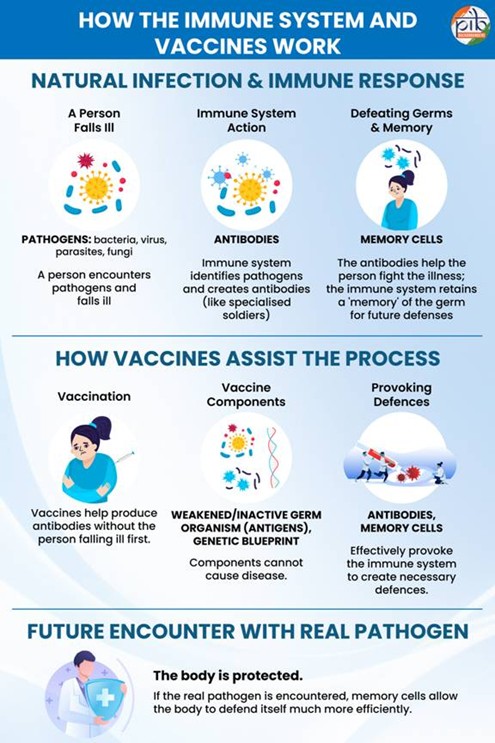
Immunisation through vaccination saves crores of lives every year by reducing the risks of contracting diseases. It builds people’s natural defences to create protection against illnesses.
In India, vaccines have had a resounding impact on the improvement of public health. Apart from polio, vaccines have eradicated smallpox, and eliminated yaws, polio, and maternal and neonatal tetanus. They have reduced child mortality rates, measles-rubella, and tuberculosis. During COVID-19, India — the pharmacy of the world — supplied over 200 crore COVID-19 vaccine doses, including indigenously developed and licensed vaccines manufactured in the country. In 2026, the Government of India launched a nationwide HPV vaccination campaign for girls aged 14 years to protect against cervical cancer, and an indigenously manufactured tetanus-diphtheria (Td) vaccine.
India’s robust Universal Immunisation Programme (UIP), a widespread network of publicly funded healthcare centres, workers, and cold-chain infrastructure, along with a strong digital network, have delivered results.
Full immunisation coverage has risen from 62% in 2015 to 98.4% as of January 2026. India’s percentage of zero-dose children relative to the total population has declined from 0.11% in 2023 to 0.06% in 2024. India has a long history of prioritising vaccination and continues to push for higher vaccination rates to further improve public health through the UIP.
India celebrates National Vaccination Day on 16 March every year to commemorate the first dose of the Oral Polio Vaccine given to citizens in 1995, under the Pulse Polio Programme launched the same year. The programme successfully eliminated polio in India, with the last case reported on 13 January 2011 in Howrah, West Bengal.
Universal Immunisation Programme
Mothers pass antibodies to their babies at birth. However, these antibodies, transferred through pregnancy and breast milk, only provide immune protection for the first few months of a newborn’s life.
Vaccines are crucial to protect babies and infants from germs and life-threatening diseases. It is best to administer vaccines to children before they are exposed to illnesses — ideally within the first 12 to 18 months of life.
The Universal Immunisation Programme, launched in 1985 and implemented by the Ministry of Health and Family Welfare, aims to provide free vaccines to children and pregnant women against various diseases. The programme reaches approximately 2.9 crore pregnant women and 2.54 crore newborns annually.
The objectives of the UIP are:
– To increase immunisation coverage
– To improve the quality of services
– To establish a reliable cold chain system to the health facility level
– To monitor performance
– To achieve self-sufficiency in vaccine production
The UIP provides vaccines to newborns, children, adolescents, and pregnant women, protecting against 12 diseases. The Japanese Encephalitis vaccine is provided only in endemic districts, while the rest are provided nationally.
In the past decade, various new vaccines were added to the programme: Inactivated Polio Vaccine (IPV) (2015), Rotavirus Vaccine (RVV) (2016), Measles-Rubella (MR) vaccine (2017), and Pneumococcal Conjugate Vaccine (PCV) (2017). The vaccines administered under UIP are:
– Bacillus Calmette-Guérin (BCG)
– Diphtheria, Pertussis, and Tetanus (DPT)
– Tetanus and adult Diphtheria (Td)
– Bivalent oral polio vaccine (bOPV)
– Measles-Rubella (MR) vaccine
– Hepatitis B (Hep B)
– Pentavalent — DPT + Hepatitis B + Haemophilus Influenzae type b (DPT + Hep B + Hib)
– Rotavirus Vaccine (RVV)
– Pneumococcal Conjugate Vaccine (PCV)
– Japanese Encephalitis (JE) Vaccine
These vaccines protect against the following life-threatening diseases:
– # – Disease and Description –
– 1 – Tuberculosis (severe childhood form) – Bacterial infection affecting the lungs; can spread to the brain and multiple organs –
– 2 – Diphtheria – Bacterial infection affecting the throat; can damage the heart and nerves –
– 3 – Pertussis (Whooping Cough) – Highly contagious cough illness, dangerous for infants –
– 4 – Tetanus – Bacterial infection from contaminated wounds causing muscle stiffness –
– 5 – Polio – Viral infection attacking the nervous system; can cause permanent paralysis or death –
– 6 – Measles – Highly contagious viral disease, causes fever and rash –
– 7 – Rubella – Mild viral illness with fever and rash; spreads through coughing and sneezing –
– 8 – Hepatitis B – Viral infection of the liver that can become chronic and cause liver damage –
– 9 – Meningitis & Pneumonia (Hib) – Meningitis: infection and inflammation of membranes surrounding the brain and spinal cord; Pneumonia: infection and inflammation of the lungs –
– 10 – Rotavirus Diarrhoea – Viral infection causing severe diarrhoea in infants –
– 11 – Pneumococcal Pneumonia – Bacterial lung infection causing fever and breathing difficulty –
– 12 – Japanese Encephalitis – Mosquito-borne viral disease causing brain inflammation –
National Immunisation Schedule
Timely vaccination is essential for protection from life-threatening diseases. The prescribed schedule under the UIP for pregnant women, infants, and children is as follows:
Pregnant Women
– Td-1: As early as possible during the first antenatal visit
– Td-2: 4 weeks after first Td shot
– Td-Booster: If two Td doses were already received in a previous pregnancy within the last 3 years
All doses ideally given before 36 weeks — but administered even if missed, including during labour.
Infants and Children
– At birth: Hep B, bOPV, BCG
– By 1st birthday: 3 doses of bOPV, 3 doses of rotavirus vaccine, 3 doses of pentavalent, 3 doses of fractional IPV, 3 doses of PCV, 1st dose of MR vaccine, 1st dose of JE vaccine (where applicable)
– By 2nd birthday: 2nd dose of MR vaccine, 1st dose of DPT booster, 1 dose of bOPV booster, 2nd dose of JE vaccine (where applicable)
– After 5th birthday: 2nd dose of DPT booster at 5 years, 1 dose of Td vaccine at 10 years, 1 dose of Td vaccine at 16 years
Recent Vaccine Launches and Programmes
The most recent chapter in this expansion is also the most ambitious — with two landmark launches in early 2026 extending UIP’s reach.
Indigenous Tetanus–Diphtheria (Td) Vaccine Launch (2026)
An indigenously manufactured Tetanus and Adult Diphtheria (Td) vaccine was launched on 21 February 2026. The vaccine is produced at the Central Research Institute (CRI), Kasauli. Approximately 55 lakh doses will be supplied to the UIP by April 2026.
India’s domestic vaccine manufacturing capacity underpins this entire edifice. As the world’s largest vaccine producer, India supplies approximately 60% of global vaccines. The launch of the indigenously manufactured Td vaccine is an expression of self-reliance.
Nationwide HPV Vaccination Campaign (2026)
A nationwide Human Papillomavirus (HPV) vaccination campaign was launched on 28 February 2026 from Ajmer, Rajasthan, by Prime Minister Narendra Modi. It targets 14-year-old girls to protect them from cervical cancer. Around 1.15 crore girls across India are expected to receive the vaccine free of cost at government health facilities.
Mission Indradhanush
To reach children and pregnant women who are unvaccinated or partially vaccinated, the government launched the Mission Indradhanush programme in 2015, followed by Intensified Mission Indradhanush Missions (with greater focus on urban areas) and greater inter-ministerial convergence. These missions aim to achieve over 90% full immunisation coverage under the UIP by strengthening routine immunisation services and targeting hard-to-reach populations.
Twelve phases of Mission Indradhanush have been held so far, up to 2023, vaccinating 5.46 crore infants and 1.32 crore pregnant women across 765 districts.
Infrastructure Supporting UIP Implementation
Community Health Centres and Workers
UIP vaccines are provided free of cost to all beneficiaries at fixed sites such as Primary Health Centres (PHCs), Community Health Centres (CHCs), and government hospitals, at sub-centres, and through outreach sessions held at Anganwadi centres or other identified locations within villages. Since 2005, UIP has been under the National Rural Health Mission and is also implemented in urban slums.
Frontline health workers — ASHAs (Accredited Social Health Activists), Anganwadi Workers (AWWs), and link workers — play a central role in mobilising beneficiaries to session sites and ensuring no child or pregnant woman is missed.
Model Immunisation Centres
The Government of India encourages states and union territories to establish model immunisation centres. They are already operational in Uttar Pradesh, Bihar, and the union territories of Chandigarh and Ladakh.
Cold-Chain Network
Vaccines must be stored continuously within a limited temperature range — from manufacture to the moment of vaccination. Temperatures too high or too low can cause a vaccine to lose its potency (its ability to protect against disease), and once lost, potency cannot be regained. The system for storing and transporting vaccines within prescribed conditions is called a cold chain system.
India’s vaccine cold chain is one of the largest in the world — spanning nearly 30,000 cold chain points, from Government Medical Supply Depots at the national level down to Primary Health Centres at the sub-district level. These storage points at hospitals, community health centres, primary health centres, and other health facilities are equipped with over 1.06 lakh ice-lined refrigerators and deep freezers, and 432 walk-in coolers and walk-in freezers for bulk vaccine storage. Conducting over 1.3 crore immunisation sessions annually across this network, maintaining temperature integrity at every point is critical to ensuring vaccines reach the last beneficiary in potent condition.
To digitise and strengthen this vast infrastructure, the Ministry of Health and Family Welfare uses the Electronic Vaccine Intelligence Network (eVIN) — a state-of-the-art software platform that tracks vaccine stock levels and storage temperatures in real time at multiple locations across the country, backed by strong IT infrastructure and trained professionals. eVIN has expanded nationwide across all states and union territories. The platform proved critical during the COVID-19 pandemic, enabling the vaccination of a record number of people in a short period.
Digital Initiatives
India’s immunisation management system has been upgraded through a robust digital ecosystem with platforms for registration, appointment scheduling, vaccine tracking, and real-time monitoring.
U-Win
U-Win is a digital platform and app to help people find vaccination centres near their residence, manage vaccination appointments at health facilities, and maintain vaccination records. One user can register up to 10 people under a single mobile number, including citizens or guardians, pregnant women, infants (0–1 years), children (1–7 years), and adolescents (7–19 years). U-Win was launched in October 2024 and is available in 12 languages, including English.
CoWIN
Like U-Win, CoWIN is a digital platform for COVID-19 vaccination registration at health and other centres, and for managing vaccination appointments and records. It was launched on 16 January 2021, and since then, over 220 crore doses have been administered through it.
Impact
Vaccination is one of several factors — alongside improvements in nutrition, sanitation, maternal care, and healthcare access — behind India’s broader gains in child and pregnant women survival rates. Better-nourished, better-immunised women face lower risks during pregnancy and childbirth, while stronger healthcare systems that deliver vaccines also expand access to skilled birth attendants and emergency obstetric care, reducing maternal mortality.
The newer vaccines — rotavirus, PCV, and Measles-Rubella — have directly targeted the leading infectious causes of child death. The percentage of zero-dose children relative to the country’s population has been halved, from 0.11% in 2023 to 0.06% in 2024 — an achievement acknowledged by the UN Inter-Agency Group for Child Mortality Estimation (2024) in positioning India as a global exemplar in child health.
Vaccination campaigns do more than protect public health — they reduce the financial burden of illness on families, keeping children healthy and allowing them to live fuller, more meaningful lives. The benefits extend across generations: a healthy child becomes a healthy adult, and a healthy population contributes more productively to the workforce, driving broader social and economic progress.
Conclusion
From eradicating smallpox in 1977 to eliminating polio and neonatal tetanus, administering 200 crore COVID-19 doses, and now pursuing measles-rubella elimination — India’s immunisation journey is one of verified, milestone-by-milestone achievement.