
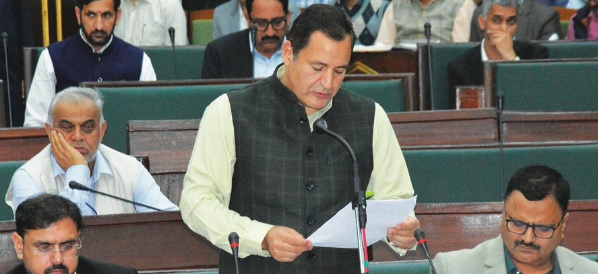
Srinagar, Mar 27: The Jammu and Kashmir Government on Friday said that the inflow of plant and nursery material, pesticides, and fertilizers from outside the Union Territory does not pose any threat of diseased or substandard inputs, as all such consignments are subjected to stringent quarantine and regulatory procedures.
Replying to a question raised by MLA Shabir Ahmad Kullay in the Legislative Assembly, Agriculture Minister Javed Dar stated that all imported agricultural inputs are allowed entry only after fulfilling prescribed quarantine norms under relevant rules.
He informed the House that a robust quarantine mechanism is in place to prevent the entry of diseased planting material. “Imported planting material is kept under observation at Post Entry Quarantine (PEQ) facilities for a period ranging from one to two years, depending on the crop. During this time, the material is continuously monitored and is released only after being certified free from any designated quarantine pests by the concerned Designated Inspection Authority,” the Minister said.
Dar further said that the government has established a comprehensive regulatory framework to check the circulation of spurious pesticides and fertilizers in the Union Territory. “A strict monitoring system ensures that all agricultural inputs are properly regulated, sampled, and tested before being made available to farmers and fruit growers,” he added.
To strengthen enforcement, the Minister said that a dedicated check post has been set up at Lower Munda in Qazigund to monitor and intercept any unauthorized transportation of agricultural inputs into the UT.
Highlighting measures to support farmers, Dar said that the Market Intervention Scheme (MIS) is being implemented to protect growers from distress sales during periods of sharp price decline in perishable commodities. He added that the government, through an order issued in December 2025, has nominated the Director Horticulture Planning and Marketing as the Nodal Officer to coordinate with evaluation teams from the Department of Agriculture & Farmers Welfare and NITI Aayog.
The Minister also informed that financial assistance is being provided for the establishment of Cold Storage and Controlled Atmosphere (CA) storage units under the Mission for Integrated Development of Horticulture (MIDH), with additional support from UT Capex funds to encourage private investment in the sector.
“Regular awareness programmes and seminars are being organized across districts to educate fruit growers about available incentives and post-harvest management practices,” he said.
Dar said that the Horticulture Department is closely monitoring the functioning of CA storage units to ensure that services agreed upon between operators and orchardists are delivered without disruption. He added that it is being ensured that at least 50 percent of storage capacity is reserved for farmers’ produce.
Pertinently, a committee constituted by the Director Horticulture, Kashmir, has reported that 90–96 percent of the CA storage capacity in Jammu and Kashmir is currently being utilized by individual apple growers, while only 4–10 percent is used by storage unit owners for their own produce.
The government reiterated its commitment to strengthening the agricultural ecosystem in J&K by ensuring quality inputs, improved infrastructure, and market support for farmers—(KNO)