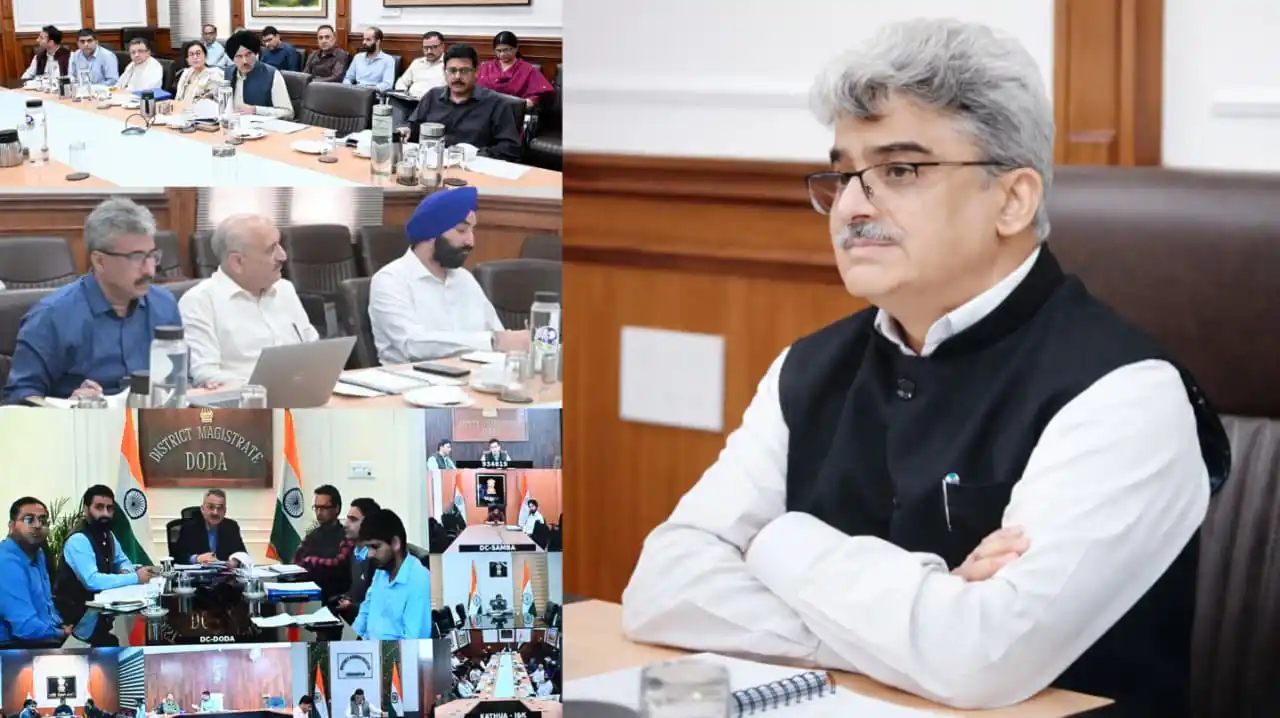
JAMMU, APRIL 02: Chief Secretary, Atal Dulloo, Thursday convened a meeting to assess the progress achieved under the District Business Reforms Action Plan (D-BRAP)-2025 across various districts and departments of Jammu and Kashmir. The reforms are being implemented under the guidance of the Department for Promotion of Industry and Internal Trade (DPIIT).
The meeting as per an official statement, coordinated by the Industries & Commerce Department, was attended by the concerned Administrative Secretaries, senior officers, Director Industries Jammu, and other concerned officials.
Taking a comprehensive department-wise review of services and reform parameters mandated under D-BRAP, the Chief Secretary underscored the significance of these reforms in improving citizen welfare and fostering a conducive business environment across the Union Territory. He emphasized that the initiative is pivotal in enhancing ease of living as well as ease of doing business at the grassroots level.
Directing the Industries & Commerce Department to strengthen coordination with line departments and district administrations, the Chief Secretary observed that while a majority of reform conditions have already been complied with, focused efforts are required to ensure timely completion of the remaining points.
He stressed the need for capacity building within departments and districts to implement pending reforms effectively inletter and spirit.He further directed Deputy Commissioners to designate a senior officer in their respective offices for daily monitoring of D-BRAP implementation to prevent any bottlenecks or delays.
Reaffirming the Government’s commitment to reform-driven governance, the Chief Secretary instructed all departments to ensure 100 percent implementation of the prescribed reforms within the nextfew months. He asserted that the pace of reforms must be sustained and tangible outcomes achieved without exception.
Highlighting the importance of seamless coordination from grassroots to the highest administrative level, he stressed that the reforms must translate into real, measurable benefits for citizens and businesses by simplifying procedures, reducing compliance burdens, and improving service delivery mechanisms as per its original spirit.
Commissioner Secretary, I&C, Vikramjit Singh, presented the overall framework of D-BRAP, informing the meeting that DPIIT has identified 46 services across 15 departments for mandatory digitization.
He further apprised that the department has developed a dedicated service dashboard, with access provided to all Deputy Commissioners, enabling real-time monitoring of service delivery through the JKSW portal. Regular review meetings are also being conducted with Deputy Commissioners and departmental nodal officers to ensure effective implementation of the reform plan.
Taking this occasion, Director Industries, Jammu, Arun Manhas, briefed the meeting on the department-wise categorization of services and outlined the specific roles and responsibilities of departments and district administrations. He also presented the current online status of services along with their PSGA notification status.
The meeting was informed that a real-time monitoring dashboard, developed in line with DPIIT guidelines, captures key aspects of e-services and inspection modules, thereby facilitating effective oversight and performance tracking.
It was further apprised that DPIIT has launched D-BRAP 2025, comprising 154 reform points to be implemented by all States and Union Territories. In Jammu & Kashmir, departments have been tasked with developing new or upgrading existing services to ensure full compliance. Significant progress has already been achieved, with most reform points complied with by the departments.
The D-BRAP framework encompasses a wide range of citizen-centric and business-related services, including land demarcation, change of land use permissions, property registration and mutation, digitization of land records, approvals for educational institutions, and issuance of Mandi licenses, among others.
Additionally, the reforms mandate online issuance of licenses and permits for health establishments, transport services, electricity and water connections, building plan approvals, vending certificates, parking licenses, and registrations under various regulatory frameworks.
The action plan also focuses on strengthening District Industries Centres and promoting the development of industrial parks to attract sector-specific investments. The overarching objective is to create an enabling, investor-friendly ecosystem at the district level, thereby fostering sustainable economic growth and employment generation across Jammu & Kashmir.
The Chief Secretary reiterated that these reforms aim to transform governance through digitization, transparency, and time-bound service delivery, ultimately positioning Jammu & Kashmir as a competitive and investment-ready destination.