This is a moment that belongs to all of us, not to any one party, but to Parliament as an institution. I appeal to all as a woman who has served this nation at every level of government, and I believe we all share the same desire to see India’s democracy stronger and more complete.
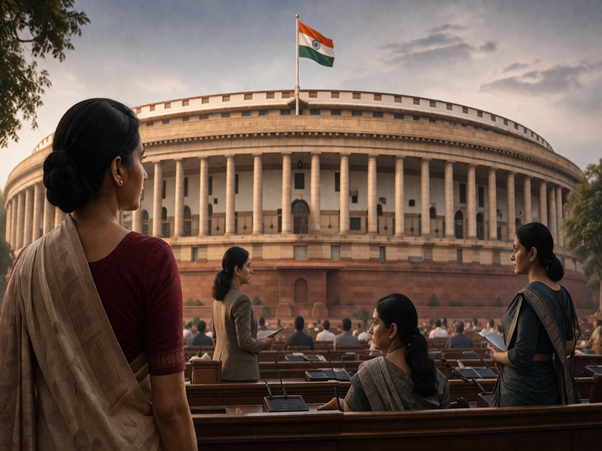
While taking my first oath as a Minister of State, I looked around the packed room and made a count. The number of women present in that space could be counted on a single hand. This visual left a mark, not as a personal achievement, but as a clear indication of the long distance that women are yet to traverse in the public sphere.
I belong to a small village near Puttur in coastal Karnataka, a traditionally rich region, where women have always shown their resilience and strength. I know what it meant to channel that strength into public life, to walk a path that few had walked before and how not every woman gets the same chance with that same fire.
The Nari Shakti Vandan Adhiniyam has already been passed. The Parliament spoke in September 2023; the Constitution was amended but now comes the difficult part: keeping that word.
Democracy That Represents Its People
India is home to 670 million women but for many long years, our lawmakers have represented merely 15% of that population. A democracy which continuously excludes half of its citizens from the process of decision-making cannot be considered as true democracy; it remains a work in progress. The Nari Shakti Vandan Adhiniyam is an important step towards completing this endeavour, but a law on paper holds little value unless it is effectively executed. The census needs to be conducted. Following that, delimitation must occur, and one third of the seats in both Parliament and every state assembly should be occupied by women in due course.
When women are included at the table where laws are made, the focal point of legislation changes. Panchayati Raj institutions where 33% reservation for women was implemented decades ago show a measurable shift in priorities. More budgets were allocated to water, health, education and child nutrition. There was less tolerance for corruption and more accountability to communities. It is not mere a coincidence. It is representation in action.
Breaking the Cycle
I have heard the argument that women should rise “on their own merit.” I respect the sentiment, but I reject the premise. Merit does not exist in a vacuum. It flourishes where opportunity exists.
For generations, structural barriers- social, economic and cultural- have kept brilliant women out of politics. The selection process for candidates has always favoured those who have well established networks and contacts, inherited political capital and freedom from domestic responsibilities. Women, on the other hand, have had none of these advantages in their favour.
Reservation does not lower the bar. It removes the wall.
Women were initially dismissed when they entered Panchayats in large numbers. Eventually, in study after study, they were rated as more effective, more accessible, and more honest than their male counterparts by their own communities. When given a fair chance, women do not just participate. They lead.
What This Means for Policy
My extensive experience in the government has taught me that who is in the room determines what is discussed. Women legislators push for maternal health funding when it would otherwise be cut. They flag the gendered impact of policies that might fall hardest on women in practice. They bring constituency concerns that male colleagues, through no fault of their own, simply do not encounter.
33% reservation in Parliament and state assemblies means that for the first time, these voices will not be exceptional. They will be structural. Permanent. Impossible to ignore.
Nari Shakti: From Vision to Law
Prime Minister Narendra Modi has long held that India cannot realise its full potential without the full and equal participation of its women. This is not rhetoric, but a conviction that has driven policy after policy, from Beti Bachao Beti Padhao to the record inclusion of women in Jan Dhan, Ujjwala and PM Awas Yojana. He has consistently spoken about Nari Shakti not as a slogan but as the foundation of a Viksit Bharat. The Nari Shakti Vandan Adhiniyam is the fullest expression of that vision, bringing women’s empowerment from welfare into the very structure of governance.
To My Colleagues Across Party Lines
This is a moment that belongs to all of us, not to any one party, but to Parliament as an institution. I appeal to all as a woman who has served this nation at every level of government, and I believe we all share the same desire to see India’s democracy stronger and more complete. What we owe to the women of India now is urgency, in conducting the census, completing delimitation, and ensuring not a single day is lost needlessly.
I understand the concerns around implementation, rotation of reserved seats, proxy candidates, sunset clauses. These are legitimate debates but we need to ensure that this gets immediate attention. The principle is sound. The need is urgent. Let us not allow the perfect to be the enemy of the transformative.
A Nation That Chooses to Be Just
History was made in September 2023. But history is only as meaningful as what follows it. A country that chooses to be just does its silent, lasting work of living by the laws it passes. For every young girl in any community who aspires to serve her country, for the leader who has never had a platform, and for the voice that has never been given a microphone, now is the time to act.
Implement this law. Make the room bigger. India is watching.
The author is the Union Minister of State for MSME and Labour & Employment