90% credit guarantee. 100% subsidy on certification. 3.5% govt procurement from women-owned MSMEs. India cannot rise unless its women rise with it.
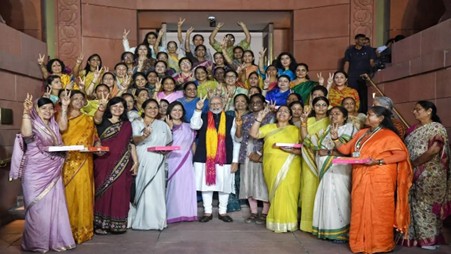
When Prime Minister Narendra Modi stood before Parliament and championed the Nari Shakti Vandan Adhiniyam in September 2023, reserving one-third of seats in the Lok Sabha and State Legislatures for women, he articulated a conviction that India cannot rise unless its women rise with it. That same intent is visible every single day in the work done by Government in MSME sector.
The MSME sector is often called the backbone of India’s economy. But if we look closely, at its heart stands the quiet force of women entrepreneurs. And today, that quiet force is finally receiving national recognition, institutional support, and policy momentum it has always deserved.
The Numbers Tell the Story
The scale of women’s participation in India’s MSME ecosystem is constantly expanding. As of early 2026, over 3.11 crore women-led enterprises stand registered on the Udyam Registration Portal and the Udyam Assist Platform. In fact, as per Udyam and Udyam Assist registrations, women-owned enterprises account for approximately 40% of all registered MSMEs in the country and play a significant role in employment generation. One of the most consequential reforms for women entrepreneurs has been the simplification of registration through the Udyam Registration Portal. Fully online, paperless, and based on self-declaration, it removed the bureaucratic gate keeping that disproportionately disadvantaged woman. The Udyam Assist Platform, launched in January 2023, went further in reaching women in the informal economy who lacked PAN or GSTN, and brought them within the embrace of Priority Sector Lending and government scheme benefits.
This is the direct result of a government that chose to place women at the centre of its economic agenda as drivers of growth.
Nari Shakti as Economic Force
Prime Minister Modi has consistently emphasized that empowering women is not a social obligation but is a national strategy. In his own words, when women are empowered, families are empowered, and when families are empowered, the nation grows from strength to strength.
The Nari Shakti Vandan Adhiniyam is the most visible expression of this philosophy in the political sphere. But in the economic sphere especially in the MSME sector, the government’s commitment to women has been translated into a comprehensive, multi-pronged policy framework that touches credit, skill, market access, recognition, and dignity.
A Policy Architecture Built for Women
The Ministry of MSME has systematically woven women’s empowerment into every major programme and scheme it runs.
Together, they support entrepreneurs through eight key intervention categories on the supply side: access to technology, access to credit and finance, promoting digitalization, infrastructure support, formalization and inclusion, access to market, and industry-grade skilling.
Over 3.2 lakh women-owned enterprises have been supported under the Prime Minister’s Employment Generation Programme (PMEGP) over the past five years. As of recent data, 39% of all PMEGP beneficiaries are women which are a testament to both the scheme’s design and women’s hunger to build.
The Credit Guarantee Fund Trust for Micro and Small Enterprises (CGTMSE) offers women borrowers enhanced guarantee cover of up to 90%, making banks more willing to extend credit without collateral demands.
Further, the Public Procurement Policy was amended to mandate that Central Ministries, Departments, and Public Sector Enterprises procure at least 3% of their annual procurement from women-owned micro and small enterprises. This creates a guaranteed, predictable market for women entrepreneurs’ thereby converting government spending into women’s business growth. It is encouraging to note that in financial year 2025-26, 3.5% of the total procurement by Central Ministries / Departments / Central Public Sector Enterprises was from women MSMEs.
Under the ZED (Zero Defect Zero Effect) Certification scheme, women-owned MSMEs receive 100% subsidy on certification costs. These details matter and they show the efforts of a Ministry that has thought carefully about where women face barriers and has placed targeted support at precisely those pressure points.
The Mahila Coir Yojana offers exclusive skill development and financial support to women artisans in the coir sector. Special focus is being given to handhold women for marketing preparedness through MSME-TEAM (Trade Enablement and Marketing) under which 50% of its 5 lakh beneficiary have been targeted to be women. The Yashasvini Campaign runs dedicated nationwide awareness drives to inform women about MSME schemes and registration benefits. Under the special MSME Idea Hackathon 3.0 organised for women entrepreneurs alone, over 18,888 ideas were received which clearly shows an overflow of creative and entrepreneurial energy waiting for an outlet.
Additionally, the ministry has a dedicated Women Entrepreneurship Cell (WEC), which serves as the nodal point for advancing women’s entrepreneurship by coordinating across schemes, monitoring and assessing outcomes for women, and engaging with ecosystem stakeholders.
All such initiatives have focused on gender targeting and convergence and reflect a trajectory from women’s inclusion as a subsidy provision within individual schemes toward a more deliberate, cross-cutting architecture for gender-responsive entrepreneurship support.
Skill, Confidence, Community
Beyond credit and markets, the government has recognized that entrepreneurship is also a matter of skill and confidence. In the North-East, where women have traditionally been the economic backbone of their communities, targeted Entrepreneurship Development Programmes have ensured women form the majority of trained participants.
Self-Help Groups have been integrated with MSME support ecosystems, creating communities of women entrepreneurs who support each other, building not just businesses but networks of mutual strength.
This is a government in forward motion. Each budget, each scheme, each portal simplification is a brick in an edifice that Prime Minister Modi began constructing with a simple but radical premise that India’s women are a potential to be unleashed.
The Spirit of Nari Shakti in Every Enterprise
The Nari Shakti Vandan Adhiniyam told the world that India’s women belong in its Parliament. The MSME policies of this Government are telling the world that India’s women belong in its marketplaces, its factories, its export chains, its innovation hubs, and its boardrooms.
These are two expressions of the same truth that Prime Minister Modi has made the cornerstone of his vision for a Viksit Bharat by 2047. A developed India is an India where more than 3 crore women entrepreneurs (and still counting) are the very engine of development.
We are not there yet. But under this Government’s watch, and with this Prime Minister’s commitment, we are unmistakably on our way.
The author is Union Minister of State, Ministry of Micro, Small & Medium Enterprises and Labour & Employment