The fate of the strait is directly linked to what happens next to the world economy
On Tuesday, two tankers were attacked as they transited the Strait of Hormuz via a passage in Omani waters. Gulf countries responded by sharply condemning the attacks and blaming Iran. The United States then launched attacks on Iranian territory, to which Tehran responded by striking Bahrain and Kuwait. US President Donald Trump has now said the memorandum of understanding (MoU) that Iran and the US signed is void.
This latest escalation illustrates how the Strait of Hormuz has become the central issue in the US-Israel war with Iran that began on February 28. Disagreements over the strait’s future have proven to be the hardest to resolve in the US-Iranian negotiations, as questions about Iran’s nuclear programme have been put to the side.
The disruption of traffic in the Strait of Hormuz has an immediate and costly price tag attached, for Iran, for its Gulf neighbours, and for a global economy that has spent four and a half months absorbing the largest oil supply shock in the history of the modern market.
Iran’s leverage is also its liability
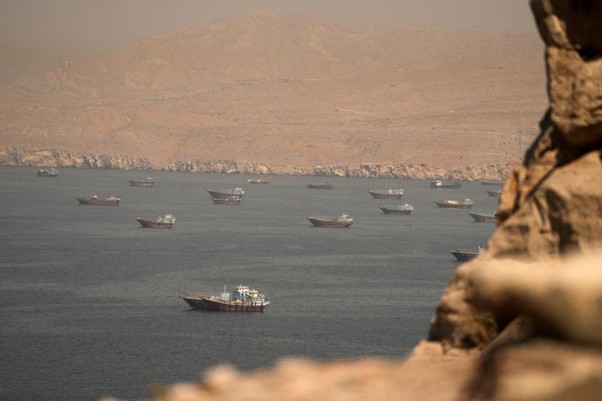
For Tehran, the strait is its strongest card – one that is also incredibly costly. Since the war began, Iranian forces have mined the strait, attacked vessels and cut traffic through the passage by roughly 95 percent. This has led to what the International Energy Agency’s Fatih Birol has called “the largest supply disruption in the history of the global oil market”.
That leverage is real: about a fifth of the world’s oil and a fifth of its liquefied natural gas (LNG) normally move through Hormuz, and no amount of Gulf pipeline capacity can fully replace it.
But Iran has effectively been strangling its own lifeline along with everyone else’s. Iranian crude, once sold for $3 a barrel less than international benchmarks, is now selling at a 20 percent discount. The country’s oil exports collapsed by more than 90 percent in May as US naval enforcement squeezed its shadow fleet.
Even before the war, the World Bank projected that Iran’s economy would contract in 2026. The impact of the collapse of oil sales will be far-reaching because of the closure.
A 60-day US Treasury waiver issued on June 22, permitting Iran to sell oil at full market rates through August 21, but has now been renounced following the attacks on Tuesday.
This is the economic backdrop to Iran’s insistence on asserting joint authority over the strait and floating a system of transit fees or “service charges” for passing ships. Washington has made clear that Iran cannot charge tolls in international waters governed by the right of transit passage under the Law of the Sea.
For Tehran, the dispute is not really about toll revenue, which would be rather modest when compared to its oil income; it is about establishing precedent and sovereignty over a chokepoint that is its only real point of leverage once sanctions relief and frozen-asset release are negotiated.
The latter is itself contested: Iran wants half of an estimated $25bn in frozen assets released immediately, while the US has resisted. A separate $300bn reconstruction fund floated in the MoU has already become a political flashpoint in Washington.
The Gulf is paying for a crisis it didn’t start
For the Gulf states, the Strait of Hormuz crisis has meant improvising around geography. Saudi Arabia has redirected crude through its roughly 1,200km (746-mile) East-West pipeline to the Red Sea port of Yanbu, and the UAE has leaned on the Habshan-to-Fujairah line to the Gulf of Oman.
Together, though, these pipelines carry a fraction of what Hormuz once did, at best 7 million barrels a day of design capacity for the Saudi line and under 1.8 million for the Emirati one, against roughly 20 million barrels a day that transited the strait before the war.
Both alternatives have themselves come under attack: Iranian strikes cut the East-West pipeline’s throughput by an estimated 700,000 barrels a day in April, and drone attacks disrupted loading at Fujairah. Seaborne crude exports from Gulf states excluding Iran fell by roughly half between February and March.
Qatar, host to the talks between Iran and the US, has its own acute stake: its entire LNG export industry depends on the Strait of Hormuz, and it has been pushing the hardest for a settlement.
Oman, drawn into Iran’s sovereignty claim as co-owner of the strait’s territorial waters, is caught between commercial interest in a resolution and a legal position, as a signatory to the United Nations Convention on the Law of the Sea (UNCLOS) that publicly rejects Iranian tolls. Iraq, highly dependent on its Gulf terminals, has quietly explored an export route north through Turkiye.
None of these workarounds are cheap, and all of them are political as well as commercial, tying Gulf capitals’ economic fortunes to a settlement between the US and Iran.
The rest of the world: Insurance bills and inflation
Beyond the region, the crisis has been transmitted mainly through two channels: price and insurance. Higher oil prices are passed on to various consumer goods down supply chains and suppress growth. According to estimates, the global economy can slow down to 2.8 percent in 2026 from 3.4 percent last year due to the closure of the strait.
Insurance for Hormuz transit, which cost roughly 0.25 percent of a vessel’s value before the war, has spiked as high as 8 percent, turning a single large tanker’s coverage into a $3m-to-$8m expense. Shipping lines including CMA CGM and Hapag-Lloyd have layered on conflict surcharges of $1,500 to $2,000 per twenty-foot equivalent unit (TEU). Washington’s own International Development Finance Corporation has had to step in as, in effect, an insurer of last resort, offering up to $40bn in reinsurance capacity to keep vessels moving.
China has absorbed the largest share of this pain: It takes close to 40 percent of its crude imports through the Strait of Hormuz and buys more than 80 percent of Iran’s oil exports outright, making it simultaneously Tehran’s most important customer and one of the war’s most exposed bystanders. Japan, which sources 70 percent of its Middle Eastern crude via the strait, has already tapped strategic reserves.
For import-dependent economies across Asia and Europe, the strait’s fate is not an abstraction of Middle East diplomacy; it shows up directly in fuel, freight and fertiliser prices.
Oil and gas dominate the headlines, but roughly 30 percent of the world’s seaborne fertiliser trade also passes through Hormuz.
The World Bank’s fertiliser price index has risen more than 12 percent in the first quarter of 2026 and has since climbed to its highest level since October 2022, driven largely by the closure. The Food and Agriculture Organization has warned that the resulting scarcity of urea and other nitrogen products will show up as lower yields through the 2026–2027 growing season, hitting import-dependent and already food-insecure countries in Africa and Asia the hardest.
Unlike an oil-price spike, which mainly stings at the pump, a fertiliser shortfall reaches into next year’s harvest, meaning an unresolved Hormuz standoff carries a slower-moving but longer tail of economic damage than crude prices alone suggest.
That is the arithmetic weighing on both sides. A deal that reopens the Strait of Hormuz without resolving who controls it risks recreating the same instability that shut it in the first place; one that concedes Iranian toll authority risks a precedent Washington and shipping nations will not accept. Until that circle is squared, the global economy is left pricing in a chokepoint that neither side can fully afford to keep closed, nor fully agree how to reopen.
The views expressed in this article are the author’s own and do not necessarily reflect Al Jazeera’s editorial policy. Abdulla Banndar Al-Etaibi is assistant professor in the Department of International Affairs at the College of Arts and Sciences, Qatar University. Courtesy: Al Jazeera