
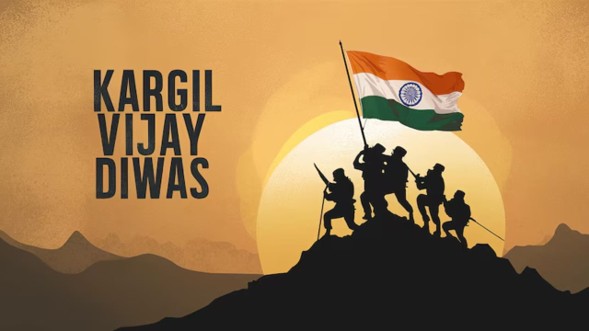
A Tribute To Valour, Sacrifice, And The Spirit Of India
Kargil Vijay Diwas honours the courage, sacrifice, and unwavering resolve of the Bravehearts of Operation Vijay. It commemorates India’s historic victory in the Kargil War and celebrates the spirit that safeguarded the Nation’s sovereignty. The occasion also reflects Kargil’s enduring legacy. It continues to strengthen India’s military preparedness, inspire generations, and reinforce the Nation’s unwavering commitment to its security.
When Courage Conquered The Peaks
The Kargil War stands among the greatest chapters in India’s military history. It reflects unmatched bravery, grit, and determination. It remains a lasting symbol of national pride and inspiration.
This year, the nation marks the 27th Kargil Vijay Diwas with gratitude and reverence. It commemorates India’s historic victory in 1999. Indian soldiers reclaimed the snow-covered heights of Kargil through extraordinary courage and unwavering resolve. On 26 July, the Tricolour once again flew proudly over the rugged mountains of Ladakh. It became a timeless symbol of sacrifice, valour, and India’s unbreakable spirit.
The Kargil conflict began in May 1999. Intruders crossed the Line of Control and occupied Indian positions on commanding heights. Their aim was to cut the link between Kashmir and Ladakh. The larger objective was to force India into negotiations on the Kashmir dispute. But they underestimated the will of a nation. India responded with Operation Vijay. The mission reflected meticulous planning, unwavering determination, and the indomitable spirit of Indian soldiers. After more than two months of intense fighting, every intruder was driven out. Every occupied position returned to Indian control.
The Road To Operation Vijay
The Kargil War began in the summer of 1999, soon after the Lahore Declaration. While much of India endured scorching heat, fierce battles unfolded across the icy heights of Kargil. Pakistani forces infiltrated Indian territory and occupied winter vacated posts on commanding ridges. The conflict tested courage, endurance, and sacrifice in one of the world’s harshest battlefields. It remains the only conventional war fought between two nuclear armed nations.
The Infiltration
The intrusion was part of Pakistan’s Operation Badr. Pakistani forces, disguised as Kashmiri terrorists, crossed the Line of Control and occupied Indian positions. Their aim was to cut the link between Kashmir and Ladakh. They also sought to isolate Indian Army troops on the Siachen Glacier. The larger objective was to force India into negotiations on the Kashmir dispute.
On 3 May 1999, local residents first reported suspicious movement in the Kargil sector. Reconnaissance patrols were immediately dispatched. Extensive patrolling and aerial surveillance soon revealed the scale of the occupation. The infiltrators had entrenched themselves on dominating heights overlooking the Srinagar to Leh Highway. Many positions stood above 5,000 metres, making every military operation exceptionally challenging.
Operation Vijay Begins
India responded with restraint, resolve, and determination. The government directed that the Line of Control would not be crossed. The mission was clear. Every occupied post had to be reclaimed.
The Indian Army launched Operation Vijay to evict the intruders. The Indian Air Force joined the campaign through Operation Safed Sagar on 26 May 1999. The Indian Navy also deployed in full strength, demonstrating India’s resolve across every domain. Together, the three Services executed a coordinated campaign.
Operation Vijay followed the strategy of contain, evict, and deny. Priority was given to recapturing the heights dominating the Srinagar to Leh Highway. Additional troops, artillery, engineers, specialised equipment, and logistics were rapidly inducted. Soldiers climbed near vertical cliffs under relentless enemy fire. They battled freezing temperatures, thin air, and unforgiving terrain.
Battles That Changed The Course Of The War
The Battle of Tololing marked one of the first major breakthroughs of the campaign. Indian troops launched their assault in the last week of May 1999. Point 4590 and Tololing was fully recaptured on 13 June, opening the way for further advances.
The Battle of Tiger Hill became one of the defining moments of the war. Tiger Hill was among the highest peaks in the Dras sector and one of the Indian Army’s most important objectives. After a daring assault, the peak was recaptured on 4 July 1999, significantly shifting the momentum in India’s favour.
Fierce fighting also took place at Point 4875, Batalik, Mushkoh Valley, and Kaksar. Indian soldiers fought peak by peak to reclaim every occupied position. After nearly three months of relentless operations, every occupied Indian post was recaptured. India secured victory without crossing the Line of Control, earning global respect for its restraint, professionalism, and unwavering resolve.
A Victory That Inspired A Nation
The Kargil War became a defining chapter in India’s history. It showcased the extraordinary courage of Indian soldiers and united the nation in pride. On 14 July 1999, then Prime Minister Atal Bihari Vajpayee addressed the nation and declared Operation Vijay a success. He paid tribute to the courage, sacrifice, and unwavering resolve of the Armed Forces.
The victory reaffirmed that every inch of Indian territory would be defended at any cost. It strengthened the nation’s faith in its Armed Forces and inspired generations of Indians.
The Bravery That Defined Kargil
The victory in Kargil was made possible by countless acts of courage. Every peak reclaimed reflected the determination and sacrifice of India’s Armed Forces. While every soldier contributed to Operation Vijay, several acts of exceptional gallantry became defining moments of the conflict. Heroes such as Grenadier Yogendra Singh Yadav, Captain Vikram Batra, Captain Vijyant Thapar, and many others became symbols of courage and selfless service.
The nation honoured this extraordinary valour with its highest military decorations:
– 4 soldiers awarded the Param Vir Chakra
– 9 awarded the Maha Vir Chakra
– 55 honoured with the Vir Chakra
– 1 conferred the Sarvottam Yudh Seva Medal
– 6 received the Uttam Yudh Seva Medal
– 8 awarded the Yudh Seva Medal
– 83 personnel received the Sena Medal
– 24 awarded the Vayu Sena Medal
These honours reflect the extraordinary courage, leadership, and sacrifice displayed during the Kargil War.
From Battlefield Lessons to a Stronger Defence Ecosystem
The Kargil War became a turning point in India’s defence journey. It highlighted the need for stronger coordination, faster modernisation, and greater self-reliance. Over the years, India has undertaken wide ranging reforms to strengthen its defence ecosystem and build indigenous capabilities.
Key Reforms And Initiatives
Establishment of the Department of Military Affairs: Created as a part of Higher Defence Management Reforms, it functions under the CDS and promotes jointmanship among the Army, Navy, and Air Force.
Creation of the Chief of Defence Staff: The CDS serves as the single point military adviser to the Government. General Bipin Rawat became India’s first CDS in 2020. The post is currently held by General N. S. Raja Subramani.
Foreign Direct Investment in Defence: The FDI limit has increased to 74 per cent through the Automatic Route and up to 100 per cent through the Government Route. As of March 2026, the sector has attracted FDI worth ₹6,670.59 crore.
Enhanced Defence Budget: India’s defence allocation has risen steadily from ₹2.53 lakh crore in 2013–14 to ₹7.85 lakh crore in 2026–27. Capital expenditure has increased from ₹94,587.95 crore in 2014–15 to ₹2.19 lakh crore in 2026–27.
Growth in Defence Production and Exports:
– Defence production reached an all-time high of ₹1.78 lakh crore in 2025–26, almost four times higher than ₹46,429 crore in 2014–15.
– Defence exports increased from ₹686 crore in 2013–14 to ₹38,424 crore in 2025–26, a rise of more than 56 times.
– Indian defence products are now exported to over 80 countries.
– Nearly 65 per cent of defence equipment is now produced within the country, compared to an earlier import dependence of 65 to 70 per cent.
Srijan Defence Portal: Connects Defence Public Sector Undertakings and Service Headquarters with industries, MSMEs, and startups for indigenisation.
Positive Indigenisation Lists: Till May 2026, five Positive Indigenisation Lists covering 5,012 items of DPSUs have been notified. More than 15,700 defence items have been indigenised during the last five years.
Defence Industrial Corridors:
– Uttar Pradesh Defence Industrial Corridor: Investment commitments worth ₹42,057 crore, with grounded investments of ₹4,409 crore.
– Tamil Nadu Defence Industrial Corridor: Investments worth ₹32,699 crore, with actual investments reaching ₹6,446 crore.
Agnipath Scheme: Launched to recruit young men and women into the Armed Forces as Agniveers for a four-year service period, creating a youthful, tech-savvy, and combat-ready military force.
Towards A Future Ready Military
Modern conflicts demand advanced technology, superior firepower, and rapid decision making. India has strengthened its military capabilities through the induction of modern platforms and the development of next generation defence technologies.
Modern Platforms In Service
– Arjun Mk IA Battle Tank: Inducted in February 2021, strengthening indigenous armoured capability.
– INS Vikrant: India’s first indigenous aircraft carrier, commissioned on 2 September 2022.
– Rafale Fighter Aircraft: By 2030, India will operate 62 Rafale aircraft, including 26 Rafale M.
– Apache and Chinook Helicopters: Enhanced combat capability and strategic airlift capacity.
– Drone Warfare: Integrated into military doctrine for surveillance, reconnaissance, and precision operations.
– BrahMos Cruise Missile: Multi-platform supersonic cruise missile with a range of up to 290 kilometres.
– Project 17A Stealth Frigates: Seven next generation guided missile warships designed for anti-air, anti-surface, and anti-submarine warfare.
– Sandhayak Class Survey Vessels: Strengthening India’s hydrographic capability.
– Arnala Class Anti-Submarine Warfare Shallow Water Craft: Eight indigenous ships strengthening coastal defence.
Emerging Technologies And Strategic Capabilities
– Mission Shakti: Anti-satellite missile test conducted on 27 March 2019.
– Artificial Intelligence in Defence: 75 AI based technologies introduced in 2022 for surveillance, cyber security, logistics, and autonomous systems.
– Mission Divyastra: Long range missile with multiple warheads tested on 11 March 2024.
– Pinaka Long Range Guided Rocket: Maiden flight test on 29 December 2025, demonstrating a maximum range of 120 kilometres.
– Advanced Air Defence System: Successfully tested on 23 August 2025.
– Hypersonic Missile Technologies: Long duration scramjet combustor ground test completed in January 2026.
– Kusha Long Range Surface to Air Missile: Maiden flight test in July 2026, neutralising fighter jets, missiles, and UAVs.
– Long Range Land Attack Cruise Missile: Successfully flight tested in June 2026.
– Netra Airborne Early Warning and Control System: Final Operational Clearance certificate handed over in June 2026.
Kargil’s Enduring Legacy
Surgical Strikes and Balakot Air Strikes
Following the Uri terror attack, India conducted Surgical Strikes on 28 and 29 September 2016. On 26 February 2019, the Balakot airstrikes eliminated a large number of Jaish-e-Mohammad terrorists in an intelligence-led operation.
Operation SINDOOR
In May 2025, following the Pahalgam terror attack, the Armed Forces struck nine terrorist camps in Pakistan and Pakistan occupied Jammu and Kashmir. The operation relied on accurate intelligence, drones, loitering munitions, and layered air defence. Over 100 terrorists were killed in action, including individuals linked to IC-814 hijack and Pulwama blast.
Celebrating The Spirit Of Kargil
Shaurya Vijay Yatra: Flagged off on 14 July 2026, a 1,900-kilometre motorcycle expedition from the National War Memorial to the Kargil War Memorial in Dras.
Wheels of Valour: Sanchar Shakti: The Corps of Signals Dare Devils created a world record on 1 July 2026, performing on motorcycles inside the 9.8-kilometre Atal Tunnel.
Tiger Hill Expedition 2026: Organised on 17 July 2026 to promote military tourism while preserving the legacy of the Kargil War.
Honouring Veterans and Bravehearts: Tri Services Ex Servicemen visited the Kargil War Memorial and Heritage Hut Museum on 16 July 2026.
Commemorative Treks and Military Displays: 137 soldiers undertook a trek to Point 5140 on 13 July 2026. A Weapon and Equipment Display was organised at Hanle.
Leh to Dras Motorcycle Expedition: Indian Army riders undertook an expedition from Leh to the Kargil War Memorial on 12 and 13 July 2026.
The Victory That Lives On
Twenty-seven years later, the echoes of Kargil still resonate across the Nation. The victory stands as an enduring symbol of courage, sacrifice, and unwavering patriotism. Every peak recaptured reminds us that India’s sovereignty is non-negotiable and will be defended at any cost.
Inspired by the valour of its Bravehearts, India has emerged stronger, better prepared, and increasingly self-reliant. As the Nation salutes the heroes of Kargil, it also renews its solemn resolve to uphold their legacy. Their courage will forever inspire generations to serve the Nation with honour, duty, and unwavering commitment.
This is an abridged version of the original PIB article. All important points, figures, and key messages have been retained. For complete details, please refer to the full release on the PIB website.