
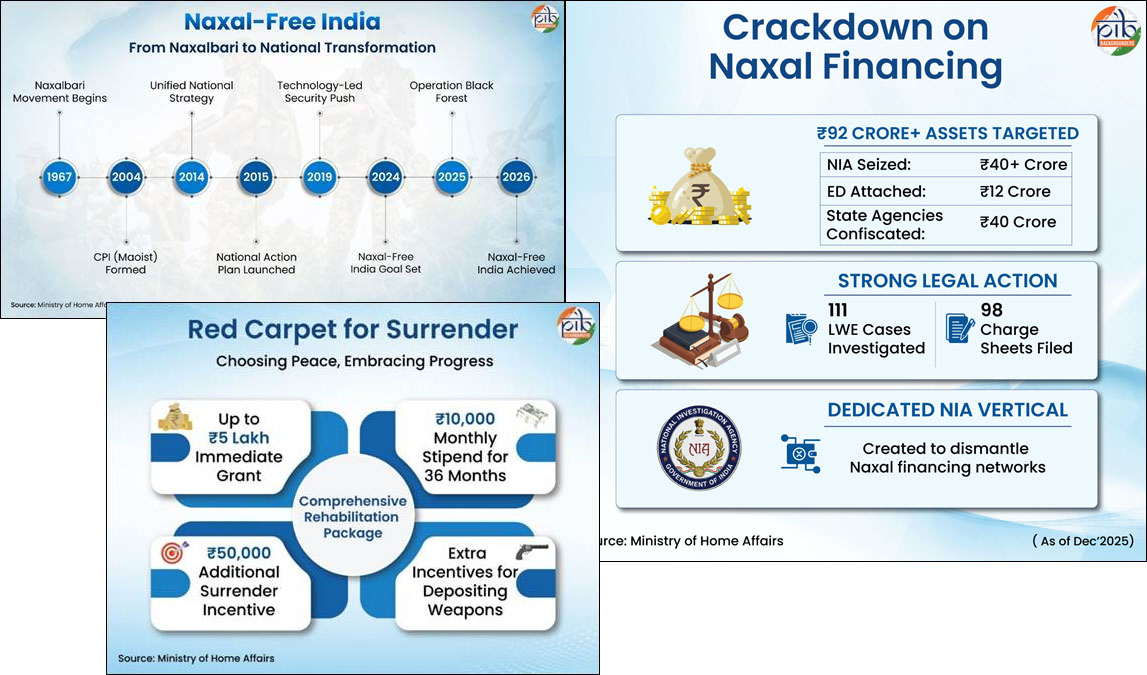
India has achieved the historic milestone of becoming effectively free from Left Wing Extremism (LWE), with no district in the country remaining LWE-affected. This transformation was driven by an integrated strategy combining security operations, infrastructure expansion, rehabilitation of surrendered cadres, tribal welfare, and improved governance. The coordinated approach sharply reduced violence, restored state presence in remote regions, and accelerated inclusive development, creating a lasting foundation for peace and prosperity.
New Era of Peace and Security
For nearly six decades, India grappled with Left-Wing Extremism (LWE). It was not a distant or abstract challenge, but a lived reality for millions of tribal families, villages cut off from roads, schools, and the broader promise of inclusive development. Violence was persistent, and uncertainty defined everyday life.
On 31 March 2026, this changed, marking a historic milestone in India’s internal security journey as the country became effectively free from Naxalism. When the current government assumed office in May 2014, the Red Corridor remained one of the most serious internal security challenges. Earlier approaches were largely fragmented and incident-driven, managing symptoms rather than addressing the structural roots of the problem. A more comprehensive and integrated strategy was subsequently pursued to resolve it.
Over the last twelve years, the transformation was guided by three mutually reinforcing strands of action: restoring trust and faith through strengthened security operations and community outreach; expanding infrastructure through improved physical and digital connectivity; and delivering welfare focused on dignity, inclusive service delivery, and mainstreaming affected communities.
Restoring Faith in the State
LWE grew from the Naxalbari uprising of West Bengal in 1967, inspired by Maoist ideology and the doctrine of armed revolution. Its guiding principle was simple and violent: power flows from the barrel of the gun. Nearly 92 per cent of Naxalites’ weapons were looted directly from police armouries. Over time, several extremist organisations merged under CPI (Maoist) in 2004, making it India’s biggest internal security challenge.
The decade from 2004 to 2014 was among the most violent in LWE history. Violence peaked in 2010 with 1,936 incidents and 720 civilian deaths in a single year. The full decade recorded 17,542 violent incidents, 1,913 security force deaths, and 5,019 civilian deaths. There was no consistent national policy. State governments operated in silos.
Policy Shift: From Scattered Response to Unified Strategy
The first decisive action came in 2015 with the approval of the National Policy and Action Plan to address LWE. This replaced the earlier, ad hoc approach with a structured, whole-of-government framework. It deployed Central Armed Police Forces (CAPF), provided specialised training, and allocated funds through various schemes. Till now, approximately ₹4,289.20 crore have been released since the inception of the Special Central Assistance (SCA) Scheme in 2017.
Under the Special Infrastructure Scheme (SIS), projects worth ₹1,761 crore have been sanctioned for LWE-affected States. Since 2014-15, ₹3,805.04 crore has been released under the Security Related Expenditure (SRE) Scheme.
For the first time, India implemented a structured and comprehensive approach based on a three-pronged strategy against LWE: Dialogue, Security, and Coordination.
On 24th August 2024, the Government of India set a target to make the country Naxal-free by 31 March 2026. The target was achieved on schedule through intensified security operations, stronger coordination, infrastructure expansion, and accelerated development outreach.
Building the Security Grid
The Government systematically filled the security vacuum in Naxal-affected areas through infrastructure expansion, specialised forces, and improved operational coordination.
– 663 fortified police stations were constructed, compared to just 66 before 2014
– 408 new CAPF security camps were established over the past seven years
– 68 night-landing helipads were built for rapid deployment
– 400 bullet-proof and blast-proof vehicles were provided
– 5 hospitals were constructed for welfare and medical support
A layered, specialised security architecture was developed, bringing together CoBRA, CRPF, District Reserve Guard (DRG), and elite state units such as Jharkhand Jaguar, Chhattisgarh Police units, and Andhra Pradesh’s Greyhounds.
Technology: The Game Changer
After 2014, the Central Government transformed counter-Naxal operations through the extensive use of modern technology. Unmanned Aerial Vehicles (UAV), drones, satellite imagery, and AI-based data analysis enabled real-time monitoring and precise surveillance. Advanced location-tracking systems, scientific call-log analysis, mobile data analytics, and social media monitoring were operationalised.
Landmark Operations to Trace, Target, Neutralise
The Government’s “Trace, Target, Neutralise” doctrine delivered remarkable results. A series of coordinated operations, including Operation Black Forest, Operation Octopus, Operation Double Bull, Operation Thunderstorm, Operation Bhimbarg, and Operation Chakrabandha, significantly weakened Maoist networks.
Among them, Operation Black Forest emerged as a major breakthrough, dismantling a key Maoist stronghold, leading to the elimination of over 30 Maoists. Operation Double Bull resulted in Gumla, Lohardaga, and Latehar districts becoming Naxal-free.
Choking the Support System
The Union Government adopted a comprehensive All-Agency approach, targeting not just armed cadres but the entire ecosystem supporting them. A dedicated vertical was established within the National Investigation Agency (NIA) to disrupt Naxal financing networks. As of December 2025, the NIA had seized assets worth over ₹40 crore. The Enforcement Directorate attached assets worth ₹12 crore, while State agencies confiscated an additional ₹40 crore. By December 2025, 111 LWE cases had been investigated and 98 charge sheets filed.
Red Carpet for Surrender
The Government’s firm security response has been complemented by a rehabilitation-focused approach, with a clear message: “For those who lay down their arms, there is a red carpet.” Surrendering cadres receive an immediate grant of ₹5 lakh for higher-ranked cadres and ₹2.5 lakh for others, along with a monthly stipend of ₹10,000 for 36 months.
In 2025 alone, 2,337 Naxalites laid down their arms, while 3,927 cadres surrendered between 2024 and March 2026.
On 28 July 2026, under ‘Nayi Disha, Nayi Pahal’ anti-Naxal campaign, 16 active Maoists surrendered in Ranchi, including one Regional Commander, three Zonal Commanders, and three Sub-Zonal Commanders. On 29 July 2026, eight more Maoists carrying a combined reward of ₹49 lakh surrendered before the Bijapur Police. On the same day, security forces also arrested a top Maoist leader and Politburo member carrying a reward of ₹1 crore.
Building a New Future: Infrastructure and Connectivity
The resolve to end Naxalism was never merely about eliminating Naxalites. It was about ensuring that every facility available in big cities reaches the poor tribals of the region.
Road Connectivity: A total of 15,189 kilometres of roads have been constructed under the Road Requirement Plan (RRP) and the Road Connectivity Project for LWE Affected Areas (RCPLWEA).
Digital & Mobile Connectivity: 9,497 towers have been commissioned. In the areas that were most LWE affected, 96% of villages (44,728 out of 46,592 villages) now have mobile connectivity.
Financial Inclusion: During April 2015 to March 2026, 1,804 bank branches opened, 1,321 ATMs installed, 74,720 banking correspondents appointed, and 6,025 post offices established.
Education & Skill Development: 259 Eklavya Model Residential Schools (EMRS) have been sanctioned, with 179 made functional. Additionally, 47 Industrial Training Institutes (ITIs) and 49 Skill Development Centres (SDCs) were developed with an investment of nearly ₹800 crore. Skill training was provided to over 90,000 youth and women.
Under the Tribal Youth Exchange Programme (TYEP) , a total of 37,655 tribal youth have participated since 2014.
Civic Action Programmes: Since 2014, ₹221.88 crore has been released under the programme, helping strengthen trust and bridge the gap between security forces and local communities.
People’s Welfare & Dignity
A sustained focus on tribal welfare has played a vital role in reducing LWE’s influence. The rehabilitation framework for surrendered cadres has encouraged their integration into mainstream society through skill development, livelihood assistance, housing support under Pradhan Mantri Awas Yojana, and financial assistance for self-employment.
Several targeted initiatives accelerated this transformation: the National Policy and Action Plan, Special Central Assistance, the Aspirational Districts Programme, and the PM-JANMAN initiative for Particularly Vulnerable Tribal Groups (PVTGs). The launch of the Dharti Aaba Janjatiya Gram Utkarsh Abhiyan further strengthened efforts to bridge infrastructure gaps in tribal villages.
Case Study: Chhattisgarh’s Journey from Naxalism to Development
For decades, Bastar in Chhattisgarh remained one of the country’s most Naxal-affected regions. A key turning point came in 2017 with the formation of the Bastariya Battalion, which recruited 1,143 personnel, including around 400 local youth. More than 3,240 kilometres of roads were constructed, and 889 mobile towers were installed.
In May 2026, the Shaheed Veer Gunda Dhur Seva Dera initiative was launched to convert security gains into lasting development. Around 70 CAPF camps are being transformed into service centres. Cultural initiatives such as Bastar Pandum and the Bastar Olympics strengthened community participation and tribal identity.
Results of a Decade of Transformation
The results of a decade of transformation are clearly reflected in the key indicators of Left Wing Extremism. The number of LWE-affected districts declined sharply from 126 in 2014 to zero by 2026. Similarly, the count of the most affected districts also fell from 35 to zero during the same period. Naxal-related incidents dropped from 870 in 2014 to just 33 in 2026. Fatalities also saw a significant reduction, coming down from 310 to 11 over the decade.
A Defining Chapter in India’s Security and Development Story
India’s achievement of a Naxal-Free India stands among the most important internal security successes in the country’s independent history. It reflects the impact of decisive leadership, sustained policy implementation, and a multi-dimensional strategy combining security, development, and rehabilitation.
The next journey has already begun. The achievement of a Naxal-Free Bharat is not merely the end of an insurgency. It is the beginning of a new chapter of peace, inclusion, and progress for some of India’s most vulnerable communities.
Disclaimer: This is an abridged version of the original PIB article. All significant points and key messages have been retained. For complete details, please refer to the full release on the PIB website.