
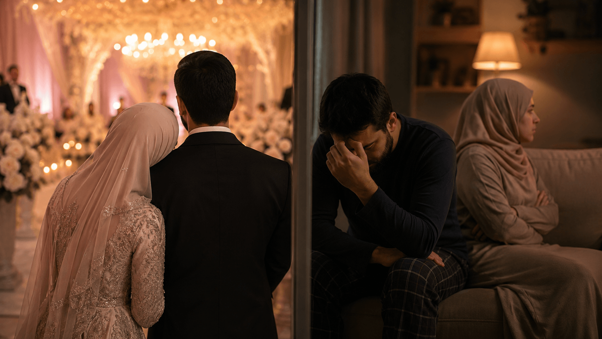
A wedding lasts for a day, but marriage is the life that comes afterward
Luxury weddings. Constant romance. Perfect husbands and wives. “Relationship goals.” And the expectation that a happy marriage should always feel happy. Scroll through Instagram, TikTok, YouTube, or any social media platform today, and marriage can begin to look almost magical.
We see beautifully decorated homes, surprise flowers, expensive anniversary dinners, matching outfits, romantic vacations, thoughtful gifts, and couples laughing together in perfectly edited videos. There is nothing inherently wrong with any of these things. The problem begins when we start comparing our real marriages to someone else’s carefully selected moments.
Social media can quietly teach us to believe that a successful marriage must look a certain way, and for Muslims, this can be particularly dangerous when those expectations begin to replace the Islamic understanding of marriage.
Allah gives us a very different picture of what marriage is meant to provide. In Surah Ar-Rum, Allah says, “And of His signs is that He created for you from yourselves mates that you may find tranquility in them; and He placed between you affection and mercy” (Qur’an 30:21).
Notice what Allah highlights: tranquility, affection, and mercy. He does not describe marriage as a life of luxury, constant excitement, or uninterrupted happiness. He describes something much deeper. Marriage is meant to become a place of sakinah, where two people can find comfort and security, and a relationship built upon affection and mercy.
One of the first expectations social media has dramatically changed is the idea that a wedding must be extraordinary. Today, weddings can easily become visual productions. The venue must be impressive, the decorations must be spectacular, the clothes must be luxurious, the photography must look cinematic, and every moment must be worthy of posting. It is easy to start believing that the more beautiful and expensive the wedding, the more successful the marriage will be.
But a wedding lasts for a day, while marriage is the life that comes afterward. There is nothing wrong with celebrating a nikah beautifully or sharing happiness with family and friends, but when appearances become more important than the actual responsibilities of marriage, priorities have shifted. A couple can spend enormous amounts of money creating a wedding that looks perfect while beginning their married life under financial pressure.
Another couple may have a simple nikah and a modest celebration but build a deeply loving and peaceful home. Which marriage is more successful? The one that photographs better? Islam teaches us to look beyond appearances. When the Prophet ﷺ spoke about choosing a spouse, he mentioned qualities such as wealth, family status, beauty, and religion, but directed believers toward religion as the quality that should ultimately be prioritized. The person you marry matters far more than the wedding you have.
Another expectation social media has created is that a good spouse should be romantic all the time. Online, marriage can look like one continuous romantic experience. Every morning begins with affection, every anniversary involves a surprise, every disagreement is resolved beautifully, and every ordinary moment becomes a romantic memory. But real marriage is not a two-minute relationship montage.
Real marriage involves tired mornings, bills, work, household responsibilities, misunderstandings, different personalities, family pressures, parenting, illness, and emotional exhaustion. Sometimes love looks like flowers or a surprise dinner, but sometimes love looks like washing the dishes because your spouse is exhausted.
Sometimes love is an affectionate message, while at other times it is simply remaining patient when you are frustrated. This is why the Qur’anic concept of rahmah, or mercy, is so important. Allah did not only mention affection between spouses; He mentioned affection and mercy. There will be moments when affection comes naturally, but there will also be moments when mercy is what keeps you gentle with one another.
A marriage cannot survive on romance alone. It requires compassion, patience, forgiveness, responsibility, and the willingness to continue treating your spouse with kindness even during difficult seasons.
Social media has also encouraged another unrealistic expectation: the belief that our spouse should be perfect. We see videos of the endlessly patient husband, the emotionally intelligent wife, the spouse who always knows exactly what to say, the person who never forgets an important date, never loses their temper, communicates perfectly, and seems to understand their partner without explanation.
Eventually, we can begin looking for this imaginary person in our own marriages. But there is no perfect husband and no perfect wife. Marriage brings two imperfect human beings together. You will discover habits you did not notice before marriage. You will misunderstand one another. You will sometimes say the wrong thing. Your spouse will have weaknesses, and so will you. That does not necessarily mean you married the wrong person.
Sometimes it simply means you married a human being. The Sunnah teaches us to value character, faith, and good qualities rather than searching for an impossible standard of perfection. Social media, however, allows us to see the finished product without seeing the struggle behind it. We may see a loving husband on camera without seeing the difficult conversation the couple had the night before. We may see a smiling wife without seeing the exhaustion behind the smile. We have to remind ourselves that we should never compare our behind-the-scenes to someone else’s highlight reel.
Perhaps one of the most damaging expectations is the idea of “relationship goals.” The phrase sounds harmless, but it can slowly turn another person’s marriage into the measuring stick for our own. You see another couple traveling and suddenly your marriage feels boring. They buy a house and you feel behind. They have children and you begin questioning your own circumstances. They post romantic messages and you wonder why your spouse doesn’t express love in the same way. They celebrate an anniversary extravagantly and suddenly your own celebration feels inadequate.
Slowly, someone else’s marriage becomes the standard by which you judge your own. But social media gives us access to moments, not entire marriages. We don’t know their financial situation, their private struggles, their disagreements, their disappointments, or what happens when the camera is turned off. A couple may post one beautiful photograph from a holiday while privately dealing with serious difficulties.
Another couple may never post anything at all and have an extraordinarily loving marriage. Your marriage does not need to be Instagram-worthy to be meaningful. Some of the most precious moments in a marriage are the ones nobody else sees: the quiet conversation after Fajr, the meal prepared after a long day, the dua made for your spouse, the apology, the forgiveness, the private joke, or the sacrifice that nobody applauded. These moments may never become content, but they may be exactly what makes a marriage strong.
Perhaps the most dangerous expectation social media has created is the belief that marriage should make us happy all the time. We are constantly shown couples who appear to be enjoying every moment of life together, and it can become easy to believe that if we are frustrated, lonely, bored, or disappointed, something must be fundamentally wrong with our marriage. But marriage can bring enormous happiness while still containing difficult moments.
Life itself was never designed to be a continuous state of happiness. There will be financial difficulties, illness, grief, disagreements, parenting challenges, and seasons when one spouse has to carry more responsibility because the other is struggling. Islam does not describe marriage as an endless emotional high. Allah describes spouses as a source of tranquility, affection, and mercy. Tranquility is different from constant excitement.
A peaceful marriage may not always feel exciting. Sometimes it simply feels safe, stable, familiar, and comforting. Sometimes the greatest blessing is knowing that someone is beside you through the difficult seasons of life. The goal should not be to chase constant happiness but to build something good, meaningful, and pleasing to Allah.
So what should Muslims expect from marriage if social media has given us so many unrealistic expectations? Perhaps the answer is to return to the Qur’an. Allah gives us a beautiful framework: tranquility, affection, and mercy. These qualities require work. Tranquility means creating a home where your spouse feels safe. Affection means continuing to nurture love rather than assuming it will take care of itself.
Mercy means recognizing that the person beside you is imperfect, just as you are. Marriage is not about finding someone who perfectly completes your fantasy. It is about finding someone with whom you can build a life. And building a life requires patience, sacrifice, forgiveness, communication, responsibility, and faith.
The next time you see a couple online and think, “Why isn’t my marriage like that?” pause for a moment. You are looking at a few seconds of someone’s life, not their entire marriage. The next time you think, “My spouse doesn’t do these romantic things, so maybe they don’t love me,” ask yourself how your spouse might be showing love in ways that social media does not celebrate. Perhaps they work long hours to provide.
Perhaps they take care of responsibilities when you are exhausted. Perhaps they listen when you need someone to talk to. Perhaps they make sacrifices quietly. Perhaps they express love differently from the couples you see online. Love does not always look cinematic. Sometimes it looks ordinary, and ordinary can be beautiful.
There is a kind of marriage that will probably never go viral. It will not receive millions of views or become someone’s “relationship goals.” There will be no trending audio, perfect photoshoot, or carefully edited montage.
Instead, there will be two people waking up for Fajr, making dua for one another, disagreeing without humiliating each other, apologizing when they are wrong, forgiving one another, raising children, dealing with financial difficulties, supporting each other through illness, helping each other return to Allah after spiritual weakness, and growing older together. That marriage may never impress strangers on the internet, but it may be far closer to what Allah intended.
Social media will continue showing us perfect weddings, perfect couples, perfect homes, perfect anniversaries, and seemingly perfect lives. But we should never allow a perfectly edited image to make us dissatisfied with a real life. Your marriage does not have to look perfect. It has to be real, sincere, compassionate, and rooted in what pleases Allah. Perhaps the most beautiful marriage is not the one everyone envies online. It is the one that quietly brings two people closer to Allah.
Courtesy: IslamiCity