
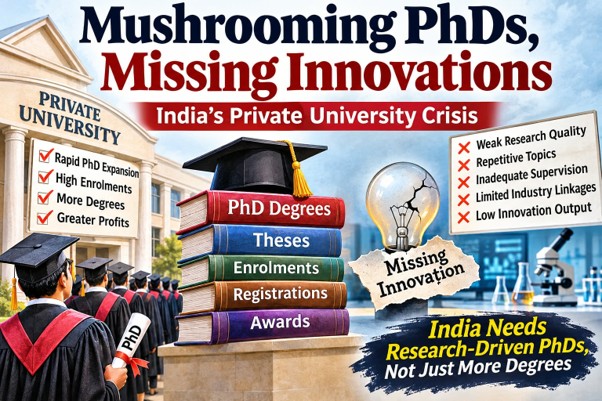
India must move from PhD expansion to research excellence. Without innovation, the mushrooming of doctoral degrees risks becoming an expansion of credentials rather than an advancement of knowledge.
India’s higher education system is witnessing an unprecedented expansion of doctoral programmes, particularly in private universities. PhD degrees, once regarded as the highest symbol of intellectual achievement, are increasingly becoming a subject of concern. The critical question is no longer how many doctoral scholars India produces, but how much knowledge, innovation, and social transformation these scholars contribute. The mushrooming of PhD programmes without corresponding improvements in research quality threatens the credibility of Indian academia.
Private universities have played an important role in expanding access to higher education. They have invested in infrastructure, introduced new academic programmes, and created opportunities for research scholars. However, the rapid growth of doctoral enrolments also raises serious questions about institutional preparedness, research supervision, academic integrity, and the actual contribution of doctoral research. Expansion without quality is not progress; it is an invitation to academic mediocrity.
A PhD is not merely an academic qualification. It represents the ability to identify a meaningful research problem, develop original ideas, apply rigorous methodologies, and contribute new knowledge to society. Unfortunately, in some institutions, the doctoral process risks becoming a mechanical exercise involving admission, registration, coursework, thesis submission, and the award of a degree. When the emphasis shifts from intellectual discovery to procedural completion, the very purpose of doctoral education is undermined.
The central concern is the growing disconnect between the number of PhDs produced and the innovations generated. India needs researchers who develop new technologies, improve agricultural productivity, strengthen financial institutions, address healthcare challenges, and provide solutions to pressing social and economic problems. Yet, research that remains confined to university libraries, with little practical application or academic influence, cannot adequately serve the country’s developmental aspirations.
Another serious concern is the quality of research supervision. A doctoral supervisor is expected to act as a mentor, intellectual guide, and guardian of academic integrity. However, excessive supervisory workloads, inadequate research infrastructure, and weak institutional monitoring can compromise the quality of doctoral training. In some cases, the relationship between supervisor and scholar may become excessively hierarchical, limiting independent thinking and intellectual creativity.
The problem is not exclusive to private universities. Public institutions also face challenges related to research quality, funding, supervision, and accountability. Nevertheless, private universities must demonstrate that their doctoral programmes are driven by academic excellence rather than institutional expansion or the commercial value of higher education. The credibility of a university depends not on the number of PhD scholars it enrols but on the quality of its research outcomes.
The proliferation of repetitive research topics is another major challenge. Numerous doctoral theses address similar problems using conventional methodologies, with limited originality or meaningful theoretical advancement. Research scholars may spend years examining familiar issues without producing fresh insights. A doctoral thesis that merely reproduces existing knowledge, changes the geographical setting, or applies an established model to another dataset cannot automatically be considered a significant contribution.
The growing availability of artificial intelligence and digital research tools has further complicated the situation. While these technologies can improve research efficiency, they may also encourage superficial scholarship when used without intellectual discipline. Automated literature reviews, mechanically generated research proposals, and poorly verified data analysis can weaken the foundations of doctoral research. Universities must ensure that technology strengthens critical thinking rather than replacing it.
India’s research ecosystem must move beyond a degree-oriented model towards an innovation-oriented framework. Doctoral programmes should be evaluated on their ability to produce original knowledge, patents, prototypes, policy recommendations, high-quality publications, and solutions to real-world problems. Not every PhD must produce a patent or commercial product, particularly in the humanities and social sciences. However, every doctoral thesis must demonstrate originality, methodological rigour, and a defensible contribution to knowledge.
The government, University Grants Commission, and other regulatory authorities must strengthen the monitoring of doctoral programmes. Universities should be required to demonstrate adequate research infrastructure, qualified supervisors, transparent admission procedures, and effective mechanisms for assessing research quality. Independent academic audits should examine not only the number of PhDs awarded but also the originality, relevance, and impact of doctoral research.
Private universities must also establish a culture of research accountability. Doctoral admissions should be aligned with supervisory capacity and available research resources. Research scholars should receive meaningful academic mentoring, access to laboratories and libraries, opportunities for interdisciplinary collaboration, and exposure to national and international research networks. Universities must encourage scholars to pursue difficult questions rather than merely complete predetermined research projects.
Industry–academia collaboration can provide an important pathway towards productive research. Universities should identify research problems emerging from manufacturing, banking, agriculture, healthcare, education, and emerging technologies. Such collaboration can make doctoral research more relevant to India’s economic and social development. At the same time, fundamental research must remain protected because innovation often emerges from curiosity-driven scientific investigation.
India’s ambition to become a developed nation by 2047 cannot be achieved through the multiplication of academic degrees alone. The country needs researchers capable of questioning established assumptions, developing original ideas, and translating knowledge into meaningful outcomes. Private universities have a significant responsibility in this national mission.
The time has come to reconsider the meaning and purpose of a PhD. A doctoral degree must represent intellectual independence, academic integrity, and genuine research achievement. The challenge before Indian higher education is not to produce more PhDs at any cost, but to produce better researchers who can contribute to knowledge, innovation, and national development.
About the Author
Dr. Rajinder Kumar Uppal is an academician, economist, author and researcher with 39 years of experience in higher education and research. He holds a Ph.D. in Economics and Management and a D.Litt. in Business Administration. He has authored 85 books, published 365 research papers, completed seven major research projects and guided 21 Ph.D. scholars. His work focuses on higher education, research quality, banking and finance, and institutional reform. He currently serves as Principal of Sardar Parkash Singh Badal College of Management and Technology, Gidderbaha, Punjab.