
Origins and Evolution of the Asian Youth Games
The Asian Youth Games (AYG) created under the aegis of the Olympic Council of Asia (OCA), nurtures the next generation of Asian sporting talent to help them compete internationally and also provide a stepping stone towards larger events. Born from Singapore’s ambitious bid to host the 2010 Summer Youth Olympics, the Games were envisioned as more than just a sporting competition, they were designed as a comprehensive platform for youth development, cultural exchange, and sporting excellence.
In 2008, the OCA’s Executive Board unanimously approved Singapore’s hosting of the inaugural edition, with all 45 member nations endorsing the decision on April 6, 2008.[1] This marked the beginning of the multi-sport event, specifically targeting athletes aged 14 to 18 years.[2]
For India, the Asian Youth Games represent far more than a continental sporting competition, they symbolise our nation’s commitment to nurturing young talent and building a robust pipeline for future Olympic champions.
Tracing India’s Progress in the Asian Youth Games
India’s journey across the three editions of these Games tells a compelling story of systematic improvement, enhanced support structures, and the transformative impact of government initiatives in grassroots sports development.
Asian Youth Games: Singapore 2009 (June 29 – July 7, 2009)
The inaugural edition in Singapore brought together young athletes from across Asia in what was described as a celebration of youth, sports, and learning. According to the Olympic Council of Asia, the Games featured 1,321 athletes across 9 sports in over 90 sporting events.[3]
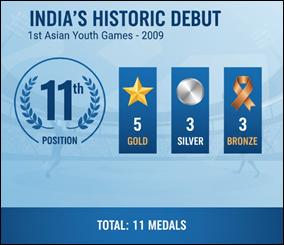
India’s debut at the Asian Youth Games in Singapore yielded 11 medals- five gold, three silver, and three bronze, this performance placed India 11th in the overall standings, a respectable showing that established the nation’s presence on the youth sporting stage.
Asian Youth Games: Nanjing, China 2013 (August 16- August 24, 2013)
The second edition in Nanjing, China, marked a significant expansion of the event’s scope and scale. The Games featured 2,314 athletes competing across 16 sports in 122 events.[4]
At the second Asian Youth Games, India made a strong impression with a well-rounded performance across multiple disciplines.
Indian athletes bagged 14 medals- three Gold, four Silver, and seven Bronze, securing 10th place in the overall standings.
The 2013 Games highlighted India’s expanding and increasingly diverse talent base, as young athletes ventured into new disciplines and performed more competitively on the Asian stage.
Asian Youth Games: Manama, Bahrain 2025 (October 22- October 31, 2025)
After more than a decade, the Asian Youth Games returned in a spectacular fashion. The event brought together over 4,000 young athletes from all 45 Asian nations competing across 26 sports.
Marking a historic milestone, India delivered its best-ever performance at the Asian Youth Games 2025, winning 48 medals — 13 Gold, 18 Silver, and 17 Bronze — to finish 6th overall.
The Indian contingent of 229 athletes (107 men and 122 women), supported by 90 officials, showcased the nation’s growing inclusivity in youth sports.
India delivered exceptional performances across multiple disciplines at the Asian Youth Games 2025.
The nation topped the medal tally in Beach Wrestling with three Gold and two Silver, while Wrestling added three Gold, two Silver, and two Bronze to the overall count.
Boxing emerged as India’s most successful discipline in terms of gold medals, contributing four Gold, two Silver, and one Bronze.
In Kabaddi, both the boys’ and girls’ teams remained unbeaten throughout the tournament, clinching gold medals in the sport’s debut appearance at the Games.
Overall, India’s 48-medal haul was more than four times the 2009 tally and over three times the 2013 count, cementing the nation’s place among Asia’s top sporting powers and making Manama 2025 a defining chapter in India’s youth sports journey.
Asian Youth Games 2025: Gender Parity and Participation
A remarkable highlight of India’s participation at this year’s Asian Youth Games was the strong gender balance within the team. Of the 229 athletes, 122 were female and 107 male, marking a notable instance where women outnumbered men in a major multi-sport international event. This highlighted the increasing inclusivity and empowerment of young female athletes in the country.
In the category of medals, girls won 9 gold, 11 silver, and 6 bronze medals, totaling 26 medals, which accounts for 54.17% of the total medals. Boys secured 4 gold, 7 silver, and 8 bronze medals, making a total of 19 medals, representing 39.58%. The mixed category did not have any gold or silver medals but won 3 bronze medals, totaling 3 medals, which is 6.25% of the total medals.
Female athletes accounted for over half of India’s total medals and an even higher share of gold medals (69.23%). This remarkable trend underscores the growing strength of India’s women athletes, nurtured through consistent opportunities and structured support at the grassroots levels.
NOTE: Out of 77 medal winning athletes, 46 were female, 31 were male.
Official Recognition and Support
India’s historic performance this year received widespread recognition from the highest offices.
Prime Minister Narendra Modi congratulated the contingent, stating: “Our young athletes have scripted history at the Asian Youth Games 2025 with their best-ever performance, winning an impressive 48 medals. Congrats to the contingent. Their passion, determination and hard work are clearly visible. My best wishes for their future endeavours.”[5]
The Indian Olympic Association also announced substantial cash rewards for athletes and coaches, recognising their achievement:
Gold medallists- 5 lakh rupees each
Silver medallists- 3 lakh rupees each
Bronze medallists- 2 lakh rupees each
Fourth-place finishers- 50 thousand rupees each
Coaches of medal-winning athletes- 1 lakh rupees each
Both the boys’ and girls’ kabaddi teams- 10 lakh rupees each in recognition of their outstanding performances.
Indian Olympic Association (IOA) President P.T. Usha stated: “The Indian Olympic Association takes immense pride in the exemplary performance of our young athletes at the 3rd Asian Youth Games. Their achievements reflect the future of Indian sport and the potential that lies within our youth. The IOA remains fully committed to providing every possible support to nurture and develop this emerging talent.”[6]
Conclusion
India recorded its best-ever performance at the 2025 Asian Youth Games winning 48 medals, surpassing previous tallies from 2009 and 2013. This represents more than statistical growth—it reflects systematic transformation in youth sports infrastructure, coaching quality, athlete support systems, and competitive mindset.
With the next Asian Youth Games scheduled for 2029 in Uzbekistan, India’s trajectory suggests continued improvement is not just possible but probable. The foundation laid through comprehensive government support via the Ministry of Youth Affairs and Sports, Sports Authority of India programs including Khelo India and Target Olympic Podium Scheme (TOPS) Development, and the involvement of National Sports Federations has created an ecosystem conducive to sustained excellence.