During a recent visit to an artisan cluster in rural Assam, a simple scene revealed a profound transformation underway in India’s handicraft ecosystem. Several craftspersons were weaving dry water hyacinth, not into the traditional baskets their community had made for centuries, but into sleek office folders designed for corporate boardrooms. Their hands moved with the same practiced rhythm, following the age-old technique. Yet, the product and its purpose had transformed entirely.
As we celebrate the National Handicrafts Week from 8th to 14th December 2025, this scene becomes emblematic of the quiet revolution sweeping through India’s handicraft landscape today. Our living handicraft traditions are undergoing a significant metamorphosis. They are extending into new spaces, new markets and new futures. The motifs remain authentic while the mediums and forms evolve in ways we could scarcely have imagined a decade ago.
Handicrafts As Living Knowledge Systems
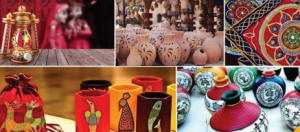
To understand this evolution, it is important to recognise that India’s handicrafts have never been mere objects of beauty. They are living knowledge systems deeply embedded in cultural identity and community traditions. In Madhubani, paintings were traditionally created by women using rice paste on freshly plastered mud walls during festivals, weddings and rites of passage. The fish symbolises fertility, the peacock represents love, and the iconography is collective rather than individual in origin. For the Gond community, the act of painting is tied to animistic beliefs, natural forces and protective spirits believed to inhabit forests. Their art is not merely aesthetic but a ritualistic cosmology rooted in oral tradition.
Function has always shaped form. In Assam, water hyacinth, an invasive aquatic weed, is dried and woven into utilitarian household baskets. In Karnataka, Channapatna’s lacquer-turned wooden toys served as simple children’s playthings, crafted on lathes passed down through generations. The medium, the form, and the motif were inseparable, locked into specific ceremonial and functional contexts.
Tradition Expanding Into Contemporary Expression
What is unfolding today is not a break from tradition but an expansion of it. The motifs, patterns, and techniques remain recognisable, yet their applications have become strikingly contemporary. This shift is not singular but multi-dimensional. The Madhubani fish, once part of a larger fertility narrative, now appears on cushions, tote bags and phone cases, extracted and recoloured for contemporary use. Gond animals and plants with their bold colours and geometry are admired today even outside their mythological context.
The biggest transition, however, is in the medium. Water hyacinth today forms corporate folders and designer handbags. Madhubani has moved from mud walls to wooden furniture, garments and leather accessories. Channapatna craft, which once produced only toys, now appears in decorative maps, chandeliers, home décor and designer furniture. The traditional lacquer remains unchanged, but the forms have become thoroughly contemporary. This is adaptation, not dilution.
Indian craft-based fashion has also become a fixture on global runways, with traditional embroidery showcased at Paris Haute Couture Week. Museums such as the National Gallery of Victoria’s “Transforming Worlds” now feature Gond, Madhubani and their modern adaptations within contemporary art dialogues rather than merely ethnographic contexts.
Leadership And Government Interventions Driving Transformation
This transformation has received crucial support from national leadership and strategic government interventions. The leadership of Hon’ble Prime Minister has given extraordinary momentum to this movement. His repeated call for ‘Vocal for Local’ and ‘Local to Global’ reflects his deep affection for our artisans. He always urges citizens to buy local, as he himself has observed that “when we do that, we don’t just buy goods; we bring home hope to a family, honor the hard work of an artisan, and give wings to the dreams of a young entrepreneur.” In his latest “Mann Ki Baat” address, he shared how he consciously presents handcrafted Indian products during meetings with world leaders, ensuring that India’s rich craft heritage travels with him wherever he goes. This, he noted, is not merely symbolic, it is his way of showcasing India’s artistic legacy and ensuring that the talent of our artisans is recognised on the world stage.
Various Government initiatives are driving this transformation. The Ministry of Textiles through the Development Commissioner (Handicrafts) is providing direct support to the handicrafts artisans through skill development, cluster-based training programmes, marketing support, infrastructure and technology support, credit support, etc. under the National Handicraft Development Programme (NHDP). The National Institute of Fashion Technology (NIFT) through its 19 campuses across India have built bridges between artisans and contemporary designers, creating a smoother path for design innovation rooted in tradition. The Geographical Indications Registry has protected over 366 handicrafts, safeguarding community knowledge and ensuring their rightful recognition.
In Assam, the state where I hail from, several traditional handicrafts have received long-overdue recognition through recent GI registrations, including the Sarthebari Metal Craft, Majuli Mask, Bihu Dhol, Jaapi, Pani Meteka, Asharikandi Terracotta and several handicrafts from the Bodo community. Each registration reflects how diverse corners of Assam and India are today finding a renewed place on the national platform after decades of being overlooked.
A Dynamic, Evolving Heritage For Viksit Bharat
The greatest lesson from India’s handicraft evolution is this: tradition is not static. It adapts, absorbs, and advances. The journey of water hyacinth from household baskets to global accessories symbolises the resilience and creativity of our artisan communities. As India moves toward realizing its vision of Viksit Bharat by 2047, the handicraft sector stands at a powerful intersection of heritage and innovation, rural livelihood and global aspiration, identity and modernity.
As this movement gathers strength, it becomes our shared duty to ensure that every artisan is empowered and every tradition continues to thrive. India’s handicraft heritage must not survive only as a memory, but flourish as a living expression of our identity. Each time a household chooses local, each time a designer partners with a handicraft cluster, we advance the spirit of Aatmanirbhar Bharat. And it is these very hands, steadfast, creative and rooted in centuries of wisdom that will illuminate India’s path for generations to come.
The author is the Minister of State for Textiles and External Affairs