Strategic autonomy is not about oscillating between poles, but about preventing one’s own agenda from being subsumed by that of another power. For India today, this means preventing escalation with China without succumbing to the illusion of partnership, and negotiating firmly with the US without disrupting constructive engagement.
Shashi Tharoor
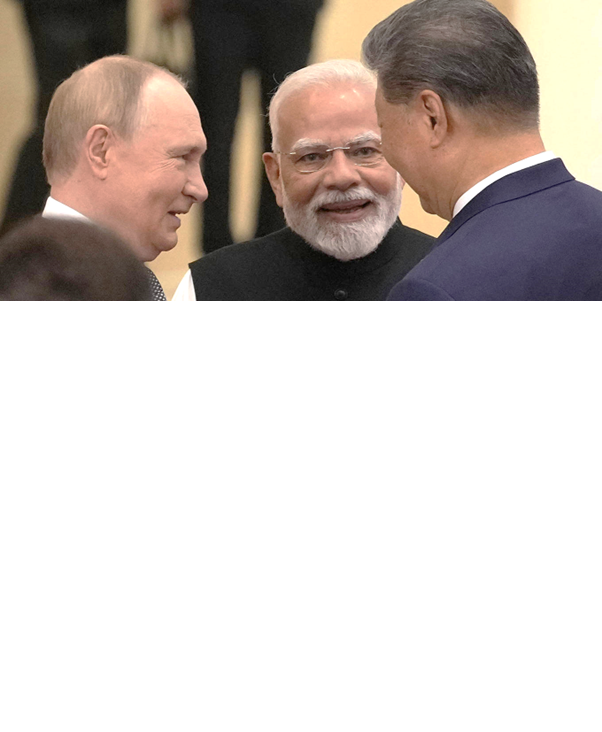
Indian Prime Minister Narendra Modi’s recent visit to Tianjin for the Shanghai Cooperation Organization (SCO) summit was his first trip to China in seven years. His presence alongside Chinese President Xi Jinping and Russian President Vladimir Putin projected an image of multipolar solidarity seemingly crafted to unsettle US President Donald Trump’s administration. But behind the optics lies a more complex strategic reality, which India must navigate with caution and clarity.
Modi’s visit to China had the trappings of a diplomatic reset. In a cordial hour-long meeting, Modi and Xi agreed to resume direct flights between their countries and reopen the Kailash Mansarovar Yatra, an important Hindu pilgrimage route to the fabled abode of Lord Shiva in Tibet. Hands were shaken, photos were taken, and a new phase of peaceful cooperation between the two Asian powers seemed to be beginning.
But there is considerable reason for skepticism. Since the 1950s, India has repeatedly sought rapprochement with China, only to be met with disappointment, even betrayal. The 1962 war, which began when Chinese forces launched coordinated attacks along the countries’ Himalayan border, shattered early hopes of good relations.
In the late 1980s, outreach by then-Indian Prime Minister Rajiv Gandhi ushered in a period of relative calm. But, over the last decade, the bilateral relationship has been marked by rising tensions, with border incidents in Depsang in 2013, Chumar in 2014, and Doklam in 2017, as well as deadly clashes in Galwan in 2020.
Today, disputes over the Line of Actual Control (LAC) along the Sino-Indian frontier remain unresolved, and China’s infrastructure buildup along the LAC continues apace. Meanwhile, China’s deepening ties with Pakistan – reflected in the China-Pakistan Economic Corridor, as well as Chinese military aid and diplomatic support – underscore India’s strategic vulnerabilities. Not even the most carefully curated atmospherics can obscure how difficult these issues will be to resolve.
The Sino-Indian relationship is also marked by major economic imbalances. India’s trade deficit with China hovers around $100 billion, reflecting the country’s reliance on a wide range of Chinese goods, from electronics and pharmaceutical intermediates to rare earths. While Indian information-technology companies and services providers struggle to access Chinese markets, Chinese firms dominate Indian supply chains. And so far, Indian calls for economic reciprocity have yielded few results.
With the sustainable-development agenda under severe strain, leading thinkers examine the initiatives and innovations that are delivering results. Subscribe to PS Premium now, so you don’t miss out.
No summit can paper over the structural fault lines that beset the Sino-Indian relationship. At the SCO summit, while Xi spoke of the dragon and the elephant walking together, Modi again called for peace on their shared border and a fairer trade relationship. He also reiterated India’s opposition to China’s transnational Belt and Road Initiative – the largest single project is a highway through territory in Pakistan that India claims – and its uncompromising stance on terrorism.
Beyond their bilateral disagreements, India and China differ in their visions for international relations. China is promoting an alternative global order: at the SCO summit, Xi championed initiatives in AI, finance, and infrastructure aimed at reducing reliance on Western institutions. For Russia, isolated by sanctions, this amounts to a geopolitical lifeline. But India views the SCO merely as a useful platform for regional engagement and a stage on which to assert its strategic autonomy. India has no interest in abandoning its long-standing relationship with the United States.
Just as India’s foreign-policy establishment has sometimes overestimated the potential for a diplomatic reset with China, it has often underestimated the resilience of ties with the US. Unlike China, the US does not occupy Indian territory, provide Pakistan with intelligence and operational support in wartime, or seek to redraw borders in Asia. On the contrary, over the past two decades, India and the US have painstakingly built a strategic partnership encompassing defense interoperability, intelligence sharing, counter-terrorism, and maritime security.
India’s participation, with the US, Australia, and Japan, in the Quad grouping reflects a shared commitment to maintaining a stable balance of power in an Indo-Pacific that China seeks to dominate. Uncertainty about the Quad’s future – including its next summit, which is supposed to be held in India – does not negate this imperative.
Moreover, the US is a key partner to India in science, technology, and education, and a source of investment in critical sectors from semiconductors to clean energy. The US is also India’s largest export destination, reflected in India’s $40 billion bilateral trade surplus. Though India-US relations are undoubtedly tense – senior US officials have lumped India with China and Russia as “bad actors” in global trade, and the Trump administration has imposed a 50% tariff on Indian goods – bilateral trade disputes can be resolved through negotiations, which are underway.
Ultimately, the logic of US-India cooperation is not transactional; it is structural. Despite the current chill, the two countries maintain a shared interest in securing global supply chains and keeping China’s hegemonic ambitions in check. Conversely, while Modi’s visit to China was necessary to prevent further deterioration in bilateral ties, the impediments to a genuine thaw remain formidable. Geography, ideology, and power asymmetries do not yield easily to diplomacy, no matter how much political will is behind it.
As India’s leaders navigate these relationships, they must remember that strategic autonomy is not about oscillating between poles, but about crafting a space where India can pursue its interests without being subsumed by another power’s agenda. Preventing escalation with China must not mean falling prey to the illusion of partnership. And negotiating firmly with the US must not mean allowing disagreement to disrupt engagement in areas of structural alignment.
India’s foreign policy must not be guided by the theater of summitry, but by the substance of strategic interest. The dragon may offer handshakes, but its claws remain visible. The eagle may have ruffled feathers, but its wings still offer lift. Engaging with both requires not just balance, but foresight.
Shashi Tharoor, a former UN under-secretary-general and former Indian Minister of State for External Affairs and Minister of State for Human Resource Development, is an MP for the Indian National Congress and Chairman of the Parliamentary Standing Committee on External Affairs. He was re-elected to the Lok Sabha for a fourth successive term, representing Thiruvananthapuram. He is the author, most recently, of Ambedkar: A Life (Aleph Book Company, 2022).
Source: Project Syndicate