Media delegation from Jammu visits forensic university, ISRO facilities
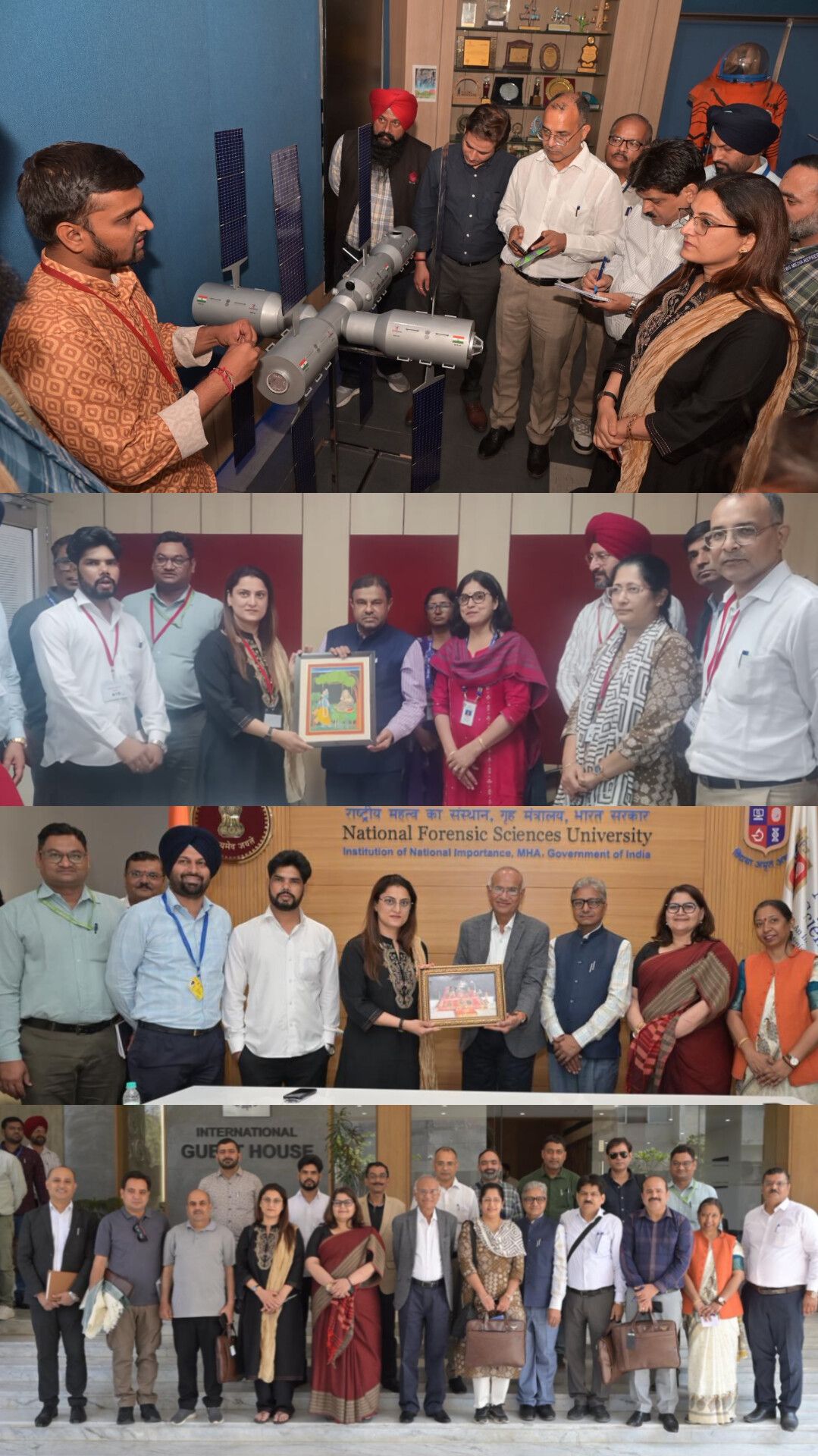
Ahmedabad/Jammu, FEBRUARY 25: The Union Territory of Jammu and Kashmir has been provided 23 mobile forensic vans by the National Forensic Sciences University (NFSU), Gujarat, to strengthen the criminal justice delivery system and enable prompt, on-site scientific investigation at crime scenes. This was stated by the Vice Chancellor of NFSU, Dr. J. M Vyas during an interaction with the media persons from Jammu and Kashmir who are on a PIB led media tour to the state.
Dr. Vyas, as per PIB statement, said the mobile vans, equipped with advanced forensic tools and gadgets, aim to expedite evidence collection and improve conviction rates. He also highlighted NFSU’s role in supporting investigations of complex cases across the country. Dr. Vyas informed that the University houses around nine Centres of Excellence dedicated to addressing diverse domains of physical and digital crimes. He highlighted that NFSU is actively engaged in education, specialized training and advanced research for national as well as international law enforcement agencies. He further stated that the University is playing a leading role in strengthening crime prevention mechanisms through the application of preventive forensics.
Campus Director Prof. S. O. Junare emphasised that forensic science is an applied science integral to modern investigations, including terrorism and cybercrime cases. He noted that NFSU experts handle several major cases, including cyber frauds, cryptocurrency crimes, data breaches and smart device investigations, and contribute extensively to cases from Jammu and Kashmir.
During the visit, the media delegation toured several state-of-the-art laboratories and Centres of Excellence on the campus, including the Digital Forensics Laboratory, DNA Testing Laboratory, Ballistics Laboratory, and the Narcotic and Psychotropic Substances Testing Laboratory. The delegation was apprised of the scientific processes involved in DNA analysis for various types of crimes, testing and identification of narcotic drugs and psychotropic substances, and evaluation of bulletproof gear, wearable protective equipment and specialized vehicles.
The team also visited the Nutritional Supplements Testing Laboratory for sportspersons, where experts demonstrated the processes and advanced equipment used for testing nutritional supplements in accordance with World Anti-Doping Agency (WADA) guidelines, in coordination with FSSAI standards. The laboratory also provides certification services following stringent quality checks and compliance protocols.
Established as an Institute of National Importance, NFSU has 14 campuses across India, including one international campus in Uganda. Originally founded in 2009 as Gujarat Forensic Sciences University, it was reconstituted in 2020 as the National Forensic Sciences University. It is the only dedicated forensic sciences university of its kind in the world, committed to advancing forensic education, research and capacity building at the national and global levels.
The media delegation later visited the Space Applications Centre (SAC) of Indian Space Research Organisation (ISRO), where the team toured key facilities including the Planetary Immersive Lab (PLASIV Lab) and the Semiconductor Laboratory. The media persons were apprised of the highly sophisticated semiconductor technology and the controlled environment in which research on semiconductors and their packaging is undertaken for various satellite components.
The Semiconductor Lab has been established with the objective of making India self-reliant in semiconductor packaging technology. The Centre specialises in in-house Low Temperature Co-fired Ceramic (LTCC) foundry technology for developing high-performance miniature components for space applications, including Gallium Nitride (GaN) components and advanced quantum devices.
Addressing the media, Dr. Nilesh Desai, Director, SAC, stated that the primary mandate of the Centre is the creation, design, development and application of diverse payloads for satellites. He also briefed the delegation about upcoming ISRO missions, including Chandrayaan-4, scheduled for launch in 2028 with an orbiter and lander aimed at collecting lunar soil samples. He further highlighted future missions such as Mission Venus and MOM-II (Mars Orbiter Mission-II).
Dr. Desai informed that SAC is also engaged in training and capacity-building programmes in collaboration with institutions such as the Satish Dhawan Centre for Space and the Central University of Jammu. He apprised the media about the Indian Astronomical Observatory (IAO) at Hanle, Ladakh, located at an altitude of 4,500 metres, which is involved in tracking space objects, and about the LAMA project focused on monitoring natural resources and the environment in Ladakh.
Dr. Abha Chhabra, HoD (HRD), ISRO, also addressed the delegation and briefed the media on various ongoing projects of ISRO and SAC.
Earlier, the delegation visited the ISRO Museum, where they were familiarised with different types of satellites developed by ISRO across its 23 centres in India. Through immersive technology and 3D modelling, the media persons were provided insights into images generated by satellites using active and passive sensors for applications such as navigation, disaster management and agriculture.
The visit provided the media representatives with valuable exposure to advanced scientific institutions and enabled them to better understand the technological strides being made in Gujarat. The media tour is aimed to foster greater awareness about important national institutions and developmental initiatives.