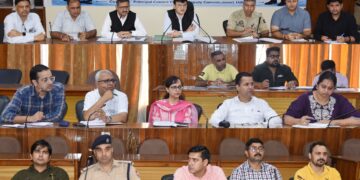
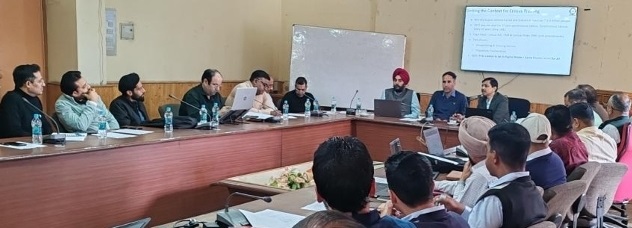
SRINAGAR, APRIL 15: Training Programme for Master Trainers on Houselisting and Housing Census (Phase-I) under Census 2027 commenced Wednesday at the Jammu & Kashmir Institute of Management, Public Administration and Rural Development (IMPARD), Main Campus, M.A. Road, Srinagar.
The programme, as per an official statement, is being organized in collaboration with the Directorate of Census Operations, J&K, and the Office of the Registrar General and Census Commissioner, Government of India.
The four-day training programme, scheduled from April 15 to April 18, is witnessing the participation of around 34 Master Trainers drawn from various districts of Jammu & Kashmir and Ladakh. These Master Trainers will play a pivotal role in cascading the training further by training field-level trainers at the district level, who will subsequently train enumerators and supervisors across different blocks, ensuring effective implementation of Census operations throughout the region.
In his inaugural address, Dr. Bilal Ahmad Bhat, Course Coordinator, highlighted the critical importance of the Census as the largest and most comprehensive source of statistical data on the demographic, social, and economic characteristics of the population. He emphasized that the data generated through the Census serves as a foundational input for evidence-based policy making, planning, and governance.
Dr. Bhat further noted that Census data plays a vital role in fulfilling constitutional requirements such as delimitation of constituencies, reservation of seats for Scheduled Castes (SCs) and Scheduled Tribes (STs), and equitable allocation of developmental resources.
Welcoming the participants, He expressed his appreciation for the commitment of the Master Trainers and underscored their responsibility in ensuring accuracy and reliability in data collection.
Arun Kumar, Joint Chief Principal Census Officer and National Trainer, Directorate of Census Operations, J&K, in his address, stressed the crucial role of Master Trainers in maintaining the quality and credibility of Census data. He pointed out that the success of the Census largely depends on the efficiency and understanding of trainers at all levels. He urged the participants to thoroughly familiarize themselves with the detailed manuals, structured procedures, and comprehensive guidelines developed for Census operations, and to effectively address queries at the field level. He reiterated that the Census, being the world’s largest enumeration exercise, holds immense significance not only for administrators and policymakers but also for researchers, academicians, and the general public.
Manmeet Singh Loomba, Deputy Chief Principal Census Officer and National Trainer, Directorate of Census Operations J&K, highlighted a significant transformation in the upcoming Census exercise. He informed that, for the first time in the 150-year history of the Census, data collection will be conducted using digital technology through a specially designed mobile application. This technological advancement is expected to enhance the accuracy, efficiency, and timeliness of data collection. He further emphasized that the Census 2027 data will be instrumental in shaping future developmental strategies, particularly in Jammu & Kashmir and Ladakh.
The programme marks a significant step towards capacity building and preparedness for the successful conduct of Census 2027. Through structured training and collaborative efforts, the initiative aims to ensure a robust, transparent, and technology-driven Census process across the region.