
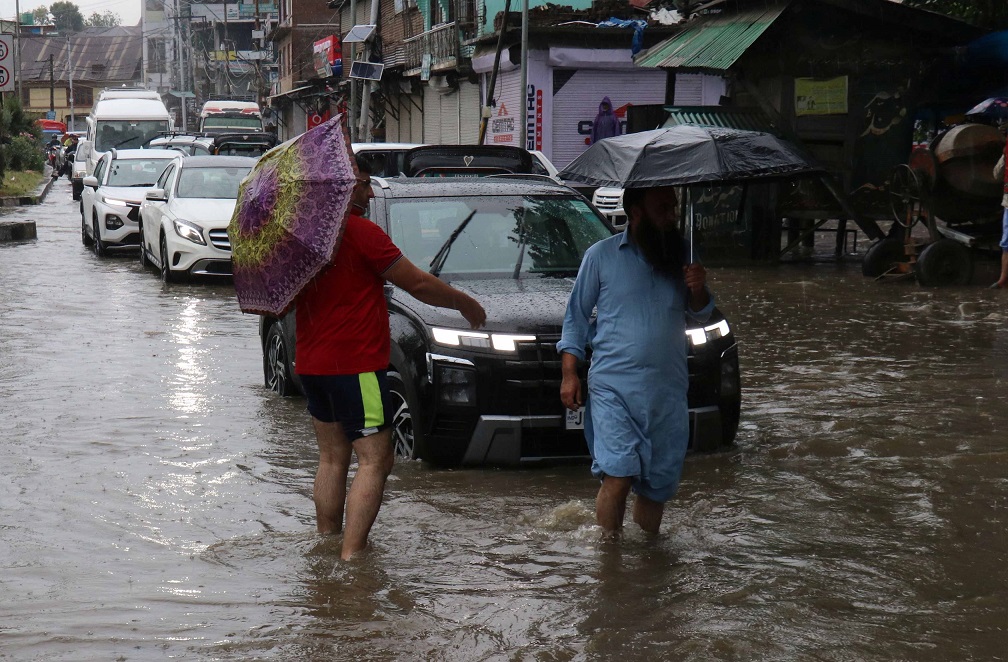
Srinagar, Jul 20: Hours of intense rainfall on Monday left several parts of Srinagar submerged, disrupting traffic, inundating roads and reviving questions over the city’s drainage infrastructure despite years of investment under the Smart Cities Mission.
Waterlogging was reported from several areas, including Khanyar, Sada Kadal, Nalamar, Rajbagh, Dalgate, Bohri Kadal, Jawahar Nagar, Bemina, Residency Road and parts of the city centre, with commuters stranded for hours and vehicles crawling through inundated roads.
Residents in some areas also staged protests, demanding immediate measures to address the recurring problem.
As criticism mounted, Srinagar Smart City Limited (SSCL) distanced itself from the waterlogging and drainage issues reported in several parts of the city, saying many of the affected roads were not executed under the Smart City project.
An official of SSCL told KNO that media reports linking the flooding to Smart City works are “incorrect”.
“The roads at Khanyar, Sada Kadal and several other places where drainage failures occurred were not executed under the Srinagar Smart City project,” the official said.
He said the Smart City project had executed redevelopment works on the Dal Gate-Gojwara corridor, M.A. Road, Residency Road and Karan Nagar. “We have executed these roads, but the drainage and sewerage network there was already existing. We did not undertake drainage works,” the official said.
Referring to the inundation on Nalamar Road, the official said the stretch was constructed by the Roads & Buildings (R&B) Department and not by Srinagar Smart City Limited. “The Nalamar Road was executed by the R&B Department. It is not a Smart City road,” he added.
Earlier in the day, SMC Commissioner Faz Lul Haseeb said the rainfall had exceeded the city’s drainage carrying capacity, adding that authorities had identified nearly 60 waterlogging hotspots across Srinagar where dewatering teams had been deployed.
“Rainfall was more than the drainage capacity. We have identified almost 60 hotspots in the city and teams are being deployed wherever required,” the Commissioner had said.
The flooding has once again brought into focus the condition of Srinagar’s ageing underground drainage network, with residents questioning why roads continue to get submerged despite years of urban redevelopment.
Srinagar was selected under the Smart Cities Mission in 2017, following which Srinagar Smart City Limited was constituted to implement projects related to urban mobility, road redevelopment, heritage conservation, public spaces and civic infrastructure. Major works gathered pace after 2018 and accelerated ahead of the G20 meetings in 2023.
Alongside the Smart City Mission, the Centre sanctioned nine stormwater drainage projects worth Rs 76.79 crore for Srinagar under the AMRUT scheme to strengthen the city’s drainage network.
The J&K Government recently ordered an external audit of the Srinagar Smart City project to examine its implementation, expenditure and project outcomes. Monday’s flooding has renewed scrutiny of the city’s drainage infrastructure even as SSCL maintains that several inundated roads were outside its scope.
“Every spell of heavy rain leaves these roads submerged. People don’t care which department built the road; they want roads that don’t flood every time it rains,”said Zubair Ahmad, a resident of Khanyar.
“We have seen new roads, footpaths and beautification, but if rainwater remains on the roads for hours, commuters continue to suffer,” said Aamir Ahmad, a commuter from Rajbagh—(KNO)