
PMJVM embodies Sabka Saath, Sabka Vikaas- ensuring India’s growth story reaches its most remote forests and the communities who call them home. This will eventually contribute to India’s vision of a Viksit Bharat@2047.
Many of India’s 10.4 crore Scheduled Tribes derive 20–40% of their annual income from Minor Forest Produce (MFP). Historically, tribals sold this produce to middlemen at distress prices, earning below the cost of their own labour. To address this, the government runs the Pradhan Mantri Janjatiya Vikas Mission (PMJVM). The mission organises tribals into community-owned Van Dhan Vikas Kendras (VDVKs), moving them from raw produce sellers to value-adding entrepreneurs. So far, 4,172 VDVKs have been sanctioned, linking 12.48 lakh tribal members to the scheme. The government also buys MFP at a pre-determined Minimum Support Price (MSP). PMJVM provides enterprise funding and helps tribals access markets through fairs, e-commerce platforms, and exhibitions.
Protecting Tribal Forest Economies
For millions of forest-dwelling tribal families, Minor Forest Produce (MFP)—such as honey, tendu leaves, mahua flowers, tamarind, lac, bamboo and wild herbs—is not merely a forest resource. It is a primary source of livelihood. About 20% to 40% of their annual income is from selling MFP. Yet, despite directly procuring and selling MFP, tribals receive only a fraction of its market value. This is because they often sell MFP to intermediaries at low prices.
The Pradhan Mantri Janjatiya Vikas Mission (PMJVM) seeks to change this equation. Launched in 2021-22, the Mission provides a systematic way for them to improve MFP’s value by skilling the tribals in newer technology and practices. The scheme links the communities to the larger national and digital markets to help them get more exposure and sell more products. It also guarantees Minimum Support Prices (MSP) to tribals by directly procuring the produce from them.
These efforts are helping forest gatherers become owners of their community enterprises while strengthening India’s tribal economy at the grassroots level.
Minor Forest Products & Minimum Support Price
While the government manages most of India’s forests to preserve ecology and wildlife, tribals and other traditional forest-dwelling communities are given access to these areas for the preservation of their livelihoods.
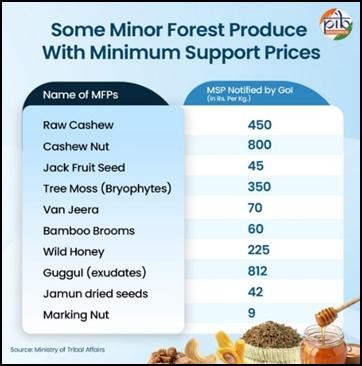
In 2006, the government enacted the Scheduled Tribes and Other Traditional Forest Dwellers (Recognition of Forest Rights) Act — also called the Forest Rights Act. The Act defines minor forest produce as “all non-timber forest produce of plant origin including bamboo, brush wood, stumps, cane, tussar, cocoons, honey, wax, lac, tendu or kendu leaves, medicinal plants and herbs, roots, tubers and the like.” The government has notified Minimum Support Price for 87 MFP items under PMJVM.
The Forest Rights Act recognises that forest-dwelling communities have historically depended on forest products for sustenance and livelihood. The Act gives tribals rights to procure and sell non-timber minor forest produce. Separately, the Provisions of the Panchayats (Extension to the Scheduled Areas) Act (1996) grants tribal Gram Panchayats ownership rights over minor forest produce.
The Tribal Cooperative Marketing Development Federation of India (TRIFED), mandated with the marketing and development of tribal products, purchases non-timber forest produce at the pre-determined price (MSP) regardless of the market price of the product. It does so through a network of state implementing agencies — including tribal development cooperatives and forest development corporations. Since 2013–14, state governments have procured 2,67,954 metric tonnes of MFPs worth Rs. 693.98 crore under the scheme.
How Does PMJVM Support Tribals?
Beyond MSP procurement, the PVJM scheme also provides skilling, technological, marketing, and infrastructural support to tribals.
Organising Tribals into Van Dhan Vikas Kendras
The Mission mobilises tribal gatherers into self-help groups (SHGs). A group of 15 SHGs, comprising about 300 tribals, are clustered together into one Van Dhan Vikas Kendra (VDVK). At least 60% of VDVK members must be from Scheduled Tribe communities.
The Van Dhan Yojana, launched on April 14, 2018, is a part of PMJVM. It forms the foundation of the VDVK model and powers its implementation across tribal communities.
Skilling, Funding and Technological Support
The Government organises skilling and other training programmes for MFP gatherers, including trainings on scientific harvesting practices, at Van Dhan Vikas Kendras (VDVKs).
The SHGs are also provided with:
Infrastructural support, established in a beneficiary’s home or a government or gram panchayat building
Primary processing equipment — cutting and sieving tools, decorticators, dryers, and packaging tools — based on locally available MFPs
Training for 30 members on sustainable harvesting and value addition, with raw materials and trainee kits provided
Working capital, facilitated through tie-ups with financial institutions, banks, and the National Scheduled Tribes Finance and Development Corporation (NSTFDC)
Storage and transportation support on a rental basis.
Marketing and Business Support
Apart from value addition, VDVKs are also centres for market linkages – both local and distant – for the final products.
VDVKs are established around local Haat Bazaars, the primary MFP procurement points, to make it easier for tribals to sell products they produce.
There are over 5,000 Haats in tribal areas.
Haats are being modernised in a phased manner— with permanent structures, storage, drinking water, shade, and weighing equipment.
VDVKs may partner with private entities or non-profits for value addition or marketing of their products.
TRIFED disseminates market intelligence — including daily rates and e-commerce avenues —to VDVKs to improve their decision-making on business deals.
PMJVM also provides:
Branding, promotion, and advertisement of tribal products through festivals, exhibitions, and artisan melas
Geo-tagging of VDVKs and other scheme assets
Geographical Indicators for tribal produce (GI is a sign used on products that have a specific geographical origin and possess qualities or a reputation that are due to that origin)
Building and upgrading IT and e-commerce platforms
Research and development support
Under the PMJVM scheme:
4,172 VDVKs have been sanctioned and 2,911 VDVKs are functional, with reported sales of around Rs. 168 crores (as on July 31, 2026).
12.48 lakh tribal members have been linked to the VDVKs.
VDVKs Help in Tribal Women Empowerment
Most collections and sales are carried out by women, making PMJVM a key instrument of tribal women’s financial empowerment.
The Nyigamane, Ho Yorbe, Medumhagdum VDVK in Arunachal Pradesh’s Leparada district was established in October 2021 with 300 women SHG members and farmers. This VDVK converts locally available non-timber forest and agricultural produce into processed, marketable goods. The products created are:
King Chilli Pickle from King Chillis (Bhut Jolokia — a north eastern Indian specialty)
Bamboo Shoot Pickle from bamboo shoots (a common MFP in north-eastern India)
Turmeric Powder from locally grown turmeric
Ginger Powder from locally grown ginger
Pineapple Jam from Pineapples (abundant in Arunachal Pradesh)
Pineapple Squash from Pineapples
Orange Squash from Oranges
The VDVK has sold Rs. 11 lakh worth of these products from 2022-23 onwards. It has empowered the women, who no longer need to depend on only seasonable agriculture for income throughout the year. The women jointly own the business – they are not mere workers but also have a stake in the brand and the enterprise.
Towards A Sustainable Forest Economy
Pradhan Mantri Janjatiya Vikas Mission (PMJVM) provides livelihood opportunities to forest-dwelling tribals, offering a systematic way to produce and market non-timber forest produce. These products are locally sourced and rooted in traditional practices — representing a forest-based economy balancing community ownership with market competitiveness.
In a world increasingly driven by mass-manufactured and plastic-packaged goods, they are India’s distinctive offering: natural, community-owned, and forest-born. PMJVM embodies Sabka Saath, Sabka Vikaas- ensuring India’s growth story reaches its most remote forests and the communities who call them home. This will eventually contribute to India’s vision of a Viksit Bharat@2047.