
Announces nationwide campaign to track down fugitives
New Delhi, Sep 06: In a significant move to bolster national security and law enforcement, Home Minister Amit Shah on Sunday announced the launch of a comprehensive, nationwide campaign aimed at tracking down fugitives who have fled India’s jurisdiction after committing serious crimes. The initiative, which has been in progress since 2019, has already resulted in the extradition of 274 fugitives from 36 countries and the seizure of properties worth approximately Rs 17,874 crore.
Shah said the campaign is part of a broader effort to dismantle criminal networks involved in economic offences, terrorism, narcotics trafficking, and gang wars, all while reinforcing India’s internal security framework.
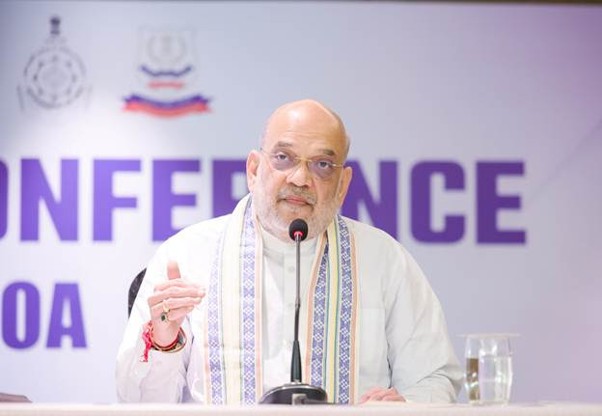
Addressing a press conference in Panaji, Goa, Shah detailed the government’s multi-pronged approach to tackling these issues, highlighting recent successes and outlining future plans. He was joined by Goa Chief Minister Pramod Sawant, with whom he discussed progress in narcotics control and criminal justice reforms.
Shah noted that since Prime Minister Narendra Modi assumed office in 2014, India has witnessed a significant transformation in its internal security landscape. The challenges faced at that time included rising terrorism in Jammu and Kashmir, Naxalism, and unrest caused by armed groups in the Northeast. Since then, decisive actions, including the abrogation of Article 370 in Jammu and Kashmir, have substantially reduced separatist sentiments, with terrorism figures trending towards zero. The region has also seen considerable development and efforts to bridge social and mental divides.
Similarly, the decades-long Naxalite insurgency has been brought under control, with most militants surrendering and joining the mainstream. In the Northeast, over 11,000 youth have laid down arms, leading to more than 14 agreements signed with various groups. These steps have fostered regional development and stability.
The campaign against fugitives, Shah explained, has been a key pillar of this security drive. Since 2019, authorities have extradited 274 individuals involved in serious crimes, including economic offences, terrorism, narcotics, and gang-related violence. The government’s efforts have been supported by technological innovations, notably the creation of ‘BHARATPOL’, a digital platform that connects more than 14 central agencies and police forces across all states. This integrated mechanism facilitates the tracking, legal action, and extradition of fugitives, streamlining processes that previously faced bureaucratic hurdles.
In addition to extradition, the government has taken measures to confiscate or seal properties linked to fugitives. Since 2019, assets worth approximately Rs 17,874 crore have been seized, underscoring the commitment to dismantling illegal financial networks associated with criminal activities.
Shah highlighted the improved legal framework, including new criminal laws and justice codes, which have simplified procedures for legal action against fugitives. Cybercrime, a growing concern in modern security, has also been addressed through a systematic mechanism monitored directly by the Prime Minister. The 1930 helpline has become an effective tool for cybercrime reporting and assistance.
In the realm of narcotics control, Shah emphasized that drugs pose a grave threat to India’s future generations and are often used to fund terrorism. Since 2019, the government has adopted a coordinated, national-level campaign to combat drug trafficking, moving beyond small seizures to dismantle entire networks. A four-tier NCORD (National Committee on Drug Abuse) mechanism was established, involving dedicated anti-narcotics task forces, joint coordination committees, and a national database of offenders called NIDAAN.
The Narcotics Control Bureau (NCB) has been restructured, and investigations have become more scientific and data-driven. Seizures have increased dramatically—from 26 lakh kilograms seized between 2004 and 2014 to over 119 lakh kilograms from 2014 to 2026, with a value of approximately Rs 1.89 lakh crore. The destruction of drugs has also surged, from 3.36 thousand kilograms to nearly 49 lakh kilograms in the same period.
Shah pointed out that the fight against drugs is now a continuous, coordinated effort involving multiple agencies and international cooperation. Agreements have been signed with 46 countries to facilitate extradition and intelligence exchange, while over 25 crore citizens have taken an oath under the Nasha Mukt Bharat Abhiyan to stay drug-free. Rehabilitation efforts have helped 5.7 lakh individuals become drug-free.
Looking ahead, Shah revealed a detailed three-year roadmap from July 2026 to July 2029, aiming for aggressive, measurable outcomes. The strategy is based on four pillars: intelligence-led enforcement, control of precursor and synthetic drugs, demand and harm reduction, and capacity building through training and coordination. The plan involves deploying advanced surveillance at borders, ports, and airports, and leveraging financial investigations to target drug kingpins.
The government is also focusing on community engagement through programs like NCC, NSS, and My Bharat to create ‘Nashamukti Mitras’—volunteers dedicated to drug prevention. Efforts include increasing de-addiction centers to 1,751 nationwide and training volunteers to ensure community participation.
Shah reaffirmed that India welcomes foreigners but not with drugs, asserting that the country’s resolve to eliminate drug trafficking is as strong as its fight against Naxalism. The government is employing a “Quadrangular Approach” to address drug smuggling routes, especially through the so-called ‘Death Triangle’ and ‘Death Crescent’ regions, which are known hubs for international drug trafficking.
Concluding his remarks, Shah emphasized that the government views the fight against drugs as one of the most critical national security battles. The coordinated efforts across multiple agencies and levels of government aim to fulfill Prime Minister Modi’s vision of a drug-free, developed India by 2047. With the new initiatives and the upcoming timeline, authorities are determined to eradicate the menace of drugs and ensure a safer, more secure future for the country.