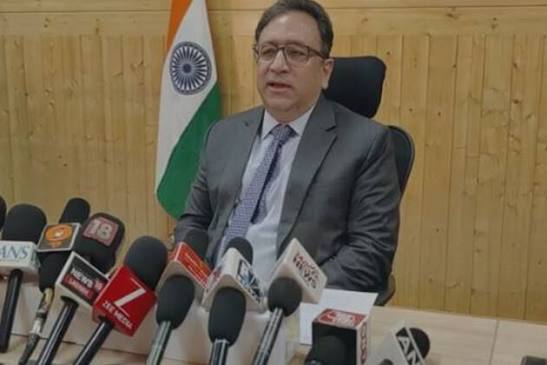
Ladakh, Oct 17: Ladakh Chief Secretary Ashish Kundra on Saturday said Article 371 of the Constitution offers sufficient flexibility to provide constitutional safeguards for Ladakh, with a separate provision, proposed as Article 371K.
Addressing a press conference here, Chief Secretary Kundra said, “These provisions were discussed during negotiations to address the region’s demands and are under active consideration.”
He said, “Several models had been considered, including the Sixth Schedule, statehood and a Union Territory with a legislature, before Article 371 was proposed as a possible alternative.”
“Fundamentally, as I said, it is about constitutional safeguards. It has many models,” he added.
Kundra said the Sixth Schedule was designed for a different geographical, historical and cultural context, particularly in Northeastern states where minority tribes require protection against possible discrimination by majority tribes.
“They need protection against any discriminatory action from the majority. So, the Sixth Schedule has a different geographical, historical, cultural context and it doesn’t make much sense to talk about it here,” he said.
On the demand for statehood or a Union Territory with a legislature, he said Ladakh currently receives 100 per cent funding from the Centre, including for employees’ salaries and pensions.
He said that in Union Territories with legislatures, such as Jammu and Kashmir and Delhi, public accounts are separate and the administrations have to meet salary and pension obligations through their own income. “So, it was suggested that we will fulfil the fundamental demand of the central government. But we will find another creative solution for that,” he said.
Kundra further said Article 371, under which special provisions from Article 371A to Article 371J already exist, could provide the flexibility required to frame constitutional protections suited to Ladakh. “Article 371A to J is still there. So, Article 371K was suggested that it will be written especially for Ladakh. Now, in the last meeting, you agreed to this,” he said.
He said the minutes of the previous meeting had been signed by the participants, describing the atmosphere as positive. “And in general, we can say that it was a happy atmosphere that good progress has been made,” Kundra said.
Referring to subsequent discussions, he said Ladakh’s representatives had sought documents explaining the proposed structure and the framework for moving forward. “What kind of structure will it be? Will it have a framework? How will we move forward?” he said, recounting the questions raised by the representatives.
Kundra said the Ministry of Home Affairs provided a detailed 32-page document to the leaders on February 16, outlining various aspects of the proposed framework.
He said the constitutional amendment, the demands of Ladakh’s people and the nature of the future democratic structure would be shaped through further deliberations. “The constitutional amendment and the demands of the people here. What kind of democratic structure will it be? It will come out through a discussion, through reflection,” he said—(KNO)