Twelve Years Of Vishwaas, Nirman, And Jan Kalyaan
India has achieved a sustained environmental transformation through deliberate policy action and consistent implementation over twelve years. The country has expanded forest and tree cover, restored wetlands, mangroves, and coastal ecosystems, and advanced river rejuvenation through the Namami Gange Programme. Wildlife populations of tigers, lions, elephants, rhinos, and other species have increased. India has also raised solid waste processing rates, advanced circular economy practices, promoted green skills, adopted technology for conservation, and strengthened disaster resilience. It has met key climate targets years ahead of schedule and led global initiatives including the International Solar Alliance (ISA), One Sun One World One Grid (OSOWOG), Coalition for Disaster Resilient Infrastructure (CDRI), Mission LiFE, and the International Big Cat Alliance (IBCA).
Three Pillars of India’s Green Transformation
India has pursued environmental transformation guided by Vishwaas, Nirman, and Jan Kalyaan, recognising that ecological security is critical for economic growth, public welfare, and national resilience. These efforts have strengthened India’s ecological capability, expanded national capacity for sustainable development, and enhanced global credibility.
Pillar 1: Increasing Ecological Capability and Biodiversity
Forest Cover
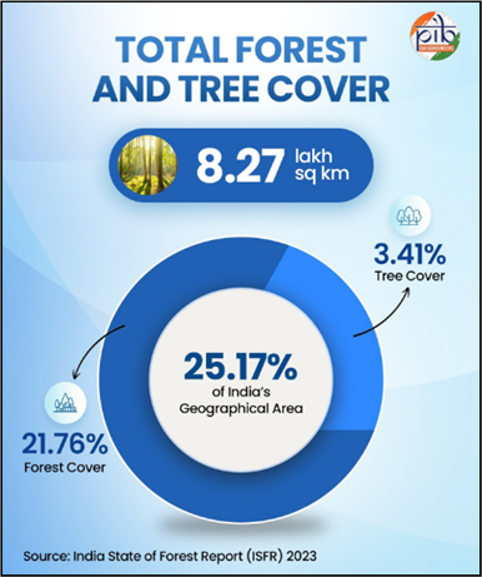
The Green India Mission (GIM), launched in FY 2015–16, has released ₹1,019.26 crore as of March 2026. According to the India State of Forest Report (ISFR) 2023, India’s forest and tree cover stands at 8.27 lakh sq. km, accounting for 25.17 percent of the country’s geographical area. India’s forests currently store 30.43 billion tonnes of carbon stock.
Under CAMPA, more than 3.20 lakh hectares of compensatory afforestation were undertaken between FY 2020–21 and 2024–25. The Nagar Van Yojana has released ₹557.62 crore for development of 626 Nagar Vans/Vatikas as of March 31, 2026.
The “Ek Ped Maa Ke Naam” campaign, launched in 2024, saw a total of 262.4 crore saplings planted till December 2025.
River Ecosystems: Namami Gange Programme
Launched in June 2014, the Namami Gange Programme was initially funded with ₹20,000 crore and extended under Phase-II till March 2026 with an additional ₹22,500 crore. As of February 2026, 524 projects worth ₹43,030 crore were sanctioned, with around 355 projects completed. A total of 218 sewerage infrastructure projects costing ₹35,698 crore have been undertaken, with a combined treatment capacity of 6,610 MLD. Industrial BOD load declined from 26 TPD in 2017 to 10.75 TPD in 2024. Approximately 33,024 hectares have been afforested. Gangetic dolphin population was estimated at 6,327 dolphins.
Wetlands Conservation
India had only 26 Ramsar sites in 2014. By April 2026, the number increased to 99 wetlands. Under the National Plan for Conservation of Aquatic Ecosystems (NPCA), cumulative financial releases reached ₹1,088.85 crore.
Mangrove Conservation
India’s mangrove cover increased from 4,628 sq. km in 2013 to 4,992 sq. km in 2023 – a net gain of 363 sq. km. The MISHTI scheme was launched with an initial outlay of ₹100 crore.
Coastal Conservation
India’s first eight beaches received Blue Flag certification in 2020. The number increased to 18 in 2025–26, spread across seven coastal States and four Union Territories. The National Coastal Mission was extended for 2025–31 with an allocation of ₹767 crore.
Wildlife Conservation
Project Tiger: Tiger Reserves increased from 46 to 58 between 2014 and 2025. Tiger population rose from 2,226 in 2014 to 3,682 in 2022. India supports over 70% of the world’s wild tigers.
Project Cheetah: Launched on 17 September 2022, 29 cheetahs have been brought from Namibia, South Africa, and Botswana. The cheetah population has now reached 53.
Project Lion: Lion numbers increased from 523 in 2015 to 891 in 2025 – a rise of over 70%.
Leopard: The “Status of Leopards in India 2022” report estimates 13,874 leopards, up from 12,852 in 2018.
Snow Leopard: The first Snow Leopard Population Assessment in India (2019–2023) estimated 718 snow leopards across six regions.
Elephant: India supports nearly 60 percent of the global wild Asian elephant population, with 22,446 wild elephants estimated. Elephant Reserves increased from 26 in 2014 to 33 in 2025–26.
One Horned Rhinoceros: Rhino numbers have grown from 1,500 to over 4,000 as of September 2024 – a nearly 170 percent increase.
Pillar 2: Expanding National Capacity for Sustainable Transformation
Solid Waste Management
Solid waste processing capacity surged from 17 percent in 2014 to over 77 percent by 2024. Urban India processes 1,29,206 TPD out of 1,59,109 TPD of municipal solid waste generated daily. Through biomining and bioremediation, 1,138 dumpsites have been fully remediated across 1,048 cities, with 877 lakh metric tonnes of legacy waste cleared and 7,646 acres of land reclaimed.
Circular Economy and EPR
As of March 2026, India has 4,574 registered recyclers across waste streams. Total waste processed stands at 417.57 lakh MT. Category-wise recycling includes: Plastic Waste (196.97 lakh MT, 2,986 recyclers), Battery Waste (69.37 lakh MT), Tyre Waste (122.29 lakh MT), E-Waste (28.75 lakh MT), and Used Oil (0.19 lakh MT).
Education and Green Skills
Under the EEAT Scheme, over 1 lakh eco-clubs were facilitated, engaging around 5.5 lakh students. Under the EEARSD Scheme, over 1.34 crore students participated in environmental education initiatives, and 1.14 lakh eco-clubs were registered across 23 States.
Disaster Resilience
The Common Alerting Protocol-based Integrated Alert System has disseminated over 4,500 crore alert messages. The Indian Universities and Institutions Network for Disaster Risk Reduction includes more than 330 institutions.
Green Credit Programme
As of March 2026, 4,391 hectares of degraded forest land across 12 States had been identified for eco-restoration under the programme.
Pillar 3: Strengthening Credibility through Leadership and Diplomacy
Nationally Determined Contributions (NDCs)
India achieved its target of reducing emissions intensity by 33–35 percent from 2005 levels eleven years ahead of schedule, with reductions already exceeding 36 percent. The target of achieving 40 percent non-fossil electricity capacity by 2030 was met nine years early. By February 2026, non-fossil sources accounted for 52.57 percent of installed power capacity. India has created an additional carbon sink of 2.29 billion tonnes of CO₂ equivalent.
International Solar Alliance (ISA)
Launched jointly by India and France at COP21, ISA has 112 member countries today.
Coalition for Disaster Resilient Infrastructure (CDRI)
Launched by India in 2019, CDRI was granted international organization status in 2022 with its headquarters in New Delhi.
Mission LiFE (Lifestyle for Environment)
Launched in the presence of the UN Secretary-General, Mission LiFE promotes a shift from mindless consumption to mindful utilisation of natural resources.
G20 New Delhi Leaders’ Declaration (Green Development Pact)
Adopted on 9 September 2023 during India’s G20 Presidency, the Pact established global consensus on accelerating climate action, sustainable development, and inclusive green growth.
International Big Cat Alliance (IBCA)
Formally became a treaty-based intergovernmental organization on 23 January 2025. Currently, 26 member countries form part of the Alliance.
The Road to Viksit Bharat Runs Through Sustainability
Over the last twelve years, India has redefined the relationship between development and environmental stewardship. Sustainability has moved from the margins of policymaking to the centre of national planning. India’s green transformation reflects Vishwaas in nature’s ability to recover, Nirman through stronger ecological assets and institutions, and Jan Kalyaan by delivering cleaner environments, secure livelihoods, and improved quality of life for millions. As India moves towards Viksit Bharat, these principles will continue to guide its environmental journey.
Disclaimer: This is an abridged version of the original PIB article “India’s Green Transformation: Twelve Years of Vishwaas, Nirman, and Jan Kalyaan” (June 4, 2026). Key facts and data have been retained. For the complete article, please refer to the official PIB website.