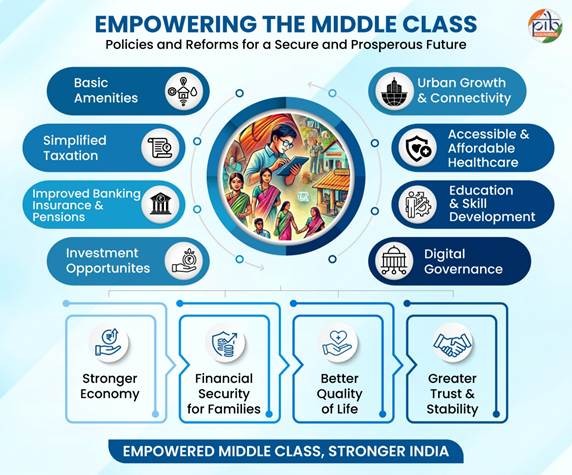
India’s socio-economic story is changing, and at its heart stands a growing, confident middle class. Once defined by careful spending and limited choices, middle-class families today are experiencing greater security, opportunity, and aspiration. Over the past 12 years, reforms in taxation, healthcare, housing, digital services, infrastructure, education, and entrepreneurship have made everyday life more affordable and convenient.
The Changing Face of India’s Middle Class
Between 2009 and 2017, the global middle-class population expanded from 1.8 billion to 3.5 billion, with about 40% in Asia, driven significantly by India and China. India’s GDP per capita grew by 53% between 2011 and 2019, while the Indian middle class expanded at 6.3% annually between 1995 and 2021, now comprising about 31% of the population.
The OECD predicts that between 2030 and 2035, India will overtake China in middle-class population in absolute terms. The World Economic Forum notes that 93% of urban consumer growth is expected outside India’s top five cities, with nearly 500 “consumer cities” likely to emerge. By 2036, India’s middle class and affluent consumers will account for 93% of all spending, up from 80% in 2026.
Strengthening the Middle Class: 12 Years of Transformative Governance
Taxation Reforms
In July 2024, the Government announced a comprehensive review of the Income Tax Act, 1961, completed in record time with the Income Tax Act, 2025 coming into effect in April 2026. In 2014, individuals with income up to ₹2.5 lakh paid zero tax. Now, individuals earning up to ₹12 lakh annually (₹12.75 lakh for salaried persons) pay zero tax under the new regime introduced in 2023.
The Goods and Services Tax (GST), introduced in July 2017, unified multiple central and state taxes into a single system. The GST taxpayer base grew from 66.5 lakh in 2017 to 1.64 crore by April 2026.
Pension and Insurance
The Unified Pension Scheme (UPS), effective since April 2025, guarantees a minimum pension of ₹10,000 per month after retirement (with at least 10 years of service). The share of insurance and pension funds in household finances rose from 28.6% in FY 2018–19 to 29.6% in FY 2024–25.
Pradhan Mantri Jeevan Jyoti Bima Yojana has recorded 26.88 crore enrolments, while Pradhan Mantri Suraksha Bima Yojana has seen 57.11 crore enrolments. Ayushman Bharat has enabled 43.52 crore health cards. The Employees’ State Insurance Scheme covers 3.24 crore employees, benefiting ~14.91 crore individuals.
Lower Loan Rates
Home loan interest rates declined from 9.5-10.5% in 2015 to 7.35-8.75% in 2025. The repo rate reduced from 8% in 2015 to 5.25% in 2026. Personal loan rates dropped from 14.25% (2014) to 12.5% (2026), while education loan rates reduced from 14.25% to 9.4%.
Pradhan Mantri MUDRA Yojana (PMMY)
Launched in April 2015, PMMY provides collateral-free loans up to ₹20 lakh. As of March 2026, it has disbursed over 57 crore loans amounting to ₹40.07 lakh crore.
Housing
Under PMAY-U 2.0 (launched September 2024), out of 125.31 lakh sanctioned houses, 98.1 lakh have been completed (May 2026) – a growth of 1,120% against the 8.04 lakh houses built between 2005-14. The SWAMIH fund has completed over 58,000 homes across 146 projects since 2019.
Metro Rail Expansion
India now has the world’s third-largest metro network. Metro expansion has accelerated from 0.68 km per month before 2014 to nearly 6 km today. The number of cities with metro services grew from 5 in 2014 to 26 in 2025, while daily ridership increased from 28 lakh to over 1.15 crore.
Railways Expansion
Budgetary support for Indian Railways increased from ₹32,000 crore in 2014-15 to ₹2.78 lakh crore in FY 2025-26. High-speed rail tracks expanded from 5,036 km in 2014 to 23,713 km in 2026. Passenger journeys increased from 716 crore in 2024-25 to 741 crore in 2025-26.
Airports Expansion
Operational airports increased from 74 in 2014 to 165 in 2026, with over ₹1.4 lakh crore invested. The UDAN scheme has connected 665 routes, serving over 164 lakh passengers since 2016.
Basic Amenities
Tap water connections increased from 3.23 crore in 2019 to 15.85 crore in May 2026 – over 390% rise. Waste processing rose from nearly negligible levels in 2014 to about 97% in 2026. Energy shortages declined sharply from 4.2% in FY 2013–14 to just 0.03% in FY 2025–26. Rural areas now receive about 22.6 hours of electricity (up from 12.5 hours), while urban areas receive 23.4 hours (up from 22.1 hours). Per capita electricity consumption rose from 957 kWh in 2013–14 to 1,460 kWh in 2024–25 – a 52.6% increase.
Healthcare
Under the Pradhan Mantri Bhartiya Janaushadhi Pariyojana, over 18,000 Jan Aushadhi Kendras supply quality generic medicines at 50-80% lower prices, saving families an estimated ₹40,000 crore in medicine expenses.
Ayushman Bharat PM-JAY, launched in September 2018, provides cashless treatment across empanelled hospitals. Over 1.85 lakh Ayushman Arogya Mandirs are operational, with cumulative footfall of over 540 crores. Out-of-pocket spending on healthcare declined from 60.6% (2014–15) to 39.4% (2021–22).
TB incidence fell 21% from 237 to 187 cases per lakh population between 2015-2024. Malaria cases and deaths dropped by around 80% from 2015-2023.
Education
India has 14.71 lakh schools supporting over 24.69 crore students and 1.01 crore teachers (2024-25). The number of IITs rose from 16 in 2014 to 23 in 2025, with student strength doubling from 65,000 to 1.35 lakh.
The Vidya Lakshmi Scheme (launched 2024) offers collateral-free education loans. Between February 2025 and February 2026, over 60,600 loans were sanctioned, amounting to over ₹7,750 crore.
Medical colleges have expanded to over 2,045 (including 818 Allopathy, 323 Dental, and 942 Ayush colleges). The number of AIIMS has tripled to 23.
Skill Development and Startups
The Skill India Mission (launched 2015) has trained 27.74 lakh candidates under PMKVY 4.0, 36.48 lakh beneficiaries under JSS, and engaged 54.41 lakh apprentices through NAPS.
Under Startup India, recognised startups grew from 502 in 2016 to over 2.23 lakh by March 2026, generating 23.3 lakh direct jobs. Approximately 48% have at least one woman director or partner.
Digital Governance
Jan Dhan accounts grew from 14.72 crore in 2015 to 58.26 crore as of May 2026, with deposits increasing from ₹15,670 crore to ₹3.01 lakh crore. Over 144 crore Aadhaar numbers have been generated. Wireless telephone subscribers reached 125.87 crore (December 2025), up from 937 million in November 2014.
DigiLocker has 69.9 crore total users (2 June 2026), with over 950 crore documents issued. UMANG app registrations have increased from 0.24 crore in 2017 to 11.39 crore.
Conclusion
Over the past twelve years, the Government has remained committed to uplifting the middle class through policies and reforms that have eased everyday challenges, strengthened financial security, housing access, healthcare, and skill development opportunities. This sustained approach has improved lives and created a strong foundation for future progress.
Disclaimer: This is an abridged version of the original PIB article “The Middle Class Journey: Progress Powered by Policy” (June 3, 2026). Key facts and data have been retained. For the complete article, please refer to the official PIB website.