India is no longer only adopting global technologies but increasingly shaping global conversations on inclusive, trusted, and human-centric technological development
India has transformed from a large digital market into an emerging global technology power over the last decade. Sustained government investments have strengthened national capability, expanded technological capacity, and enhanced global credibility. Mission-mode initiatives in Artificial Intelligence (AI), semiconductors, quantum technologies, supercomputing, cloud computing, and cybersecurity are shaping a strong innovation ecosystem.
Before the Leap
Twelve years ago, India began a determined journey to make technology a key driver of Viksit Bharat. The Government strengthened national technological capability through dedicated mission-mode programmes in emerging technologies such as semiconductors, AI, quantum technologies, supercomputing, blockchain, and cloud infrastructure. Long-term policy support and strategic investments enabled the development of indigenous technologies, secure digital systems, and globally competitive innovation ecosystems.
Digital India Programme as the Backbone
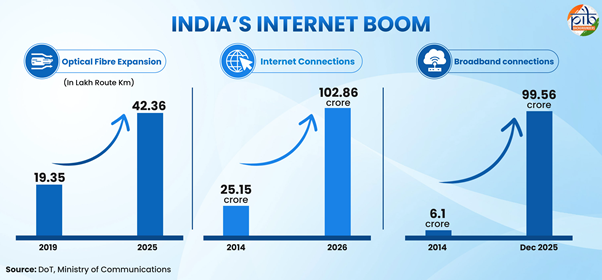
Digital India Programme, launched in 2015, laid the foundation for India’s emerging technology ecosystem. Optical fibre coverage increased from 19.35 lakh route kilometres in 2019 to 42.36 lakh route kilometres in 2025. India achieved one of the world’s fastest 5G rollouts, with services reaching 99.9% of districts. Internet connections increased from 25.15 crore in 2014 to 102.86 crore in 2026. Broadband connections rose from 6.1 crore in 2014 to 99.56 crore in December 2025. Average monthly data consumption increased from 61.66 MB in 2014 to 24.01 GB, while data costs declined sharply from ₹269 per GB to ₹8-10 per GB.
Supercomputers for High-Performance Computing
Under the National Supercomputing Mission (NSM), launched in 2015 with an outlay of ₹4,500 crore, India has deployed 38 supercomputers with a combined computing power of 47 petaflops across leading institutions. A major achievement is the development of the indigenous PARAM Rudra series.
India’s Semiconductor Ecosystem
The Government launched the Semicon India Programme in December 2021 with an outlay of ₹76,000 crore. The Union Budget 2026–27 further announced India Semiconductor Mission (ISM) 2.0 with an initial outlay of ₹1,000 crore for FY 2026–27. The Design Linked Incentive (DLI) Scheme launched in 2021 supports startups, MSMEs, and academic institutions. As of March 2026, 24 companies received fiscal support and 105 applicants received EDA tools support. Seven chips have been fabricated from 16 tape-outs, including advanced 12 nm designs. As of June 2026, 12 projects worth around ₹1.64 lakh crore have been approved under the ISM, including one semiconductor fab, two compound semiconductor fabs, and nine packaging units.
Creating Quantum Future
The Government approved the National Quantum Mission in April 2023 with an outlay of ₹6,003.65 crore. Four dedicated Thematic Hubs have been established at leading institutions, engaging more than 152 researchers across 43 organisations. The mission has supported 17 startups, including nine deep-tech ventures. India demonstrated a 1,000-km secure quantum communication network, achieving the milestone six years ahead of schedule. The foundation stone for India’s first Quantum Valley was laid in Amaravati in February 2026.
India’s AI Transformation
The Government approved the IndiaAI Mission in 2024 with an outlay of over ₹10,300 crore. India, as on March 2026, has around 1.8 lakh startups, with nearly 89% of new startups using AI solutions. A common computing facility with over 38,000 GPUs is being established. The AI Kosh platform hosts 12,115 datasets and 306 AI models across 20 sectors.
Cloud Computing
India’s indigenous cloud ecosystem began with the launch of MeghRaj in 2014. MeghRaj 2.0 strengthened this ecosystem through hybrid cloud architecture and stronger cybersecurity. As on June 2026, adoption increased from 342 government departments in 2015–16 to 2,323 departments. The Union Budget 2026–27 accelerated cloud and AI infrastructure development through major policy incentives, including tax holidays till 2047.
Blockchain
The National Blockchain Framework (NBF) was initiated in 2021 with an outlay of ₹64.76 crore. As of October 2025, over 3 crore property documents have been verified through blockchain platforms. The RBI launched Digital Rupee (e₹) pilots, while TRAI adopted blockchain-based DLT to curb spam.
Data Centers
India’s data centre sector has witnessed rapid expansion, with capacity growing from about 375 MW in 2020 to nearly 1,500 MW by 2025. Major hubs have emerged in Mumbai, Navi Mumbai, Hyderabad, Bengaluru, Noida, and Jamnagar.
Biotechnology
India’s biotechnology sector crossed USD 150 billion in 2023 and reached USD 190 billion as of June 2026. DBT-BIRAC has established 94 bioincubators across 25 States and UTs.
Building Capacity, Education, Research and Skill
The Anusandhan National Research Foundation (ANRF) was operationalised in 2024. Grants worth ₹264.70 crore had been awarded in high-impact technology areas as of March 2026. The Government approved the Research Development and Innovation (RDI) Scheme in July 2025 with a corpus of ₹1 lakh crore.
The FutureSkills PRIME programme was launched in 2018. As of March 2026, more than 27.53 lakh candidates have registered on the platform, with around 80% of learners coming from Tier-2 and Tier-3 cities. NIELIT operates through 56 centres, 750 affiliated institutes, and more than 9,000 facilitation centres.
The Government established four Centres of Excellence (CoEs) in Artificial Intelligence with a total allocation of ₹1,490 crore, focusing on Education, Healthcare, Sustainable Cities, and Agriculture. The Skilling for AI Readiness (SOAR) programme was launched in July 2025 targeting school students from class 6 to class 12.
The Chips to Start-up (C2S) Programme was launched in 2022 with an outlay of ₹250 crore over five years. Around one lakh individuals have accessed the shared national EDA infrastructure across 400 organisations. More than 75 patents have been filed by participating institutions.
India’s Growing Global Technology Credibility
India rose to 38th in the Global Innovation Index 2025 from 81st in 2015. India now hosts over 2,100 GCCs employing around 2.36 million professionals. The Bharat 6G Alliance (B6GA) was formed in 2023. The New, Emerging and Strategic Technologies (NEST) Division was set up in 2020.
SEMICON India 2025 brought together over 350 exhibiting companies from 48 countries, with 13 MoUs signed. India AI Impact Summit 2026 attracted delegations from over 100 countries, with 92 countries adopting the India AI Impact Summit Declaration and catalysing over USD 200 billion in AI-related investment commitments. India formally joined the Pax Silica coalition.
Global leadership in Digital Public Infrastructure (DPI)
India has signed agreements with 23 countries for cooperation on DPI. UPI is operational in countries like Singapore, UAE, France, Nepal, and Sri Lanka.
India’s Moment, India’s Making
Twelve years ago, India was a large digital market. Today, it is emerging as a global digital power. The journey is built on three interconnected pillars: expanding national capacity, strengthening technological capability, and building global credibility. The achievements of the past twelve years represent the technological foundation of Viksit Bharat 2047. India is no longer only adopting global technologies but increasingly shaping global conversations on inclusive, trusted, and human-centric technological development.
Disclaimer: This is an abridged version of the original PIB article “India’s Emerging Technology Ecosystem” (June 22, 2026). Key facts and data have been retained. For the complete article, please refer to the official PIB website.