Khelo India And The Road To International Excellence
The Union Cabinet’s approval of the revamped Khelo India Scheme marks a major step in India’s sporting journey. This features an enhanced Assistance to National Sports Federations, with a combined outlay of ₹36,441 crore for the period 2026–27 to 2030–31. Through stronger talent identification, wider opportunities and sustained athlete support, the programme seeks to create a clear pathway from grassroots participation to global podiums.
The Spirit of a Sporting India
Sports carry immense power to transform a nation, shaping individuals and elevating countries onto the world stage. It builds character and confidence in citizens, while announcing a nation’s arrival as a sporting superpower. Victory on the field brings immense national pride, uniting people beyond caste, creed and religion.
India’s greatest sporting asset is its youth. Around 65 per cent of the population is below 35 years of age. The Union Budget 2026–27 allocated a record ₹4,479.88 crore to the Ministry of Youth Affairs and Sports, up from ₹1,219 crore in 2013–14.
At the heart of this transformation stands the Khelo India programme, which has now entered a significantly expanded phase. From school playgrounds and village fields, young athletes will now have a clearer path forward through early identification, quality coaching, scientific support and regular competition.
The Khelo India Vision
Launched in 2017, the Khelo India Scheme merged the Rajiv Gandhi Khel Abhiyan, Urban Sports Infrastructure Scheme and National Sports Talent Search Scheme into a unified framework. The scheme follows five key pillars: establishing training centres, building coach capacity, expanding sports science and technology, organising competitions and leagues, and developing sports infrastructure.
The Mission envisions one Khelo India Training Centre in every district and aims to position India among the world’s leading sporting nations by 2036.
Growing Investment in Khelo India:
– 2017–18 to 2019–20: ₹1,756 crore approved for three years
– 2020–21: ₹328.77 crore allocated
– 2021–22 to 2025–26: ₹3,790.50 crore for five years
– 2026–27: ₹924.35 crore allocated
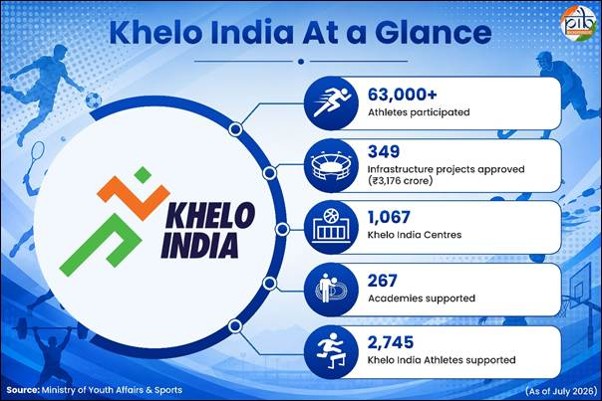
Key Achievements (As of July 2026):
– 349 new sports infrastructure projects approved with ₹3,176 crore investment
– 1,067 Khelo India Centres established
– 267 academies supported
– 2,745 Khelo India Athletes supported with coaching, equipment, medical care and monthly allowance
Revamped Khelo India Scheme: A Pathway from Grassroots to Global Excellence
The revamped scheme for 2026–27 to 2030–31 has a combined outlay of ₹36,441 crore including enhanced Assistance to National Sports Federations.
A Comprehensive Athlete Development Pathway: For the first time, young sportspersons will receive structured support at every stage through National Centres of Excellence, Khelo India Centres of Excellence, SAI Training Centres, Khelo India Accredited Academies, Khelo India Centres, and Youth Sports Companies of the Armed Forces.
The scheme also introduces Khelo India Feeder Schools and Khelo India Utkrishta Vidyalayas to integrate sports with mainstream education.
Expanding India’s Athlete Pool: The new Emerging Khelo India Athletes category will expand the structured athlete pool nearly ten-fold, creating a clear pathway from grassroots competitions to Khelo India and TOPS.
More Competitions and Wider Opportunities: School, university, regional and sport-specific leagues will provide regular competitive exposure. Greater opportunities will be created for women, para-athletes and indigenous sports.
Fitness, Coaching and Technology: The expanded Fit India Movement will promote active lifestyles. A National Coach Accreditation Board will strengthen coaching standards, while a unified digital platform will integrate athlete data, infrastructure and competitions.
Partnerships for Sporting Excellence: Partnerships with private academies and corporate institutions will bring investment and expertise. Enhanced support to National Sports Federations will strengthen coaching, sports science and international exposure.
Khelo India Games: A Stage for Future Champions
The Khelo India School Games were launched in 2018. From 2019, the event was renamed the Khelo India Youth Games (KIYG). Since 2018, more than 63,000 athletes have participated.
The Khelo India University Games and Winter Games were introduced in 2020, followed by Para Games in 2023. The Beach Games and Water Sports Festival launched in 2025, and Tribal Games made their debut in 2026.
Enabling India’s Sporting Success
Target Olympic Podium Scheme (TOPS): Launched in September 2014, TOPS supports athletes through foreign training, international competitions, coaching camps, and a monthly stipend of ₹50,000. As of April 2026, the scheme supports 51 Core Athletes, 52 Para Core Athletes and 130 Development Athletes.
KIRTI: The Khelo India Rising Talent Identification initiative identifies talent among children aged 9-18. At present, 174 Talent Assessment Centres operate with 1,87,921 assessments completed.
Sports Goods Manufacturing: The Union Budget 2026–27 allocated ₹500 crore for sports goods manufacturing to strengthen India’s position as a global hub.
India’s Rise on the Global Sporting Stage
Olympic Games: India progressed from two medals at Rio 2016 to seven at Tokyo 2020 and six at Paris 2024. At Rio 2016, India sent 117 athletes and won two medals. At Tokyo 2020, India sent 119 athletes and won seven medals. At Paris 2024, India sent 117 athletes and won six medals.
Paralympic Games: India’s medal tally increased from four at Rio 2016 to 19 at Tokyo 2020 and 29 at Paris 2024. At Rio 2016, India sent 19 athletes and won four medals. At Tokyo 2020, India sent 54 athletes and won 19 medals. At Paris 2024, India sent 84 athletes and won 29 medals.
Asian Games: India won 57 medals at Incheon 2014, 69 at Jakarta 2018, and a record 107 at Hangzhou 2023. At Incheon 2014, India sent 541 athletes. At Jakarta 2018, India sent 570 athletes. At Hangzhou 2023, India sent 655 athletes.
Commonwealth Games: India won 64 medals at Glasgow 2014, 66 at Gold Coast 2018, and 61 at Birmingham 2022. At Glasgow 2014, India sent 215 athletes. At Gold Coast 2018, India sent 218 athletes. At Birmingham 2022, India sent 210 athletes.
Commonwealth Games 2026
The Commonwealth Games 2026 were held in Glasgow from 23 July to 2 August 2026, bringing together athletes from 74 countries. India delivered a strong performance securing fourth place with 39 medals – 13 gold, 17 silver and nine bronze.
India was represented by a 124-member contingent. Jhandu Kumar opened India’s medal account with a bronze in para powerlifting. Rishikanta Singh won silver in weightlifting. Mirabai Chanu won India’s first gold, her third consecutive Commonwealth Games title. Muthupandi Raja added a silver in weightlifting.
Boxing became the highlight with 10 medals, including seven golds. Sakshi Chaudhary was among the gold medallists, while Lovlina Borgohain secured silver. Asmita Dey became India’s first Commonwealth Games gold medallist in judo, followed by Harsh Tokas. Gulveer Singh became the first Indian track and field athlete to win two individual medals at one edition. Tejaswin Shankar earned India’s first decathlon medal. Neeraj Chopra won silver in javelin throw.
From Khelo India to Glasgow Glory: Arundhati Choudhary, who won three consecutive Khelo India gold medals, won the women’s 70 kg boxing title at Glasgow 2026. Asmita Dey, a Khelo India University Games champion, became India’s first Commonwealth Games judo champion.
The Pursuit of Sporting Excellence
India’s sporting journey continues to gather momentum. Sustained investment, stronger support systems and focused athlete development are creating a lasting foundation for success. Rising participation and improved performances reflect the impact of these efforts. As India looks to the future, the nation remains committed to building champions and strengthening its place among the world’s leading sporting nations.
Disclaimer: This is an abridged version of the original PIB article. All significant points and key messages have been retained. For complete details, please refer to the full release on the PIB website.