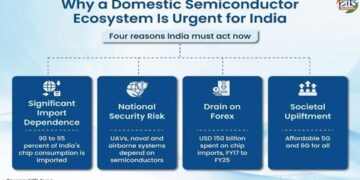
Since the India Semiconductor Mission was launched in 2021, the country has moved from policy intent to building factories, developing supply chains, training talent and commencing commercial production
For decades, India’s position in semiconductors was defined by a contrast. Indian engineers helped design sophisticated chips, but the country depended heavily on overseas facilities to manufacture, package and test them. That gap is now beginning to close. Since the India Semiconductor Mission was launched in 2021, India has moved from policy intent to building factories, developing supply chains, training talent and commencing commercial production.
The next task is larger than establishing individual plants. A semiconductor fab cannot succeed as an isolated island. It depends continuously on packaging and testing facilities, equipment maintenance, ultra-pure chemicals and gases, precision engineering, logistics, research institutions and skilled people. Bringing these capabilities closer together reduces transport and inventory costs, shortens lead times, improves coordination and lowers execution risks. India must therefore build integrated semiconductor clusters—not merely standalone fabs.
The Government of India has created the foundation through the ₹76,000 crore Semicon India Programme and support for fabrication, assembly, testing, packaging and chip design. Twelve semiconductor projects have been approved across six States, with investment commitments exceeding ₹1.64 lakh crore. They cover wafer fabrication, advanced packaging, memory assembly and testing, compound semiconductors and specialised technologies. Projects in Assam, Gujarat, Odisha, Punjab, Uttar Pradesh and Andhra Pradesh are establishing complementary capabilities, while support for design companies, advanced tools, foundry access and academic collaboration is strengthening the innovation pipeline.
The principle of ‘Sand to Silicon to Systems’ should now guide this national effort. India’s advantage will emerge when raw materials and equipment support connect seamlessly with chip design, fabrication, packaging, testing and electronics products. Co-location can accelerate supplier qualification, enable shared infrastructure and allow manufacturers, start-ups and researchers to solve production problems together. It can also help domestic MSMEs enter the semiconductor supply chain by locating near anchor customers and gradually meeting global standards of quality and reliability.
Gujarat illustrates how this cluster approach can take shape within the wider national mission. The State introduced India’s first dedicated semiconductor policy and established the Gujarat State Electronics Mission as a single-point facilitator. It now accounts for six approved projects and more than ₹1.24 lakh crore of investment. The more important achievement, however, is the emerging link between fabrication, packaging, infrastructure, suppliers and talent across Dholera, Sanand and Surat.
Sanand is developing as a major packaging cluster around facilities established by Micron Technology, Kaynes Semicon and CG Semi. Three major facilities in Gujarat have commenced commercial production in 2026. Their operations create sustained demand for equipment, specialty chemicals, industrial gases, cleanrooms, testing, logistics and precision engineering. This demand can attract suppliers, reduce dependence on distant service networks and create opportunities for Indian technology companies and MSMEs.
Dholera provides the fabrication anchor. Tata Electronics, in partnership with Taiwan’s Powerchip Semiconductor Manufacturing Corporation, is establishing India’s first commercial semiconductor fab there. Its dual-grid power, assured water, treatment facilities, expressway connectivity, international airport and dedicated industrial zones demonstrate the infrastructure intensity of semiconductor manufacturing. Crystal Matrix’s compound-semiconductor and advanced-packaging project and Suchi Semicon’s facility in Surat further widen Gujarat’s technology base and potential supplier network.
Clusters must also connect factories with knowledge. The packaging training centre at Pandit Deendayal Energy University, the ChipIN Extension Centre and the SAMARTH nanofabrication facility at IIT Gandhinagar can support industry-ready talent, research and process development. Nationally, similar links between anchor plants, universities, design centres and shared testing facilities will be essential for building capability that survives beyond initial investment incentives.
No country builds a complete semiconductor ecosystem alone. Global technology partnerships, capital and markets will remain indispensable. India’s opportunity lies in combining them with a large domestic market, deep engineering talent and trusted institutions. SEMICON India 2026, under the theme ‘Silicon to Systems: Building the Ecosystem’, can advance this shift from projects to clusters. Gujarat is an important demonstration, but the ambition is national: interconnected semiconductor clusters that reduce risk, deepen domestic value addition and make India a trusted global source of chips, technologies and systems. Success should ultimately be measured by lower lead times, faster qualification and the growing share of value created within India.
The author is Mission Director, Gujarat State Electronics Mission