Overview
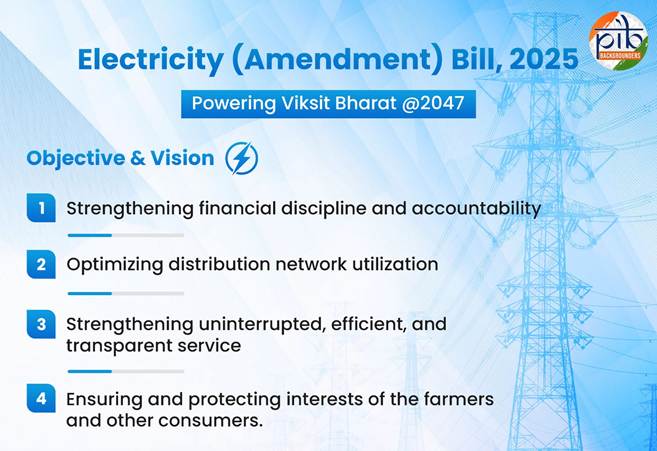
The Electricity (Amendment) Bill, 2025, is a major step toward transforming India’s power system to meet the needs of a rapidly growing economy. It aims to create a future-ready electricity sector that delivers reliable, affordable, and high-quality power to every consumer: farmers and households, to shops and industries. The Bill moves away from the old monopoly supply model and encourages a performance-driven approach, where both public and private utilities compete fairly to improve consumer service. It promotes better use of the existing electricity network with transparency and accountability so that citizens get more value for every rupee spent.
Importantly, the reforms fully protect subsidised tariffs for farmers and low-income households. By providing a platform for the Centre and States to work together, it gives a big role to the states in shaping policies. More than just an update, this Bill is a blueprint for a modern, efficient, and resilient power sector. It aligns with India’s developmental aspirations, from farmers to industries. The bill supports the country’s vision of Viksit Bharat 2047, supporting India’s long-term economic growth.
Correcting the Current: The Push Behind the Amendment
The Electricity (Amendment) Bill, 2025, was brought forward to resolve deep-rooted inefficiencies, ease financial strain on the power sector, promote competition, and optimise network cost across India’s power distribution sector.
Persistent financial losses in distribution companies (discoms) due to poor billing efficiency, high aggregate technical and commercial (AT&C) losses.
Lack of competition in electricity supply, with consumers tied to a single discom, limiting service quality and innovation.
Cross-subsidisation distortions, where industrial users pay inflated tariffs to subsidise other categories, making Indian manufacturing less competitive.
The Electricity (Amendment) Bill, 2025, aims to transform the existing market structure by rationalising cross-subsidy, promoting cost-reflective tariffs, and enabling direct procurement of power by industrial users. It seeks to dismantle longstanding barriers to India’s manufacturing competitiveness, making industrial power more affordable, reliable, and responsive to market demands, and at the same time protecting the subsidised tariff for farmers and other eligible consumers.
The Bill empowers State Electricity Regulatory Commissions (SERCs) to determine cost-reflective wheeling charges to ensure adequate network development by all the distribution licensees in accordance with the framework established by the SERCs. These regulated charges will be uniformly applicable to all users of the distribution network, whether public or private. This mechanism ensures that utilities have sufficient financial resources for staff salaries, routine maintenance, and future network development.
The ISTS Model: Efficient, Fair, Reliable
India already operates a successful Inter-State Transmission System (ISTS) built on shared infrastructure. Both public and private Transmission Service Providers (TSPs), including Powergrid (a CPSU), compete to develop ISTS assets under the oversight of the Central Electricity Regulatory Commission (CERC). Monthly payments made by users are fairly redistributed among the TSPs. This model has helped reduce costs and construction time for ISTS projects while maintaining high reliability.
Powering Reform: Core Pillars of the Bill
The Electricity (Amendment) Bill, 2025, sets the stage for a more efficient, environmentally and financially sustainable, transparent, and consumer-focused power sector. It blends structural reforms with regulatory clarity to modernise electricity distribution across India. By aligning policy with evolving needs, the Bill aims to deliver quality service, financial discipline, and sustainable growth.
The Bill promotes fair competition between government and private distribution companies in electricity supply, overseen by State Electricity Regulatory Commissions (SERCs). This approach is expected to enhance service quality, boost operational efficiency, and offer electricity supply to the industrial sector at a reasonable cost. By shifting from a monopoly-based supply to performance-driven delivery, it fosters a more accountable and consumer-oriented power sector, while protecting the interests of the farmers and other consumers.
Structural Reforms
Facilitate regulated competition in electricity distribution, allowing multiple licensees to operate in the same area using shared and optimized infrastructure.
Mandates Universal Service Obligation (USO) for all licensees, ensuring non-discriminatory access and supply to all consumers, while enabling SERCs to make Distribution licensees free from USO, in consultation with State Governments, for large consumers eligible for Open Access (more than 1 MW).
Tariff and Cross-Subsidy Rationalisation
Promotes cost-reflective tariffs while protecting subsidised consumers (e.g., farmers, poor households) through transparent budgeted subsidies under Section 65.
Seeks elimination of cross-subsidy for the Manufacturing Industry, Railways, and Metro railways within five years.
Infrastructure and Network Efficiency
Empowers Appropriate Commissions to regulate wheeling charges and prevent duplication of distribution networks.
Introduces provisions for Energy Storage Systems (ESS) and defines their role in the electricity ecosystem.
Governance and Regulatory Strengthening
Establishes an Electricity Council for Centre-State policy coordination and consensus-building.
Empowers State Electricity Regulatory Commissions (SERCs) to enforce standards, penalise non-compliance, and determine tariffs suo moto if applications are delayed.
Sustainability and Market Development
Strengthens obligations for non-fossil energy procurement, with penalties for non-compliance.
Promotes power market development, including new instruments and trading platforms.
Legal and Operational Clarity
Updated definitions and references (e.g., Companies Act 2013).Introduces detailed provisions for the Electric Line Authority, including compensation, dispute resolution, and coordination with local authorities. The power of the Electric Line Authority will be the same as the Telegraph Authority under the Indian Telegraph Act, 1885.
Conclusion:
The Electricity (Amendment) Bill, 2025, introduces key reforms to modernise India’s power sector. It promotes competition in distribution, strengthens regulatory oversight, and supports fair pricing mechanisms. The Bill safeguards subsidies for vulnerable consumers while enabling direct power access for industries. Together, these measures aim to build a more efficient, accountable, and future-ready electricity system aligned with national development priorities.
References:
Ministry of Power:
https://powermin.gov.in/sites/default/files/webform/notices/Seeking_comments_on_Draft_Electricity_Amendment_Bill_2025.pdf
Press Information Bureau:
https://www.pib.gov.in/FactsheetDetails.aspx?Id=150442